1. Visão geral
As avaliações das necessidades de financiamento FN 1 estimam o custo da implementação das prioridades nacionais de desenvolvimento. Juntamente com as conclusões da avaliação do cenário de financiamento (o "lado da oferta"), elas podem ser usadas para desenvolver metas de mobilização de recursos, como um primeiro passo para vincular os processos de planejamento e financiamento e desenvolver uma estratégia de financiamento. As avaliações das necessidades de financiamento também podem aprofundar a compreensão das intervenções necessárias para alcançar as prioridades de desenvolvimento e servir como uma verificação de realidade das estratégias nacionais de desenvolvimento.
Na prática, as necessidades de financiamento podem ser avaliadas de diferentes maneiras. As metodologias de custeio quantitativo variam desde exercícios macro de custeio "de cima para baixo" (para estabelecer uma estimativa dos requisitos gerais de financiamento para um plano nacional de desenvolvimento ou para determinar o custo de alcançar metas globais) até cálculos detalhados "de baixo para cima" baseados em atividades (para preparar orçamentos anuais, determinar necessidades setoriais de curto prazo ou específicas de intervenção, ou para financiamento de projetos). Tais exercícios de custeio quantitativo podem informar o orçamento e o planejamento em nível subnacional e nacional, setorial ou de toda a economia, bem como em torno de prioridades transversais, como a igualdade de gênero. Eles também informam processos políticos regionais e globais (veja a Tabela 1).
Muitos países já avaliam regularmente as necessidades de financiamento no contexto dos orçamentos públicos, por exemplo, ao desenvolver planos anuais e plurianuais de receitas e despesas do governo. Alguns países tomaram medidas adicionais nos últimos anos para desenvolver avaliações mais amplas das necessidades de financiamento de médio e longo prazo para alcançar os ODS. Tais avaliações mais amplas também consideram o papel que o financiamento não público pode desempenhar no cumprimento das necessidades de financiamento do desenvolvimento, mas podem estar desatualizadas devido aos impactos da Covid-19.
Nem todos os países podem considerar necessária uma avaliação completa e detalhada das necessidades de financiamento. Nesses casos, abordagens mais informais podem ser consideradas, como considerações qualitativas sobre o contexto de financiamento que precisaria estar em vigor para que resultados específicos se concretizassem (veja a experiência prática com abordagens menos formais na Seção 5).
Esta nota de orientação apresenta as principais metodologias de custeio e reúne ferramentas e experiências de atores nacionais e internacionais que realizaram avaliações das necessidades de financiamento. Ela orienta os profissionais na aplicação dessas metodologias no contexto de estruturas integradas de financiamento nacional e, portanto, dá ênfase especial à integração entre setores, prioridades políticas e opções de financiamento, perspectivas de médio a longo prazo, ao tratamento de riscos e à sustentabilidade em todas as suas dimensões.
2. O valor das avaliações das necessidades de financiamento
As avaliações das necessidades de financiamento realizadas no contexto das INFFs podem apoiar os países a FN2
Informar estratégias de mobilização de recursos, fornecendo metas para políticas de financiamento;
Fortalecer o planejamento, fornecendo uma aproximação das necessidades futuras de gastos, o que poderia servir como uma verificação de realidade das estratégias nacionais de desenvolvimento;
Priorizar a alocação de finanças públicas;
Identificar áreas prioritárias para investimento do setor privado;
Aumentar o engajamento com parceiros de desenvolvimento e outros atores não estatais sobre prioridades de financiamento e obter sua experiência e insights sobre desafios e restrições;
Fornecer insights sobre gargalos ao progresso e/ou desalinhamento entre alocações de gastos/investimentos e prioridades nacionais de desenvolvimento (veja também o bloco de construção 1.2 sobre avaliação do cenário de financiamento e o bloco de construção 1.4 sobre análise de restrições vinculantes);
Fortalecer a prestação de contas e aumentar a transparência na alocação de recursos.
Objetivos políticos claros são um pré-requisito para avaliações de necessidades úteis. "Para quê?" deve sempre acompanhar a pergunta "quanto é necessário?". Os tipos de objetivos a serem custeados, por exemplo, conforme formulados em uma estratégia ou plano nacional, e seus contextos específicos de cada país devem orientar a seleção da metodologia mais adequada e o escopo do exercício.
O valor das avaliações das necessidades de financiamento também depende da qualidade e do realismo das premissas que as sustentam. Projeções macroeconômicas e escolhas políticas – que estão na base das funções de produção e modelos usados para estimar custos – influenciam as necessidades de financiamento. Como a pandemia de COVID-19 e os recentes desastres climáticos de grande escala demonstraram, as trajetórias de crescimento e os caminhos de desenvolvimento podem ser interrompidos ou invertidos em questão de semanas devido a choques externos inesperados ou riscos de desastres não avaliados. Em um contexto global de crises cada vez mais frequentes, as abordagens de custeio que não conseguem considerar cenários de política ou crescimento flexíveis e riscos terão valor limitado.
Por esse motivo, as avaliações das necessidades de financiamento são mais valiosas quando consideradas como parte de processos nacionais regulares e contínuos, em vez de exercícios pontuais e intensivos em recursos. As necessidades de investimento devem ser revistas regularmente como parte de um monitoramento contínuo do cenário de financiamento e riscos, com premissas e projeções orientadoras atualizadas. Isso não deve exigir a criação de novos processos e sistemas; os países provavelmente já possuem processos de política e planejamento relevantes, e os parceiros de desenvolvimento podem fornecer apoio direcionado.
3. Escopo e limitações
O tipo e o escopo dos exercícios de custeio dependerão da fase em que o país se encontra em seu ciclo de planejamento, de suas necessidades específicas e da capacidade disponível (mais sobre este último ponto na Seção 5). Países que estão elaborando seus planos nacionais de desenvolvimento, ou atualizando-os para responder à pandemia de Covid-19, podem achar útil mapear as necessidades de financiamento em todas as áreas prioritárias. Se o plano nacional de desenvolvimento já tiver seus custos calculados, pode bastar uma simples verificação de se esses cálculos podem ser aprimorados (por exemplo, se permanecem válidos no contexto da Covid-19 e se incorporam totalmente considerações de sustentabilidade, igualdade de gênero, o princípio de não deixar ninguém para trás ou outras considerações relevantes para os ODS; veja a abordagem sugerida na Seção 4) ou ajustados (caso as condições mudem).
O escopo também dependerá dos objetivos políticos. Ao considerar os requisitos de financiamento de um plano de desenvolvimento completo, as avaliações das necessidades de financiamento abrangem uma ampla gama de atividades financiadas por fontes públicas e privadas e, portanto, devem considerar todos os tipos de financiamento, além dos recursos públicos, bem como sinergias e sobreposições entre setores, riscos e possíveis choques. Elas também envolverão uma ampla gama de partes interessadas, em diferentes setores e áreas de especialização. No extremo oposto do espectro, ao considerar o custo de um projeto, atividade ou intervenção específica, as avaliações das necessidades de financiamento terão um escopo mais restrito, envolvendo um número menor de atores, dependendo do setor.
No contexto das INFFs, as avaliações das necessidades de financiamento podem ser realizadas em vários níveis e com diferentes prazos. A Figura 1 ilustra as principais categorias, como custeio para orçamentos públicos anuais (detalhado, com prazos curtos), custeio para grandes projetos, como investimentos em infraestrutura resiliente (que podem ir além das finanças públicas, por exemplo, PPPs), custeio para planos de investimento público de médio prazo e investimentos públicos de longo prazo, e custeio para planos de desenvolvimento setoriais ou nacionais (que podem envolver o papel tanto do financiamento público quanto do privado).
Figura 1. O escopo das avaliações das necessidades de financiamento depende do que os países desejam custear
O escopo desejado determinará a escolha da metodologia (veja a Figura 3 e a Tabela 2 na Seção 4, que oferece uma visão geral das metodologias e seus respectivos pontos fortes e limitações). Desafios relacionados à disponibilidade de dados e capacidades (Box 2) também devem ser considerados.
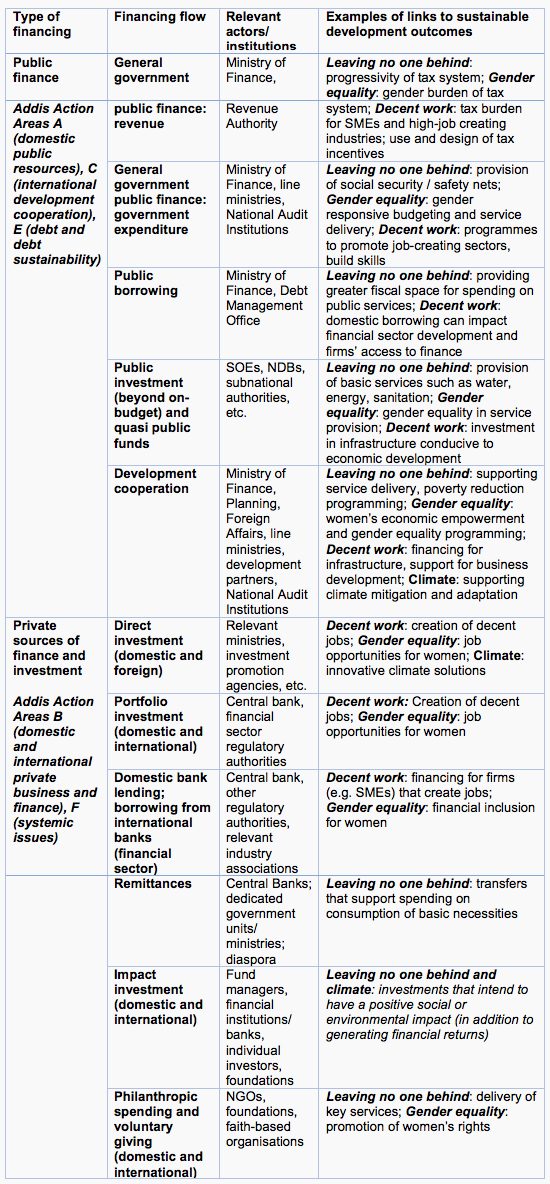
Figure 1. The continuum of public and private financing and the non-financial means for achieving sustainable development
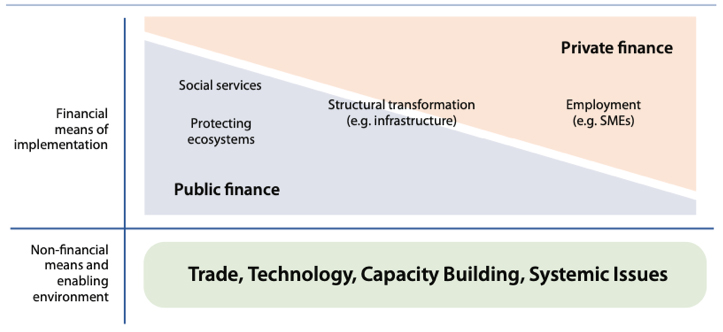
The figure is for illustrative purposes only and size of boxes is not representative of magnitudes of flows. Source: Financing for Sustainable Development Report 2016
Data coverage and comparability is a common challenge and limitation of financing landscape assessments. A comprehensive analysis requires data from a wide range of sources. However, the required data, especially on domestic private investment, investment and spending by public entities, NGOs and philanthropic funding, may be partial or unavailable. Similarly, it is not always possible to measure the impact of financing flows, i.e. to link data on financing flows to outcomes. Box 1 presents the most common challenges, Section 4.2 lays out steps that can be taken to address or lessen the impact of many of these challenges.
Os desafios mais comuns encontrados ao realizar avaliações de necessidades de financiamento em nível nacional incluem:
Dados e informações: falta de dados atuais, dados insuficientes desagregados por sexo e gênero, falta de compartilhamento de dados entre os principais ministérios (setoriais), falta de clareza sobre o que precisa ser custeado, como a ausência de articulação das intervenções necessárias para alcançar os resultados/metas desejados ou a falta de quantificação das metas para alcançá-los
Challenges linking flows to sustainable development outcomes and/or thematic priorities such as gender equality, e.g. limitations in sex-disaggregated/gender-disaggregated data
Risk of double counting where overlaps between data from different sources cannot be accounted for
Lack of timely data on certain types of financing, particularly during times of rapid change (such as countries are experiencing as a result of the covid-19 pandemic)
Challenges in projecting financing trends forward
4. "Como fazer" - Avaliações de necessidades de financiamento na prática
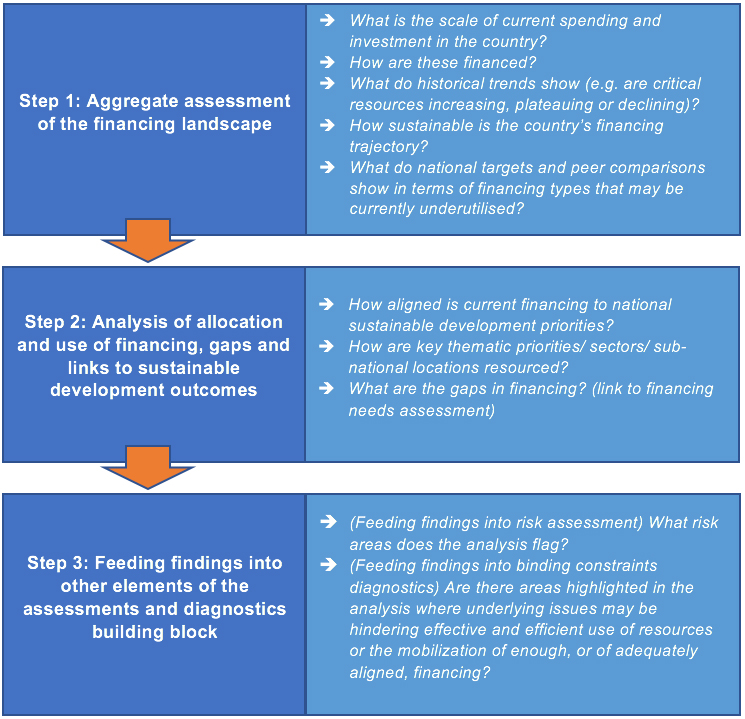
Com base nas lições de países e organizações internacionais que realizaram e apoiaram avaliações de necessidades de financiamento até o momento, bem como nas ferramentas e metodologias disponíveis, a Figura 2 estabelece uma abordagem passo a passo sugerida para avaliações de necessidades de financiamento no contexto de um INFF. As Seções 4.2 e 4.3 apresentam fontes de dados típicas e ferramentas existentes que os países podem utilizar.
Figura 2. Orientação passo a passo
Passo 1: Definindo o escopo
O primeiro passo é esclarecer o propósito de um potencial exercício de custeio, para garantir que a escolha da metodologia esteja fundamentada no que é necessário – tanto em termos de escopo quanto de investimento de recursos.
Se o objetivo for avaliar as necessidades de financiamento para uma estratégia ou plano nacional, as metodologias devem permitir uma perspectiva de médio a longo prazo e levar em conta as sinergias entre os resultados de desenvolvimento. Tais abordagens fornecem estimativas de alto nível. Os custeios específicos por setor, ou custeios que envolvem um número limitado de metas prioritárias, fornecem um panorama mais detalhado das necessidades, assim como as avaliações de necessidades para projetos ou programas específicos (a Figura 1 na Seção 3 ilustra a variação no escopo dos exercícios de custeio).
Se um custeio abrangente não for viável ou desejável, as ferramentas podem ajudar a priorizar metas e resultados de alto impacto ou altamente interligados. Isso inclui ferramentas de análise de rede, como a Ferramenta de Análise e Visualização de Interligações dos ODS do Instituto de Estratégias Ambientais Globais (IGES), por meio da qual os efeitos cascata de alcançar certas metas podem ser determinados e sinergias e compensações consideradas; ou modelos dinâmicos, como o modelo iSDG do Millennium Institute, que permitem aos usuários explorar interligações entre metas ou resultados e também simular o impacto de políticas específicas no futuro – em diferentes áreas de resultados e em um nível sistêmico. A CESPA desenvolveu uma ferramenta de otimização econométrica interativa que captura os ganhos de eficiência que podem advir do aproveitamento das interligações dos ODS. A partir de qualquer avaliação de custeio dos ODS definida pelo usuário, a ferramenta estima sinergias potenciais e apresenta estimativas de custo revisadas dos ODS que levam em conta os ganhos de decisões de financiamento sequenciadas que consideram as interligações dos ODS. O Apoio à Integração, Aceleração e Políticas (MAPS) da ONU pode já ter identificado áreas prioritárias críticas para o progresso em direção aos resultados de desenvolvimento sustentável e para as quais o custeio pode ser mais necessário.
Consultas com as principais partes interessadas podem ajudar a garantir que tanto os exercícios de custeio passados (sucessos, desafios e descobertas) quanto as necessidades atuais sejam refletidos na escolha da metodologia e nas estimativas resultantes. As perspectivas e experiências daqueles que são frequentemente invisíveis nas contas nacionais, como as mulheres e aqueles que realizam trabalho não remunerado, seriam particularmente valiosas neste contexto. A Tabela 1 no Bloco de Construção 1 Avaliações e Diagnósticos: Visão Geral, fornece uma lista das partes interessadas relevantes que devem ser consideradas.
Figure 3. Financing of government spending (in percent of GDP): an example from Sierra Leone
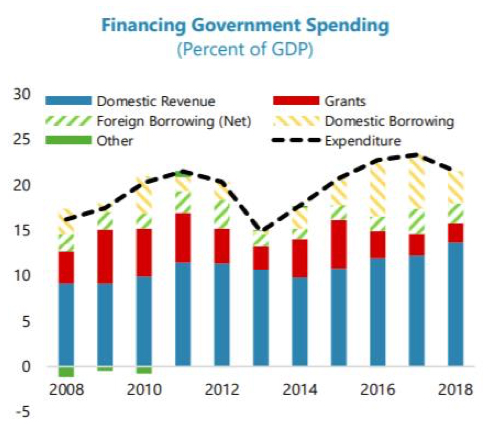
Source: IMF Article IV Consultation Sierra Leone, 2019
Private finance. Policy makers can also take steps to mobilize and better align existing private investment with sustainable development priorities and increase the envelope of private financing. Private finance is heavily dependent on broader macroeconomic developments, and is more complex to analyse, often with more limited data, compared to public finance discussed above. A wide range of indicators could be considered to assess financial sector development and its ability to finance investments in sustainable development.
In terms of real or direct investment, many countries do not capture comprehensive data on total investment by domestic firms, so proxies may have to be used as an estimate. Private gross fixed capital formation captures additions to the capital stock of an economy by the private sector and is commonly used as proxy for private investment. This includes both domestic direct investment and greenfield foreign direct investment (FDI).
In terms of financial flows, domestic credit to the private sector is an indicator of domestic financing sources. Domestic investment can also be financed externally through private external borrowing. FDI flows also includes a financial element, e.g. intracompany loans. (see also Figure 5). Cross-border portfolio equity flows are also quantifiable, and primarily represent secondary market transactions on domestic stock exchanges.
In addition, indicators of financial sector size (e.g. value of financial assets; bank deposits, % GDP), structure (e.g. share of assets held by banks, non-banks, financial markets as shown in Figure 4), breadth (e.g. financial inclusion) and depth (e.g. availability of long-term financing) can shed light on the role of the financial sector as a source and mechanism for channelling resources into investment. They can also flag areas of risk and/or challenges which can inform the risk and binding constraints assessments respectively (see building blocks 1.3 and 1.4 guidance).
Figure 4. Financial system structure (in percent of total financial assets): an example from Thailand
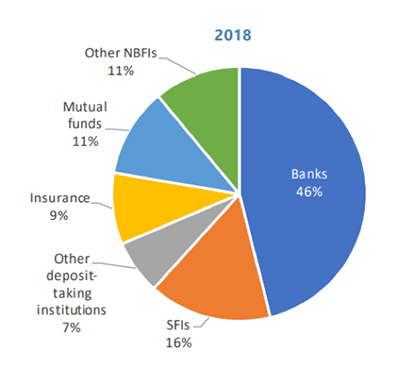
Source: IMF Country Report No.19/318 (October 2019) Thailand Financial Sector Assessment Program. Notes: NBFIs: Non-Bank Financial Institutions; SFIs: Specialised Financial Institution
Some types of private financing have a more explicit development mandate and can be tracked separately: they include private financing flows that are directly supported or incentivized through public finance and blending instruments, private sector impact investing, and private non-commercial financing, such as philanthropic spending and NGO activities. In some contexts, community financing also plays a role, including for example in service provision in the water sector. If data is not centrally available, foundation or NGO associations may be able to shed light on the scale and use of this type of financing, and should be consulted as part of the financing landscape assessment.
Islamic finance may also play a substantial role in the financing landscape. In relevant contexts and in light of principles well aligned with the SDGs, this role should be highlighted in the assessment and can be relevant to both public and private finance analysis. For example, in February 2018, the Government of Indonesia issued the world’s first sovereign green sukuk (Islamic bond) in support of the country’s commitment to combat climate change. Tools such as Zakat, Sadakah and Waqf may be considered as part of the private finance analysis, for example alongside philanthropic funding.FN 5
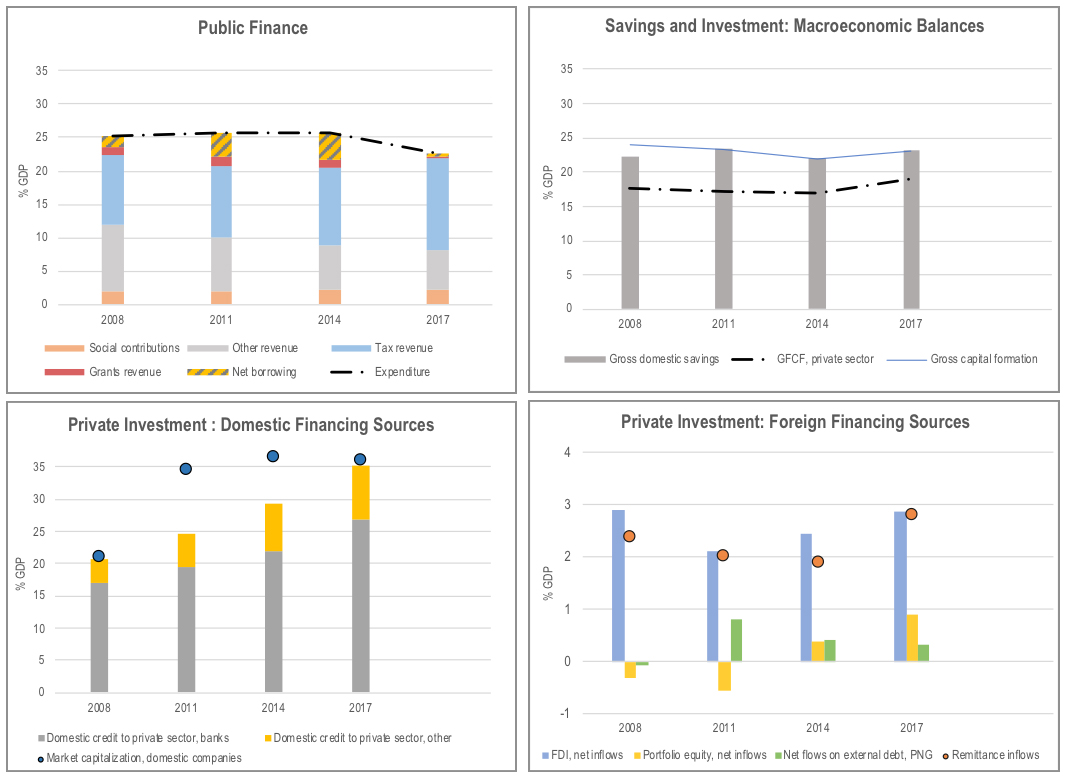
Painting an aggregate picture. Because of their unique properties and mandates, different types of public and private financing cannot be usefully added up into one overall number – they are complements and can often not substitute for each other (see Section 3 above). As noted in Section 4.2, data limitations may also increase the risk of double counting. However, comparing their scale and trends can help policymakers understand the dynamics and interconnections across public and private financing, and provide a basis for identifying the most pertinent financing challenges and opportunities. They can also provide a first approximation of financing gaps, which are spelled out at the sector level (see Step 2 below).
Figure 5 provides one illustration of an aggregate financing landscape, using Mexico as an example. It includes a panel on the public finance landscape – both government spending and sources of public finance; a macro-focused panel on the national savings and investment rate and private investment in particular, and two panels on different types of domestic and foreign private financing to fund investment. All flows are expressed as a percentage of GDP, providing a snapshot of their relative scale, showing for example the importance of domestic financing sources for private investment, improved fiscal balances due to increasing tax revenues, and steady growth in gross capital formation. Significant level of remittance inflows provide an additional potential source of financing for households and small and medium enterprises.
Figure 5. Aggregate financing landscape: an illustration using data for Mexico
Source: SDG Financing Strategy: Bangladesh Perspective (2017). Note: Own means the cost for that particular SDG and Syn means synchronisation with any other SDG.
Existing tools such as DFAs or OECD Transition Finance case studies also carry out aggregate financing landscape analysis. Figure 6, for example, from the 2017 Philippines DFA, highlights the dominance of domestic flows (public and private), low levels of international commercial finance (pointing to the need to strengthen the enabling environment for private sector investment), and the substantive role that remittances play.
Figure 6. Aggregate financing landscape: an example from the Philippines DFA
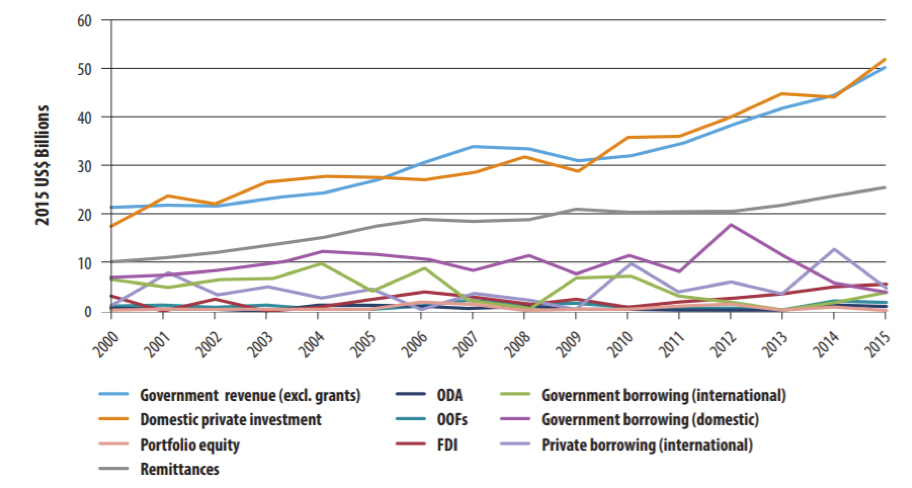
Source: Philippines Development Finance Assessment Snapshot, 2017
As ferramentas de custeio baseiam-se tipicamente em uma de quatro metodologias principais: abordagens de custo unitário bottom-up; abordagens de tendências históricas; abordagens de custo unitário top-down; e abordagens de modelagem. As duas primeiras são mais adequadas para o orçamento em nível operacional, enquanto as duas últimas para fins de planejamento mais amplos, pois geram estimativas de nível mais macro que podem subsidiar planos de longo prazo. A Figura 3 visualiza essa escolha, enquanto a Tabela 2 resume ainda mais as respectivas características e limitações das metodologias.
Figure 7. Forward-looking scenarios: an example from Timor-Leste Petroleum Fund
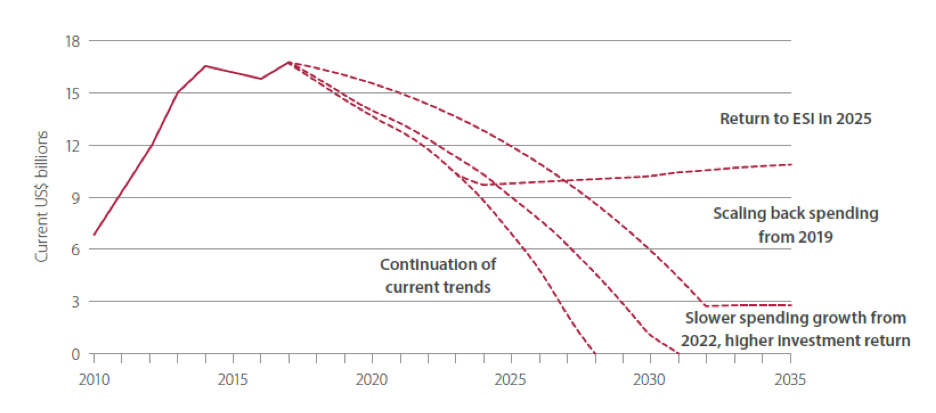
Source: Timor-Leste Development Finance Assessment, 2019. Notes: ESI: estimated sustainable income, or level of withdrawals that would be sustainable indefinitely
Public sector balance sheet analysis looks at the entirety of what the state owns and owes: the accumulated assets and liabilities that government controls, such as public corporations, natural resources and pension liabilities. In so doing, it offers a comprehensive picture of public wealth while also enabling the identification of mismatches and an assessment of the resilience of public finances. In addition, intertemporal balance sheet analysis – which combines current wealth and future revenue and expenditure – can provide insight into the sustainability of public finance and complement other scenario and forward-looking trends analysis mentioned above.
Only a handful of countries (including Australia, New Zealand and the UK) manage public wealth using balance sheets. It allows them to improve asset management and maximise the efficiency of, and returns on, public assets; and to identify and manage fiscal risks emanating from within the balance sheet or from external shocks (see also BB1.3 Risk Assessment). Considering both assets and liabilities more generally improves the evidence base for public investment decisions, and can also inform debt sustainability assessments.FN 7 The 2018 IMF Fiscal Monitor Report presents this analytical approach in detail and applies it to a range of countries (from the US and Norway to the Gambia and Indonesia). It distils some common lessons and shows how economies with stronger public sector balance sheets experience shallower recessions and recover faster in the aftermath of economic downturns, mainly as a result of greater space for countercyclical fiscal policy.
Source: IMF (2018) Fiscal Monitor: Managing Public Wealth; available from: https://www.imf.org/en/Publications/FM/Issues/2018/10/04/fiscal-monitor-october-2018
Domestic targets and peer comparisons
Comparing current trends in public and/or private finance to specific targets that countries may have set themselves, can help identify priority areas for action – for additional resource mobilization, or more efficient use of existing resources. International comparisons can also help identify areas of financing that are underexploited, where underlying challenges may be limiting flows, and that could result in additional financing becoming available (whether via efficiency gains or via new flows).
For example, within the context of the Philippines’ DFA, FDI levels in peer economies were used as a basis for dialogue about potential options for strengthening the enabling environment for private investment (Figure 8a). As part of the 2019 IMF Article IV consultation in Guyana, financial access indicators in peer countries (Figure 8b) were used to consider steps to further improve financial inclusion in the country. The OECD’s transition finance dashboard provides a rapid assessment of key financing flows and allows to identify suitable peer countries to benchmark national performance, using data on key statistics such as GDP, GNI per capita, population, and human capital index.
Figure 8a. Peer comparison examples: FDI volumes in the Philippines compared to other ASEAN-5 countries
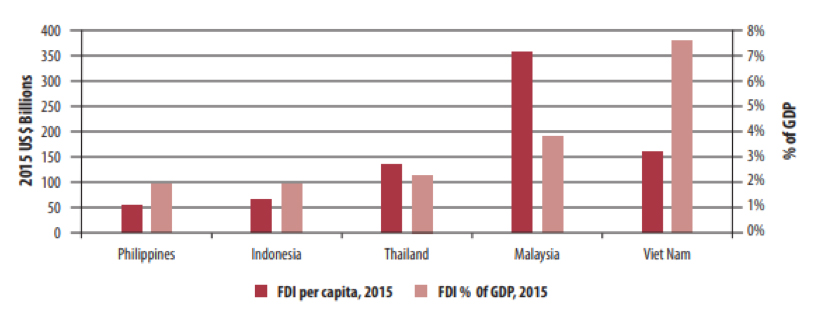
Source: Philippines Development Finance Assessment Snapshot 2017
Figure 8b. Peer comparison examples: Financial access in Guyana compared to other CARICOM countries (number per 100,000 adults)
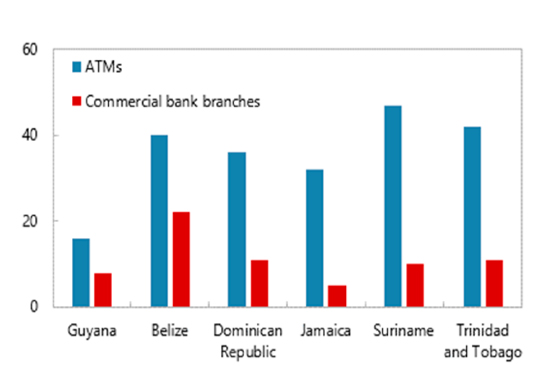
Source: IMF, Guyana 2019 Article IV consultation staff report
Passo 2: Escolhendo uma metodologia de custeio
A more disaggregated picture of current financing allocations and use allows policy makers to better understand their impact and how they’re contributing to (or undermining) the achievement of identified national development priorities. It also provides a baseline for calculating financing gaps, e.g. at the sectoral or programmatic level. It helps answer the following questions:
How aligned is current financing (both public and private) to national sustainable development priorities?
How are key thematic priorities/ sectors/ sub-national locations resourced?
What are the gaps in financing?
Where could finance be better directed at national development priorities?
A comunidade internacional também oferece uma infinidade de metodologias e ferramentas de custeio específicas por setor. Elas baseiam-se nas metodologias fundamentais apresentadas na Figura 3 e na Tabela 2, mas incorporam considerações específicas do setor. Os Quadros 3, 6 e 8 ilustram exemplos de algumas delas, relacionados com a saúde, a energia e o uso da terra, respectivamente. Uma lista mais abrangente está incluída na Tabela 4 (ver Seção 4.3).
Alguns setores e prioridades temáticas são mais facilmente quantificáveis do que outros. Para resultados em que as intervenções não são padronizadas ou têm natureza transversal (como a redução da pobreza e das desigualdades ou o fortalecimento da governança e das instituições), abordagens detalhadas de custeio de baixo para cima (bottom-up) podem ser menos adequadas. Abordagens de custeio de cima para baixo (top-down) ou baseadas em modelos podem fornecer uma estimativa aproximada das necessidades. Por exemplo, modelos de crescimento podem ser usados para estimar as necessidades de investimento em toda a economia para alcançar os resultados desejados de redução da pobreza. Alternativamente, como feito na estratégia de financiamento dos ODS de Bangladesh, os custos podem ser estimados determinando o financiamento necessário para dotar adequadamente as instituições relevantes. Por exemplo, para estimar o custo de alcançar o ODS 10 (redução das desigualdades), Bangladesh identificou os principais ministérios cujos orçamentos globais precisariam ser ampliados para atingir as metas relevantes. Da mesma forma, em relação ao ODS 16 (paz, justiça e instituições eficazes), alocou uma quantia fixa para a reforma institucional, juntamente com dotações orçamentárias recorrentes para agências e departamentos governamentais relevantes, como a força policial, prisões e tribunais.FN 4
A escolha da metodologia e a interpretação dos resultados devem também estar atentas a outras limitações e desafios:FN 5
Figure 9. Using outcome-based monitoring tools: an example from Indonesia
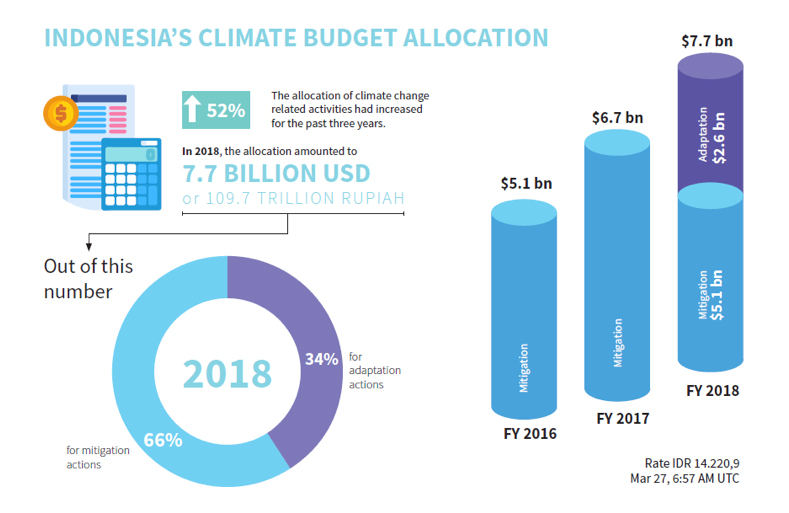
Source: Fiscal Policy Agency, Ministry of Finance, Indonesia, Indonesia Climate Budget Tagging Report, 2019.
There are also tools to assess financing beyond public budgets. For example, DFAs provide guidance on analysing key priorities for building back better from the COVID-19 pandemic, such as considerations for inclusive and green recovery. Total Official Support for Sustainable Development (TOSSD) data can shed light on the SDG contributions of cross-border official resource flows (including ODA, other official flows, South-South and triangular cooperationa) and of private finance mobilised by official interventions. FN 8 With regard to private sector activities, in the Philippines, the ‘Transformational business’ initiative has mapped corporate activities vis-à-vis the SDGs, while an SDGs dashboard in Papua New Guinea has been established for similar purposes. The OECD Quality FDI Toolkit can help assess how FDI contributes to sustainable development priorities such as economic diversification or gender equality. SDG investment monitoring initiatives such as UN ESCAP’s SDG Investment Trends Dashboard can also be used to assess the contributions of different sources of finance to particular sustainable development outcome areas.
Disaggregating data by sector
Looking at the distribution of financing by sector can help policymakers understand the types of resources invested in thematic priorities or specific SDGs. Data can commonly be disaggregated by sector, using classifications that distinguish key social sectors such as education, health and water and sanitation, and economic sectors such as agriculture, manufacturing, tourism, as well as sectors such as energy and transport. Budgetary expenditure, development cooperation, and spending and investment by SOEs can usually be broken down or classified within these sectors. Data capturing private investments such as FDI and domestic investment is often classified by economic and productive sectors, which can help build an understanding of the mix of resources invested in sustainable development priorities. Specific tools also exist to assess spending flows and financing landscapes in specific sectors (see Table 3 in Section 4.3).
Differentiating between current spending and investment in specific sectors can further help identify areas where, for example, there is underinvestment that may hinder progress in the future. This can also determine if current investments are commensurate with emerging and future risks, including disaster and climate risks. Budgetary spending and SOE activity can typically be disaggregated in this way, as can lending to the private sector.
Disaggregating data by sub-national location
Sub-national level data will likely not be available for all types of financing, but to the extent possible, cutting the data in this way will complement other analysis and offer additional insight on issues such as inequality. From a public finance perspective, this is particularly valuable in highly decentralised systems where key service delivery and spending takes place at the local level. For example, in the 2018 Solomon Islands DFA, sub-national data was used to analyse the varying ways that a key public fund was allocated at the constituency level (Figure 10); this facilitated dialogue about the monitoring and management structures that were in place around the fund.
Figure 10. Considering the sub-national level: an example from the Solomon Islands
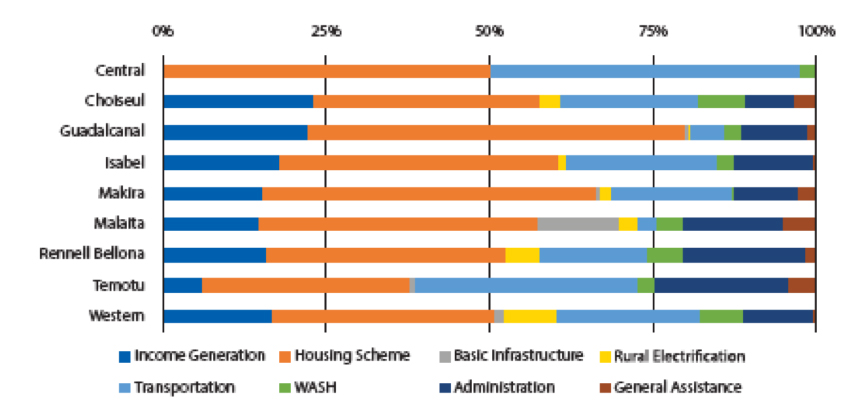
Source: Solomon Islands Development Finance Assessment, 2018
Estimating financing gaps
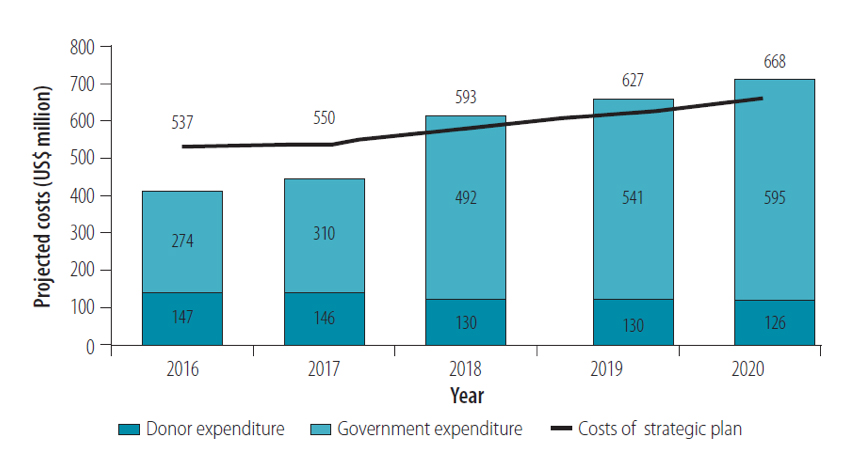
Analysis of current levels of financing for cross-cutting and thematic priority areas, such as climate and gender, individual sectors or sub-national locations can be combined with findings from financing needs assessments (see building block 1.1 guidance) to estimate financing gaps. For example, a recent needs assessment in Nepal estimated a financing need of Rs1.8 trillion in private investment for the energy sector; this was combined with analysis of available private finance (Rs480 billion) to produce a financing gap estimate of Rs1.3 trillion. In Cambodia, findings from the application of the OneHealth tool to estimate the cost of implementing the national health strategic plan for 2016-2020 were compared to projected government and donor expenditure on health over the same period to identify potential gaps (see Figure 11). For Egypt, findings drawn from ESCWA’s dynamic SDG-financing simulators estimate that the financing gap for meeting the country’s 2030 Vision for Sustainable Development and sectoral development plans amounts to $924 billion (prior to the triple food, fuel, and finance crisis) and that by factoring SDG interlinkages, the costs can be reduced by nearly 22 percent.
Figure 11. Comparison between projected costs and projected public expenditure levels in the health sector in Cambodia
Source: Estimating health plan costs with the OneHealth tool, Cambodia.
Financing gap estimates can inform prioritisation of financing policies and reforms, and the articulation of the financing strategy (see building block 2 guidance). For example, in the case of Cambodia, findings were used to consider alternative sources of financing (e.g. prepayment through formal sector and private insurance) for years that showed a shortfall in funding. In Tanzania, a similar application of the OneHealth tool, identified a range of potential funding gaps in the health sector under different scenarios, providing useful evidence for resource mobilisation from domestic and external sources.
Step 3: Linking financing landscape analysis to other assessment and diagnostics exercises
The financing landscape analysis also sheds light on financing risks and potential constraints, and should thus inform these next steps of the assessment and diagnostics phase.
Links to risk assessment. Findings related to key financing challenges and opportunities are useful to inform the scope and focus of risk assessments (see building block 1.3 guidance). For example, if specific types of finance dominate the financing landscape, risks related to their volatility may warrant particular attention; or if opportunities are identified to mobilise additional private sector finance through innovative financing mechanisms, the risk assessment would have to incorporate instrument-level risk analysis to ensure that these are harnessed in an effective and sustainable manner.
Link to binding constraints diagnostics. The financing landscape assessment provides initial insight into underlying challenges hindering effective and efficient use of resources. For example, analysis of government expenditure at the central and/or local level against indicators related to particular outcome areas (see step 2) may point to underlying inefficiencies, if large volumes are being spent but little results are being observed. Analysis from steps 1 and 2 can also flag areas where underlying obstacles may be hindering the mobilisation of additional financing and/ or its effective alignment to sustainable development priorities. For example, low levels of domestic private investment may flag constraints in financial markets that limit borrowing by firms. Lending portfolios relative to industries that are more or less environmentally sustainable, or are more or less inclusive, may highlight disconnections between the incentives that financial sector firms face in their business models and national sustainable development priorities. This may motivate a more detailed binding constraints diagnostics which in turn can also facilitate the prioritisation of necessary financing policies and reforms (see building block 1.4 guidance).
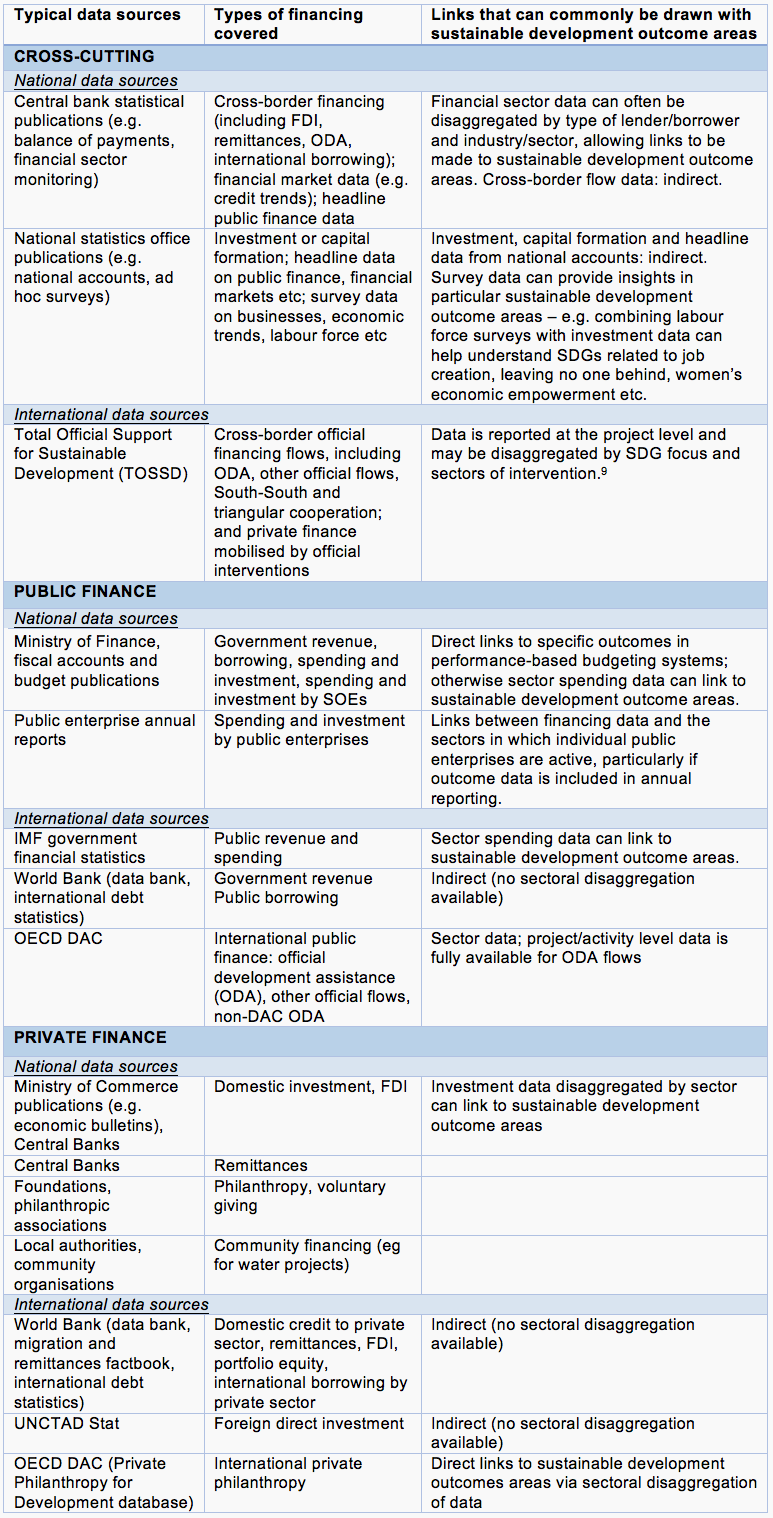
Typical sources of data and information, both national and international, are listed in Table 2. National data will often provide more timely and more granular information. International data sources can be used to complement national sources of data and may be more suitable for making international comparisons.
Table 2. Typical data sources for financing landscape analysis
Footnote 9: See TOSSD Reporting Instructions and TOSSD Data Form available at: http://www.oecd.org/dac/tossd/
Challenges may arise in relation to data quality and availability (see Box 1), both in terms of coverage of flows and ability to link financing to outcomes (e.g. with regard to gender impacts).
Some proxies may have to be used where data is unavailable, most notably for domestic commercial investment. Many countries do not capture comprehensive data on total investment by domestic firms and data capturing proxies, such as private gross fixed capital formation or borrowing by firms for investment purposes, may have to be used in its place. Data describing other flows, such as investments and spending by NGOs, faith-based or philanthropic organisations, may also be unavailable or limited within existing systems.
Proactive steps may be needed to gather data describing these flows. Insight from the institutional mapping exercise in the inception phase may help identify relevant data sources.
There may be overlaps between data from different sources, raising the risk of double counting. For example, on-budget ODA may be included in government revenue (and/or spending) data and in development cooperation data. Data on domestic lending may overlap with commercial borrowing from overseas if domestic banks are financing from international capital markets. On-budget ODA can be removed from ODA totals to avoid double counting ODA that is captured within government budget figures. Monetary survey data may show borrowing by the domestic financial system from abroad which can then be removed from data on disbursements of debt from abroad to local private actors.
This section summarizes existing tools that can contribute to a financing landscape assessment and highlights their linkages to sustainable development outcome areas. For ease of reference, they are categorised according to the types of finance covered (cross-cutting, public finance, private finance).
Table 3: Cross-cutting tools
Development outcome area: Multiple, depending on available data disaggregation by sector/ outcome area and identified priorities by the government leading the exercise.
The analytical aspect of DFAs provides an overarching picture of a country’s financing landscape and helps to identify challenges and opportunities for more integrated and effective SDG financing.
Development outcome area: Indirect relation to specific sustainable development outcome areas/ SDGs.
Article IV consultations are the culmination of the IMF country surveillance process. Reports include an assessment of economic and financial developments and policies, as well as analysis on dometic public finance and private investment and financial sector.
Development outcome area: Multiple, depending on available data disaggregation by sector which can be related to sustainable development outcome areas/ SDGs
This tool allows users to conduct analysis on financing trends and the financing mix at the country level, with a focus on tax revenue, ODA, Other Official Flows (OOF), foreign direct investment (FDI) and remittances. Data on these flows is also used to assess the relative significance of public/ private and domestic/ external financing, and to compare the financing mix in one country to that in countries with similar structural characteristics (‘peers’).
Development outcome area: Multiple. Tailored to specific thematic areas relevant to countries in fragile situations.
The OECD methodology outlines the process for developing financing strategies in fragile contexts, with the identification of current and potential sources of financing as a key step. The approach involves conducting a preliminary desk based mapping of financial flows and actors, and validating and supplementing such analysis with key stakeholders.
Development outcome area: SDGs 14 and 15/ Biodiversity
This tool is used to assess trends and the current state of public and private biodiversity finance, including financing instruments, biodiversity-related revenues, subsidies and spending. It also provides guidance on how to project future biodiversity expenditures.
Development outcome area: Multiple. Data disaggregated by SDG areas: poverty and hunger (SDG 1 and 2); health and education (SDG 3 and 4); housing, water and sanitation (SDG 6 and 11); clean energy and sustainable infrastructure (SDG 7 and 9); environment and climate (SDG 12 and 15); gender, justice and statistics (SDG 5, 16 and 17)
The UNESCAP SDG Investment Trends dashboard provides a snapshot of volumes of domestic spending and investment in Asian countries across SDG areas, broken down by government, households, repayable finance and external finance.
Development outcome area: Multiple
The SDG financing solutions simulators offer dynamic mediums to estimate financial potentials and densities to achieve national sustainable development priorities. They identify sources to bridge SDG financing gaps and serve as interactive modules to project financing propensities and capture the plausible efficiency gains from optimizing financing decisions.
Development outcome area: Multiple
Data analytics offer visual assessments of national financing for development performance and serves as a digital platform to monitor progress and track national and regional financing for development patterns in the Arab region, including the prime financial and non-financial means of implementation of the 2030 Agenda. The database also furnishes a financing health monitor and tracks financing for development flows.
Public finance
UNDRR Risk Informed Budget Review
Development outcome area: SDGs 1, 11 and 13/ Disaster risk reduction, as well as broader sustainable development outcome areas that would benefit from increased resilience.
The UNDRR Risk Informed budget Review tool is used to review public budgets across all sectors against national disaster profiles to uncover gaps in allocation to risk reduction and prevention.
Development outcome area: Indirect relation to specific sustainable development outcome areas/ SDGs.
The IMF Debt Sustainability analysis includes, among other things, an analysis of a country’s projected debt burden over the next 10 years, which can inform key challenges and opportunities in its overall financing landscape.
Development outcome area: Indirect relation to specific sustainable development outcome areas/ SDGs.
The IMF Debt Sustainability analysis includes, among other things, an analysis of a country’s projected debt burden over the next 10 years, which can inform key challenges and opportunities in its overall financing landscape.
Development outcome area: SDG 9/ Industry
This tool is primarily used in advisory work by IMF Fiscal Affairs Department on fiscal regime design but can also be used for revenue forecasting allowing users to compare actual, realised revenues with model results in tax gap analysis.
UN Women Gender Responsive Budgeting Diagnostics
Development outcome area: SDG 5/ Gender equality
The UN Women Gender Responsive Budgeting Diagnostics tool is used to assess gender equality in tax laws, policies and administration and in budget allocations and spending.
Development outcome area: SDG 3/ Health
The WHO Health Financing Country Diagnostic tool provides a comprehensive situation analysis of a country’s health financing system, including the current level, mix and sources of funding for the health sector, health expenditure patterns, and institutional arrangements for health financing. It also assesses the performance of the health system against universal health coverage objectives and goals.
Development outcome area: Multiple. Particularly areas of health (SDG 3), education (SDG 4) and social protection (SDG 1) of importance to children.
This tool provides guiding questions for performance expenditure reviews and budget analysis to assess government spending on early childhood development activities. It also includes considerations for sub-national analysis, based on assessing financial flows at the service provision point.
Development outcome area: SDG 13/ Climate
The UNDP Climate Public Expenditure and Institutional Review tool assesses volumes of funds within national budgets that target climate actions, and identifies relevant fiscal policies contributing to climate financing, including tax incentives and subsidies.
Development outcome area: SDGs 1 and 10/ Poverty and inequality
This tool is used to analyse the impact of taxes and social spending on inequality and poverty, based on incidence analysis and a diagnostic questionnaire to address questions around: the redistribution and poverty reduction as a result of social spending, subsidies and taxes; the progressivity of government revenue and spending; and how redistribution and poverty reduction could be increased within the limits of fiscal prudence.
Private finance
Development outcome area: Indirect relation to specific sustainable development outcome areas/ SDGs.
The IMF and World Bank Financial Sector Assessment Programme tool is used to paint a comprehensive picture of a country’s financial sector and to analyse its structure, strengths and vulnerabilities. It is also used to provide input for Article IV consultations.
Development outcome area: Multiple, depending on available data disaggregation by sector which can be related to SD outcome areas/ SDGs
UNCTAD Investment Policy Reviews involves the review of the policy, regulatory and institutional environment for investment; the identification of strategic investment priorities consistent with the SDGs and national development objectives; and concrete recommendations. It also includes an overview of the state of FDI in the country, with focus on sectors relevant to the country context.
Development outcome area: Indirect relation to particular sustainable development outcome areas/ SDGs.
The IFC Country Private Sector Diagnostic tool assesses opportunities and constraints in private sector growth. It looks at the overall state of the private sector and the range of near-term opportunities for private sector engagement, and provides recommendations for reforms and policies to mobilise private investment. It combines economy-wide with sector-specific analysis.
5. Financing landscape assessments in different country contexts
Country contexts vary widely, and financing landscape assessments have to be adapted accordingly:
The scope of existing data systems. Coverage of national data systems and existence of data systems that connect finance flows with particular sustainable development outcomes, differ from one country to another. Where strong systems are in place, financing landscape assessments can focus financing flows’ relation to sustainable development outcomes in more depth. Where they are less developed, emphasis will be on completing missing elements of the financing flows picture.
The complexity of the financing landscape. Complexity will vary depending on a country’s size, the state of private sector development and the depth and development of financial markets. Larger and more developed countries entail more players and a wider array of financing types and modalities, a much greater scale and diversity in the financing flows and instruments. The role of public enterprises differs sharply between countries. Similarly, NGOs, FBOs, philanthropic organisations, and the range of active development partners will impact the complexity of the exercise. Box 3 provides an overview of the specificities of financing landscape assessments in fragile and conflict-affected states.
Government capacity to build and maintain a financing landscape assessment. Maintaining an understanding of how financing trends evolve over time is an important part of the ongoing operations and management of an INFF. The initial assessment may draw on some of the tools highlighted in table 3 above. However, to incorporate this function within the ongoing oversight of an INFF, many governments will also want to develop in-house capacity. Its scope should be mindful of a government’s capacity and resources to compile and analyse data on a regular basis. Where capacity is more limited, assessments may focus on priority issues alone, or bring in international support.
Focusing on priority financing issues. Analyses of the financing landscape can hone in on key financing sources or areas where there are particular challenges or opportunities to unlock new and/or more aligned investment. For example, the development finance assessment in the Solomon Islands focused on the country’s past experience with foreign investment in the logging sector and lessons for future investment in the mining sector. A light development finance assessment in Liberia focused on the potential to engage the large Liberian diaspora, considering options such as a diaspora bond. Most governments will have a good idea upfront about key financing issues they wish to interrogate, or key challenges. They can focus the financing landscape assessments accordingly.
Countries in fragile and conflict-affected situations require a differentiated approach, able to take into consideration the nature of the fragility they face (environmental, political, societal, economic, security-related). For example, there is a need for conflict-sensitive, political economy analysis, as well as a more flexible approach and greater risk tolerance. Capacity development requirements are also greater and so is the need to consider realistic, incremental approaches to reform, based on the findings from the financing landscape assessment.
Specific financing issues need to be taken into account. For example, countries in fragile situations are more likely to have unsustainable debt burdens and to face greater challenges in accessing finance, due to issues such as ongoing physical security challenges or presence on lists such as the State Sponsors of Terrorism (SSTL). At the same time, fragility poses additional risks in terms of outflows, with significant volumes of net FDI outflows being the norm. Other specific issues can include meeting the financing needs of displaced population and the challenges of transitioning away from peacekeeping operations.
Humanitarian and peace actors play a critical role in fragile contexts; financing from these actors needs to be incorporated in the financing landscape assessment – looking at both its scale and the level of coherence and coordination with other sources of finance, including development cooperation.
Note: More on how synergies between humanitarian, development and peace financing may be strengthened in the DAC Recommendation on the Humanitarian-Development-Peace Nexus. DAC Recommendation on the Humanitarian-Development-Peace Nexus.
6. Lessons learned
The experience from countries that have completed assessments of the financing landscape, particularly those that have undertaken DFAs, highlights a few key lessons:
The need to include a broad range of public and private financing trends in the analysis, to the extent possible. If actors or types of financing are excluded, there is a risk that the policies and partnerships relevant to these types of finance will also be excluded in the financing strategy. As outlined in Section 4.1, this does not imply that all types of financing should be aggregated in one picture, but rather supports the importance of a differentiated yet comprehensive analysis of all relevant flows.
The need to engage relevant stakeholders as part of the analytical process. Engaging with stakeholders whose decisions drive trends is critical for fully understanding the context, the reasons behind those trends and identifying potential ways forward.
The need to make analysis accessible. Operationalising an INFF is about building a more integrated approach that involves engagement with a wider array of actors. It is important to make sure that the analytical outputs and dialogue around them are accessible not only to technical specialists but to the wider constituency that will be engaged with the INFF process.







.png)