1. Brief Overview
Monitoring and review is a key component of an effective integrated national financing framework (INFF) FN 1. It brings together the information required by policy makers and ensures necessary systems are in place to facilitate transparency and accountability in the implementation of the INFF and related activities and reforms FN 2. In so doing, it can facilitate learning, improve the effectiveness of financing policies, and enable policy makers to adjust course when conditions change. For example, monitoring systems can be an important enabler for rapid response and recovery planning during a shock such as COVID-19. Regular reviews provide lessons to improve implementation and design of the INFF, including governance and coordination mechanisms and processes.
Monitoring and review can be conducted at all levels of government – central agencies such as Ministries of Planning and Ministries of Finance, line ministries with sector responsibilities, and at the sub-national level by decentralized institutions. It can also be conducted by non-state actors to hold government accountable (see guidance on Building Block 4 Governance and Coordination for the institutions and processes that can facilitate access to information by all stakeholders).
In the context of an INFF, monitoring and review brings together existing data and tracking systems from across different types of finance, and links them to results (see Box 1 in Section 2). It does not aim to replace or duplicate these systems. Rather it acts as an ‘integrator’ by streamlining efforts and providing access to policy-relevant information across multiple financing policy areas, and feeding it back into integrated policy making processes.
Sections 2 and 3 of this guidance outline the value and role of INFF monitoring and review. Section 4 lays out relevant stakeholders, as well as processes that could be used as entry points. Section 5 focuses on steps countries can take to strengthen relevant monitoring and review systems and ensure the required data and information to guide overall INFF implementation is gathered and used by policy makers (Annex 2 provides an illustrative INFF monitoring and review framework FN 3 that may be used to bring together data and information from different systems). It puts forward key elements of a monitoring and review system in the context of an INFF and proposes two steps to strengthen (or establish) such a system, depending on a country’s existing processes, capacities, priorities and needs. The first is to establish a baseline, including levels of buy-in, roles and responsibilities, and data systems and capacity (a checklist for this step is included in Annex 1). The second step is to build on the baseline and fill any gaps, drawing on established good practice in the field and country examples, across four areas: i) institutionalise INFF monitoring and review; ii) integrate existing systems; iii) link the process to ongoing or planned data/ statistical reform processes, and make use of needs-based IT solutions; and iv) leverage insight and lessons from peers and regional/global knowledge-sharing platforms.
National government officials, especially members of the INFF Oversight Committee, where one is in place, and those with roles and responsibilities related to monitoring and review of financing flows and policies, are the primary audience. The guidance also provides a common reference point for development partners that support countries in these efforts.
2. The value of INFF monitoring and review
INFF monitoring and review can help governments to:
Streamline monitoring efforts by reducing gaps (common in areas of private finance and investment, and in relation to impact of financing), redundancies, overlaps (such as between government and donor systems) and misalignments in existing monitoring systems and processes related to different types of finance and financing policy areas (INFF monitoring and review as an ‘integrator’, see Box 1);
Build the necessary evidence base (i.e., with enhanced data) to improve efficiency and effectiveness of financing policies and reforms, encourage broad-based participation in policy processes by all relevant stakeholders, and enhance buy-in and understanding of the value of the INFF;
Regularly review the value added of the INFF financing strategy, including whether it is succeeding in enhancing mobilization and increasing coherence and alignment of financing vis-à-vis national sustainable development priorities;
Support dynamic policy making by facilitating learning on what works and what does not work, and by enabling timely course adjustments in response to changes in conditions, such as in the financing and risk landscapes;
Create positive feedback loops, encouraging learning and innovations from the implementation level to be fed back to policy design;
Strengthen partnerships, dialogue and trust among stakeholders;
Improve transparency and accountability.
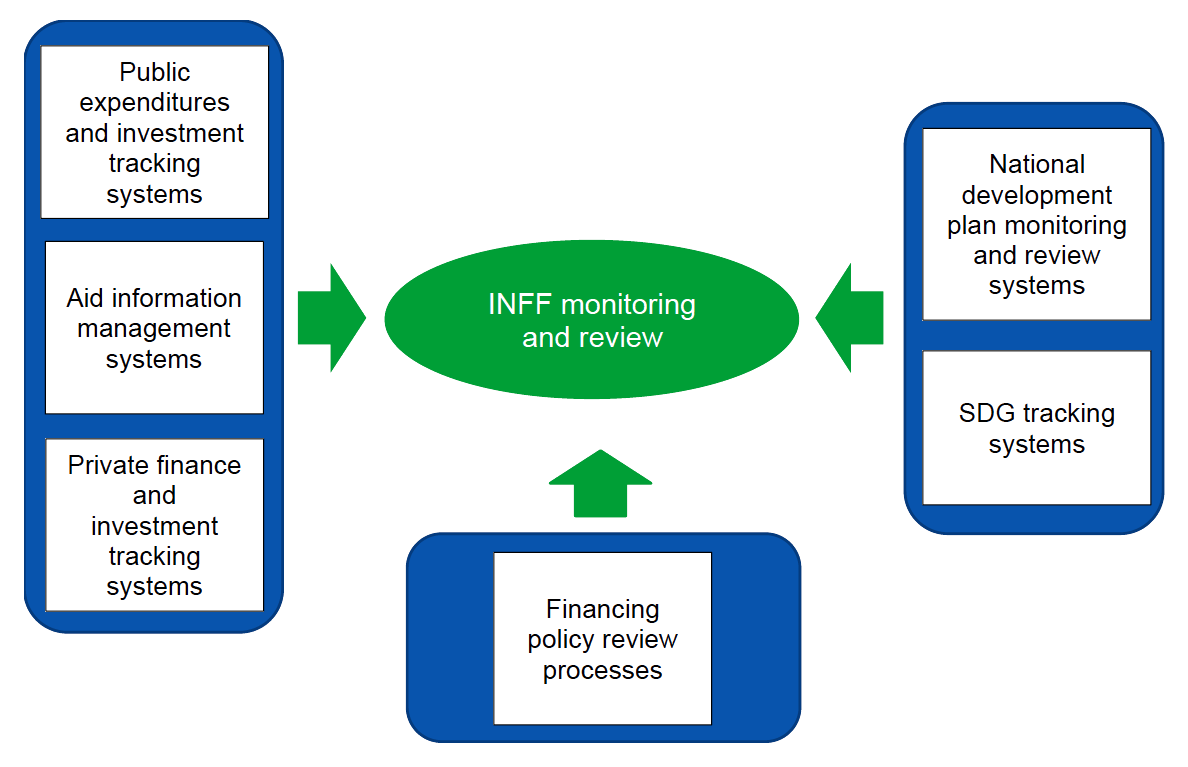
INFF monitoring and review can act as an integrator (Figure 1), as it builds on, and brings together, existing planning, budgeting and tracking systems. Countries tend to have a variety of monitoring and review systems in place (see Table 1 in Section 4.2), which are often not well aligned and/or duplicative. INFF monitoring and review facilitates tracking of both volumes and impact of all types of finance (public, private, international, domestic) as well as the implementation of relevant financing policies and strategies, including their impact vis-à-vis identified national sustainable development objectives. Thus, it not only integrates existing tracking systems across types of finance, but also provides a framework to link them to planning and results frameworks related to national development plans and/or SDG strategies.
INFF monitoring and review also provides the opportunity for governments to bring together initiatives and strategies related to data and statistical capacity, which are often developed in siloes. It can help to better link initiatives and strategies to the concrete data needs of national policymakers (see Section 5.2, Action Area 3).
Figure 1. INFF monitoring and review as ‘integrator system’
3. The role of monitoring and review within an INFF
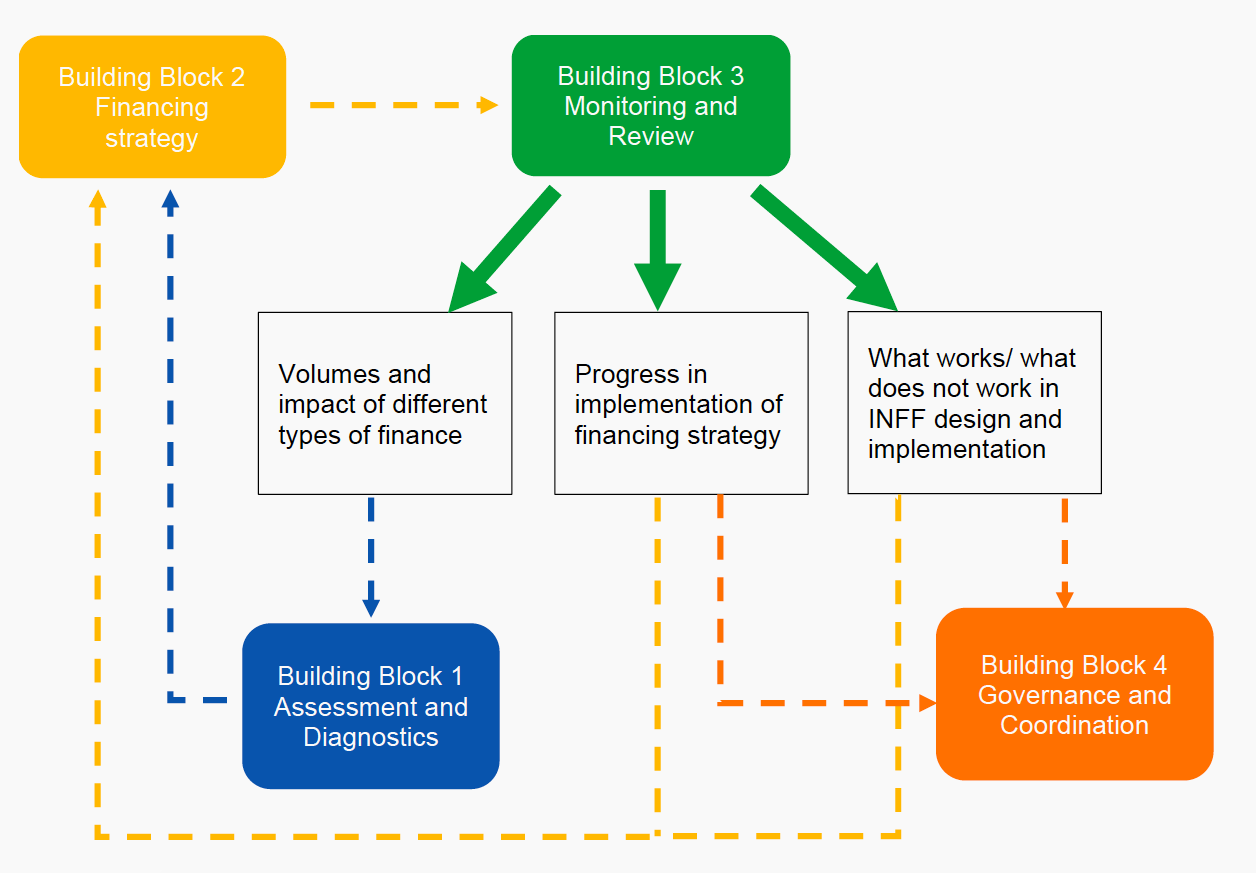
Similar to Building Block 4 on Governance and Coordination, Building Block 3 on Monitoring and Review cuts across the various INFF phases, from inception to design and ongoing implementation. Lessons from early implementers underline the importance of agreeing and clearly articulating the value added of the INFF from the inception phase. Monitoring and review tools, such as the Theory of Change, can help with this, while also providing an integrated perspective on activities related to the entire INFF process (see Box 2). Information on volumes and impact of financing as well as on the workings of related governance arrangements can feed into ongoing or updated financing needs and landscape assessments, risk assessments and binding constraints diagnostics (Building Block 1), to better understand the allocation and use of current financing sources, track mobilization and alignment efforts, and identify emerging risks and challenges. Information related to progress in the implementation of the financing strategy and to the effectiveness of INFF design can inform adjustments to specific policies (Building Block 2), and further strengthen governance and coordination arrangements (Building Block 4).
Figure 2. Linkages between building block 3 and other INFF building blocks
Надлежащий уровень амбиций будет зависеть от обстоятельств, ресурсов и потенциала страны. Усилия должны опираться на существующие институты и процессы:
INFF направлены на финансирование приоритетов устойчивого развития; соответствующие механизмы управления должны основываться на том, что уже создано для руководства и поддержки реализации ЦУР, например, на институтах и процессах, связанных с национальными стратегиями и планами, а также на тех, что используются для проведения добровольных национальных обзоров (ДНО) реализации ЦУР или для разработки определяемых на национальном уровне вкладов (ОНУВ) в рамках РКИК ООН;
INFF учитывают все источники финансирования; соответствующие механизмы управления должны опираться на институты и процессы, регулирующие государственный бюджет и более широкое управление государственными финансами (такие как подготовка бюджета, закупки и государственные инвестиции), согласование частного финансирования и инвестиций (например, платформы государственно-частного диалога), сотрудничество в целях развития (например, форумы по координации партнеров по развитию) и более широкие механизмы экономического управления (см. раздел 4 для получения более полного обзора соответствующих институтов и процессов);
INFF ориентированы на финансирование на страновом уровне; соответствующие механизмы управления в первую очередь касаются национальных институтов и процессов, которые могут направлять и поддерживать разработку и реализацию политики финансирования (см. раздел 4). Однако важно рассматривать их в контексте региональных и глобальных процессов. Политические решения или позиции, занимаемые странами на международных переговорах, не должны подрывать национальные усилия; аналогичным образом, решения в области внутренней политики финансирования должны отражать международные соглашения. Таким образом, INFF должны опираться на институты и субъектов, которые возглавляют такую деятельность, и включать их в свою работу FN 4.
How much public and private financing is spent/ invested in the country?
How is financing currently allocated? How does it contribute to the achievement of national sustainable development priorities?
To what extent do different types of finance work synergistically and in an integrated manner toward identified goals (versus undermining each other’s impact)?
Progress in implementation of the financing strategy
Is the financing strategy (and related policy reforms) succeeding in increasing mobilization of additional financing in line with set targets and from the required sources (e.g., public/ private/ domestic/ international)?
Is the financing strategy (and related policy reforms) succeeding in increasing overall coherence and alignment between financing and national sustainable development priorities?
What works/ what does not work in INFF design and implementation
What lessons can be learned to further support adjustments and improvements in financing policies? For example, how effective are the underlying governance and coordination mechanisms? Are there areas of the financing strategy that may be working better than others?
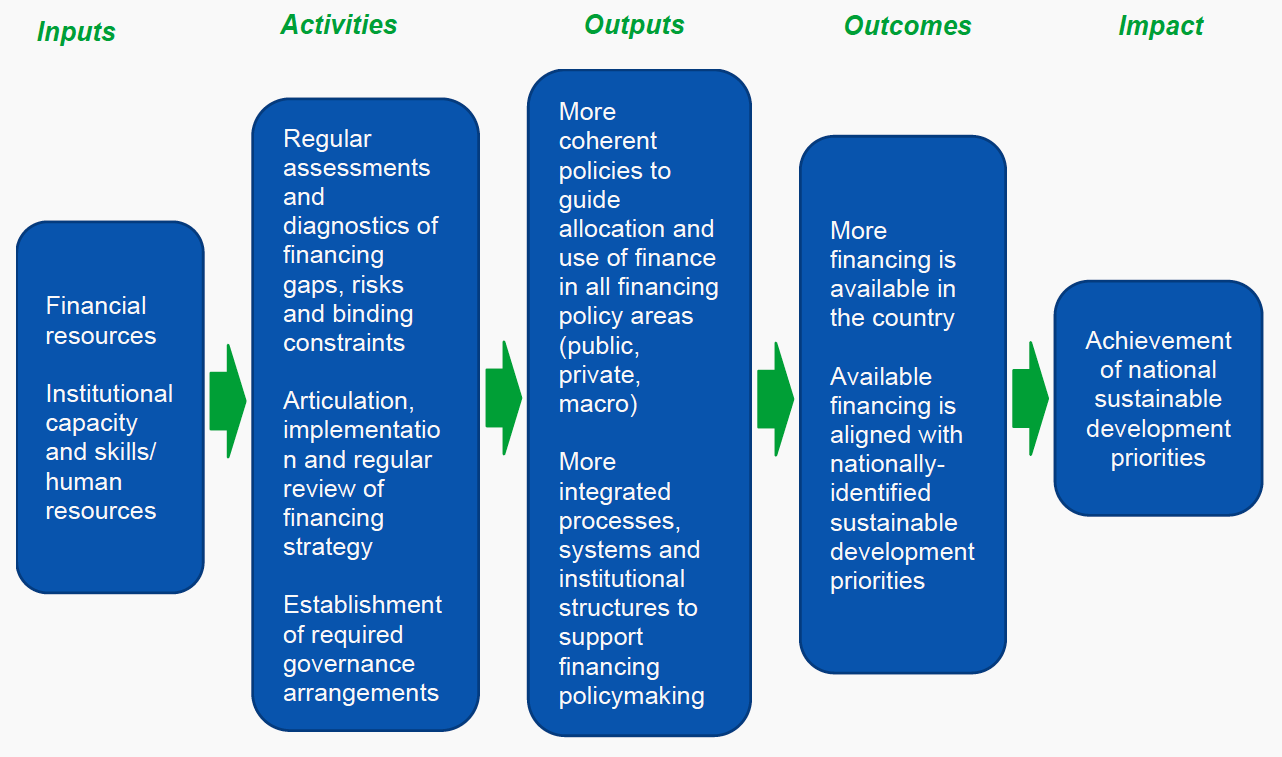
The inception phase and the INFF roadmap will contain a description of the value added and rationale of implementing an INFF in a national context. An INFF “theory of change” can link this value added to inputs, activities, and concrete and measurable outputs. Such a “theory of change” would spell out inputs and activities, and related outputs, outcomes, and the ultimate goal of achieving national sustainable development priorities, along with key assumptions/ risk factors (see Figure 3 for an example of an INFF theory of change). It would thus articulate activities across building blocks (from necessary assessments and diagnostics, financing policy formulation and review, to setting up of adequate governance structures), and tie them to concrete outputs, outcomes and the ultimate impact of contributing to the achievement of national sustainable development objectives. In so doing it can provide the basis for an integrated and comprehensive monitoring and review framework (see Annex 2 for an example), while allowing for flexibility that may be required if national and/or global contexts change. For example, assumptions and risk factors may be revisited regularly, as additional or more up-to-date information becomes available via assessment and diagnostic exercises. Similarly, the initial logic linking inputs to the desired impact can be adjusted if necessary, as information from regular monitoring of progress in INFF implementation becomes available. Thus, while developing a theory of change may visually appear as a linear process, it is not; it will inevitably involve regular validation and adjustments and support continuous learning around INFF implementation.
Figure 3. An INFF theory of change
Pre-requisites, assumptions and risk factors:
Strong commitment at the highest political and technical levels; broad-based buy-in across relevant stakeholders; willingness of non-government national and international stakeholders and partners to support the INFF; conducive global context; minimum availability of data on financial flows and their allocation/ use; political stability; functional public sector.
Annex 2 provides an illustration of a full INFF monitoring and review framework. It shows how information from different monitoring and review systems (e.g., those related to government finance, international development cooperation and private finance, where existing) may be brought together to guide overall INFF implementation and related financing policy making.
The following elements form the basis of the framework:
A theory of change (TOC) - or similar logical framework - to ensure common understanding of the rationale, effects, barriers and enablers of the INFF, while keeping in mind complexity of the change process, and with an emphasis on enabling feedback loops and learning. The scope of the TOC, which will in turn define the scope and depth of required monitoring and review, will depend on the scope of the INFF (e.g., in countries where INFFs are focused on specific sectors or financing policy areas, the TOC will be narrower in scope compared to that of an INFF covering an entire national development plan as illustrated in Box 2 in Section 3.1 and in Annex 2) and on specific activities and objectives articulated in the financing strategy (e.g., changes in, or introduction of new, policies, regulations and instruments).
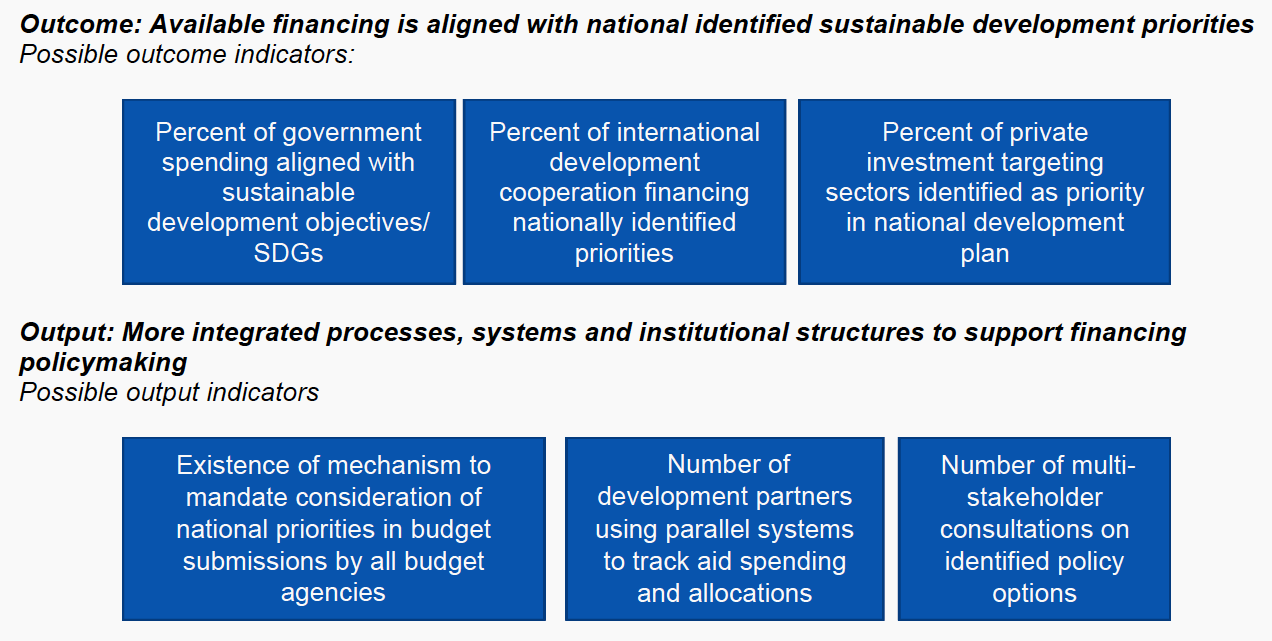
Indicators to identify which data should be regularly collected and reported on to monitor progress against the TOC. Where possible, they should be lifted from existing monitoring frameworks for different types of finance (such as those related to the national budget, and development cooperation results frameworks). Relevant globally agreed SDG indicators may also be applicable, depending on the scope of the country’s INFF. At the impact level, indicators from national development plans or sectoral plans may be used. At the activity and output levels, the choice of indicators will be informed by the INFF action plan articulated as part of the financing strategy building block (see for example Table 5 in Building Block 2 guidance on the financing strategy). Indicators can be quantitative or qualitative, and should be clear (precise and unambiguous), relevant (appropriate to the subject at hand), economic (available at a reasonable cost), adequate (providing a sufficient basis to assess performance), and monitorable (amenable to independent validation) (CREAM). Figure 4 provides some examples. Additional examples are included in Annex 2, which also lays out key information that is typically required for each indicator.
Figure 4. Examples of output and outcome indicators
Targets to establish common objectives for what needs to be completed by when, in order to achieve the outcomes identified in the TOC. Targets should be specific, measurable, achievable, relevant, and time-bound (SMART). Such SMART targets should be informed by timeframes and sequencing considerations in the INFF roadmap and financing strategy, and use, to the extent possible, already identified targets in existing financing policies and strategies. Annex 2 provides some examples.
Data systems and capacity to generate ‘good enough’ data to enable regular reporting on identified indicators, as well as access and use of such data by decision-makers and those holding them to account. Table 2 in Building Block 1.2 Financing landscape assessment provides an overview of national data sources that would likely form the basis of relevant data systems, such as central bank statistical publications, national accounts, surveys by national statistics offices, budget publications, economic bulletins, etc. (International data sources can complement national ones where there are gaps; e.g., monitoring data from Development Cooperation Forum surveys and the Global Partnership for Effective Development Cooperation may shed light on alignment of ODA with national priorities; World Bank data on Private Participation in Infrastructure can contribute to monitor the scale and alignment of public-private partnerships with national priorities).
Adequate resources, including human resources within national government to ensure the system is effectively implemented and remains functional over time, and incentives to focus on results and impact. Responsibility for INFF implementation falls primarily on national governments, and thus requires relevant resources and capacity to be available among government officials. However, it also relies on the collaboration and participation of other actors such as development partners, the private sector and civil society. Adequate resourcing of, and skills in, monitoring and review among all these stakeholders is thus also an important element of success.
Evaluation is the systematic and objective assessment of an ongoing or completed project, programme or policy, its design, implementation and results. Even though the terms review and evaluation are sometimes used as synonyms, an evaluation is usually a more robust, comprehensive and in-depth assessment. Evaluation is used across sectors and topics to determine the relevance and fulfillment of objectives, coherence of the intervention with other interventions in a country, sector or institution, development efficiency, effectiveness, impact and sustainability. Evaluation, as other review systems, serves a dual purpose of providing evidence for accountability and learning to inform enable policy adjustments and quality improvement as well as supporting transparency and oversight of expenditure.
Evaluation is a vast field of study, with extensive literature and tailored methodologies and approaches for specific sectors. Internationally accepted evaluation norms and principles include: the quality standards for development evaluation of the OECD Development Assistance Committee; the good practice standards of the Evaluation Cooperation Group; and the norms and standards of the United Nations Evaluation Group. In the area of financing, evaluation guidelines and methodologies exist in relation to specific types of finance, especially public finance (for example, related to the national budget, blended finance and private sector support, trade-related aid, and budget support). Evaluations can inform spending of public money and efficient and effective policymaking, which is critical as governments are under pressure to provide more and better services under tight fiscal environments. Examples of evaluations in the area of financing for sustainable development include evaluations focused on specific types of finance, such as budget support, and on individual government agencies or institutions, such as the CDC’s Financial Institutions portfolio evaluation.
Evaluation plays a key role in understanding progress toward achieving the Addis Ababa Action Agenda and the SDGs. The 2030 Agenda states that review of the SDGs will be “rigorous and based on evidence, informed by country-led evaluations” and calls for “strengthening of national data systems and evaluation programs” (paragraph 74). The focus has mostly been on evaluating the progress towards achieving the SDGs, for example through Voluntary National Reviews, Government Annual Reports, performance audit reports and regular evaluations of the effectiveness and coherence of sustainable development policy. Scope remains to strengthen evaluation of financing for sustainable development. INFFs provide an opportunity for both national governments and international development partners to do so. Note: For an overview of the role of evaluation in results-based management systems, see Chapter 7 of World Bank (2004) A Handbook for Development Practitioners: Ten Steps to a Results-Based Monitoring and Evaluation System, which covers the different uses, types, timing, and characteristics of evaluations.
4. Relevant stakeholders and processes
As with all INFF components, government plays the central role when it comes to monitoring and review. Leadership from both the political and senior technical levels is key to ensure sustainability and effectiveness of monitoring and review efforts (see success factors listed in Section 5.2). Typically, this leadership stems from the Ministry of Finance and/ or Planning, or the Office of the President or Prime Minister. Depending on the focus of the INFF, it may also be within specialized agencies or line ministries.
The INFF Oversight Committee, when one is present, is the likely body with overall responsibility to oversee the design and implementation of an adequate monitoring and review system, and to report on progress in implementation of the INFF financing strategy both internally (such as to senior government leadership) and publicly (e.g., around annual budget statements).
Various stakeholders, both within and outside government, will be involved in monitoring financing efforts at different levels and in different sectors. Their experience and expertise should be sought when considering INFF monitoring and review systems.
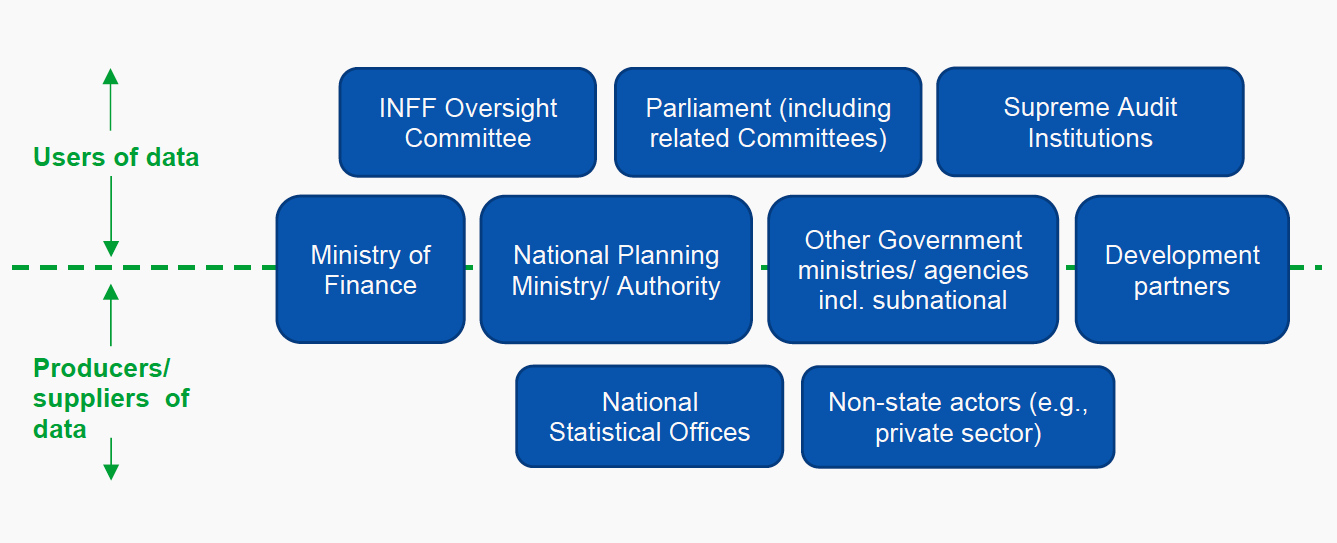
Figure 5 illustrates typical producers and users of data. Depending on the scope of the INFF, monitoring and review roles may differ. For example, if a country’s INFF is focused on a specific sector or a specific financing policy area, the role of specialized agencies may become more central. If the INFF is focused on the sub-national level (such as in Ghana) then the role of sub-national agencies would be more prominent.
Figure 5. Typical roles and responsibilities in INFF monitoring and review
Countries do not need to start from scratch when it comes to INFF monitoring and review. Existing monitoring systems, processes and frameworks should be the starting point. Such systems can be strengthened or expanded, better aligned and made more coherent within an INFF as necessary. Similar to Building Block 4 Governance and Coordination, the overarching aim should be to streamline efforts, not to replace or duplicate existing systems nor to establish new systems, unless there are gaps that need to be filled.
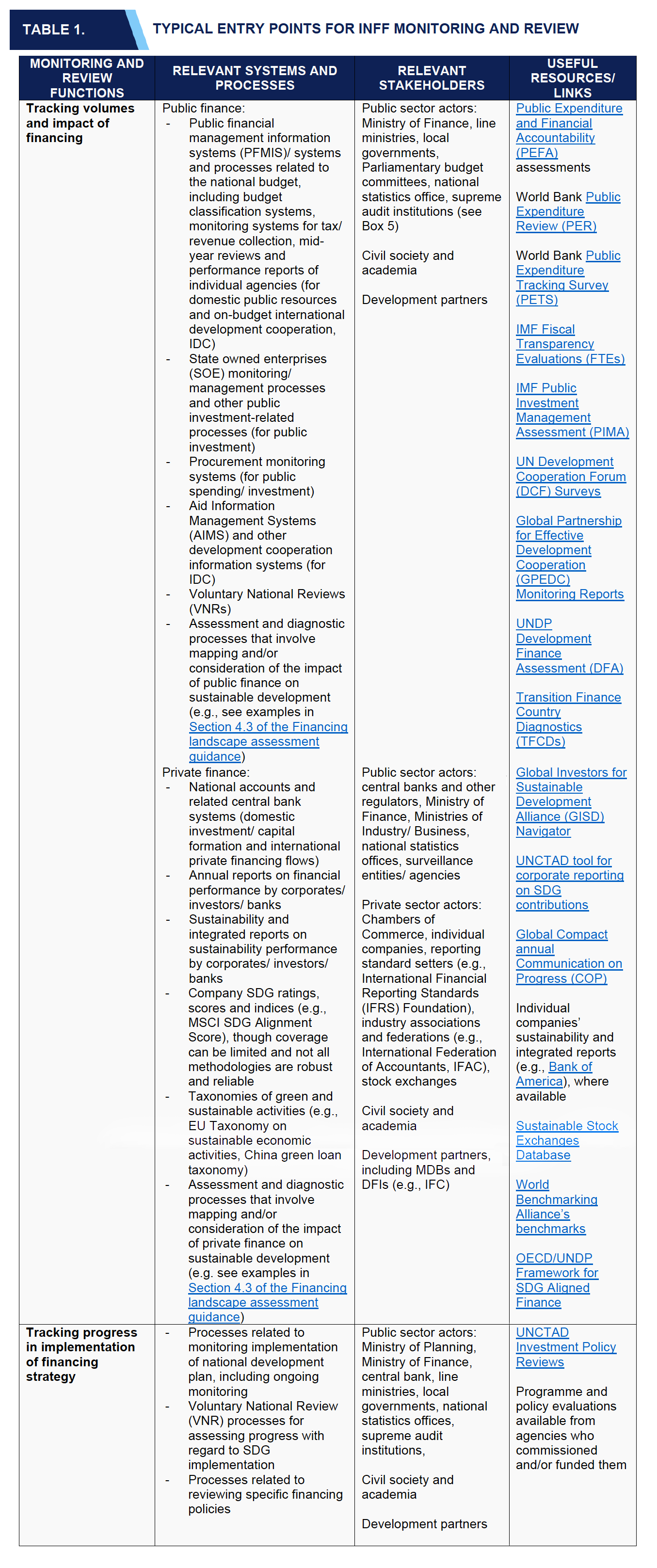
Table 1 illustrates potential entry points for INFF monitoring and review, as well as relevant stakeholders typically involved in establishing and maintaining adequate systems. It also includes links to useful resources and tools that can shed light on existing systems and processes. (Table 2 in Building Block 1.2 Financing Landscape Assessment provides an overview of data sources, which can inform the tracking of volumes of financing).
Overall, if a well-established system for monitoring implementation of the national development plan is in place, it could serve as a starting point for INFF monitoring and review. Similarly, if established processes around Voluntary National Reviews (VNR) exist, these should also be considered (see Box 4). Data and statistical strategies and reform processes may constitute another entry point (see more in Section 5.2, Action Area 3). Existing monitoring systems for different types of finance (such as national budget tracking systems and review processes, or private finance reporting initiatives) can act as entry points to build a more comprehensive system. As further articulated in Section 5, the comprehensiveness of such a system will differ depending on country contexts, reflecting the nature of INFFs as a long-term and gradual approach to guide better planning for, and implementation of, financing policy reforms.
With regard to public finance, monitoring systems relate to government finance (revenue, spending and investment), as well as development cooperation. Public financial management information systems (PFMIS) are typical starting points from the government’s perspective. A growing number of countries have gender, climate, or SDG budget tagging or coding systems in place, or are developing them as part of their INFF. Monitoring systems for government finance are usually developed around the annual budget process, with both volumes and data on performance indicators reported in relation to objectives that programmes within each budget agency are expected to achieve on an annual or multi-year basis. In the budget planning and formulation stage, and as part of their submissions to the Ministry of Finance, budget agencies may be required to articulate a narrative around how they will contribute to identified national priorities or the SDGs, and/or to link their programmes to specific goals. Data on government revenue may be collected to various degrees of disaggregation and may be subject to review with regard to questions of progressivity or inequality. There are also varying practices in relation to monitoring of tax expenditures, used to shed light on revenue foregone through tax incentives. Specific monitoring frameworks may also be in place for major investment projects (e.g., articulated by ministries and other entities involved in major infrastructure projects) and for state-owned enterprises, which may have dedicated systems to track their investments and contributions toward national development.
Monitoring systems for development cooperation and finance are based on national aid information systems and country results frameworks. According to 2018 GPEDC monitoring data, 96% of developing countries have one or more information management systems in place to collect information on development cooperation. While the quality of such information varies, it typically includes data on financial commitments, scheduled and actual disbursements, and in some cases on intended and achieved results. Data from the 2020 DCF survey shows, however, that less than half of development cooperation information systems tracked results, off-budget flows, funding gaps and conditionalities. A results framework to review the performance and results of international development cooperation was in place in just over half of respondent countries (56%). Critically, in the context of an INFF, in only 36% of cases countries and development partners use the same, or mostly overlapping, results framework, meaning that there are multiple parallel systems. Furthermore, only half of results indicators from development partners’ projects are monitored using national statistics and monitoring systems, according to GPEDC data.
With regard to private finance, the monitoring and reporting landscape is even more fragmented. On financing flow volumes, national accounts and related central banks reporting are common systems. In addition, relevant line ministries (e.g., ministries of business or local development) may have systems in place to collect and report data on investments in the country, including in relation to the role of SMEs at the sub-national level. Beyond volumes, policymakers need data and information on the impact of private business and investment on economic, environmental, and social issues to assess the private sector’s contribution to sustainable development objectives. Meaningful data and information on this remains scarce though a number of initiatives and innovations are ongoing, with INFFs providing a platform for enhancing coherence of this increasing wealth of information at the country level and feeding it into financing policy making processes.
For example, private sector- or government-led systems for consolidating data on the contributions of business to sustainable development priorities exist in some countries (e.g., in the Philippines and in Colombia) and there is a growing number of companies publishing a sustainability report (mainly large, listed companies). However, information published is often not comparable across companies or time, and tends to focus on qualitative indicators rather than on quantitative data. Companies select the issues they choose to communicate, as sustainability reporting remains largely voluntary. In addition, sustainability-related information is generally behind paywalls and is not in the public domain; policymakers could change this by creating an open repository for company sustainability data to create more transparency. Companies also need to adjust their internal systems to track and report data on environmental and social issues. This might be particularly challenging for smaller companies with limited resources. Nonetheless, voluntary sustainability reports can be a starting point. Governments can increase their relevance by agreeing (including at the global level) on harmonized metrics and indicators to be used for company disclosure. Countries across a range of development contexts (e.g., EU, China, Mexico, South Africa, Mongolia, Bangladesh) have developed or are in the process of developing taxonomies that could enhance reporting on both volumes and impact of private business and finance. The G20 Sustainable Finance Working Group (SFWG), established in 2021, is also working on improving corporate sustainability disclosure and on facilitating the compatibility and consistency of national approaches regarding sustainable taxonomies. The INFF process can help consider these national and international efforts in connection to public finance classification systems.
Table 1. Typical entry points for INFF monitoring and review
Комплексные национальные механизмы финансирования (INFF) были представлены в Аддис-Абебской программе действий и получили дальнейшее развитие в Докладе о финансировании устойчивого развития 2019 года, подготовленном Межучрежденческой целевой группой по финансированию развития (IATF). В ответ на интерес со стороны ряда стран-«пионеров» IATF продолжила разработку методологий и методических материалов для содействия проектированию и внедрению INFF. На страновом уровне система ООН, Европейский союз (ЕС) и другие партнеры по развитию оказывают поддержку правительствам в запуске INFF, в том числе путем адаптации глобальных методологий к конкретным условиям каждой страны. ПРООН, в частности, обеспечивает техническое руководство. Примерно в 60 странах целевое финансирование было предоставлено Совместным фондом ЦУР. По состоянию на первый квартал 2021 года правительства около семидесяти стран предприняли шаги по внедрению INFF. Интерес к INFF и динамика их развития также продолжают расти в рамках глобальных политических процессов, включая «Группу двадцати» (G20), где INFF были определены в качестве приоритетного направления для Рабочей группы по развитию.
Supreme Audit Institutions (SAI) play an important role in contributing evidence for more informed policymaking. Their traditional role of overseeing public expenditure is evolving towards taking a broader, more comprehensive view on reliability, effectiveness, efficiency and economy of policies and programmes. The International Organisations of Supreme Audit Institutions (INTOSAI) has launched several initiatives to support SAIs in this new role and at INTOSAI XXII in Abu Dhabi in 2016, the following four approaches for SAIs to auditing and reviewing SDG issues were identified: i) assessing the preparedness of national governments to implement SDGs; ii) undertaking performance audits in the context of SDGs; iii) contributing to the implementation of SDG 16, which envisages effective, accountable and transparent institutions; and iv) possibilities for SAIs to act as models of transparency and accountability in their own operations. Regional working groups support SAIs as well. For example, AFROSAI published a guideline on Sustainable SAIs in 2019. The role of SAIs is also touched on in the World Public Sector Report 2019 and there is material available from the OECD on SAI and good governance. Guidance on Building Block 4 Governance and Coordination discusses the role that SAIs can play in the context of an INFF.
5. Практическое руководство: управление и координация INFF
У разных стран свои приоритеты и потребности, свои политические и административные системы, а также свои институциональные условия. Именно они должны стать отправной точкой, направленной на постепенное совершенствование с учетом главной цели — повышения согласованности политики финансирования.
На рисунке 2 представлено пошаговое руководство: от выявления и оценки существующих институтов и процессов (раздел 5.1) до рассмотрения мер по их укреплению для эффективной реализации INFF (раздел 5.2). Цель состоит в том, чтобы повысить согласованность существующих механизмов управления и при необходимости устранить пробелы. Оба шага структурированы по трем функциям, определенным выше как ключевые элементы согласованного управления: (i) обязательства и лидерство, (ii) доступ к знаниям и мнениям, (iii) координация между заинтересованными сторонами.
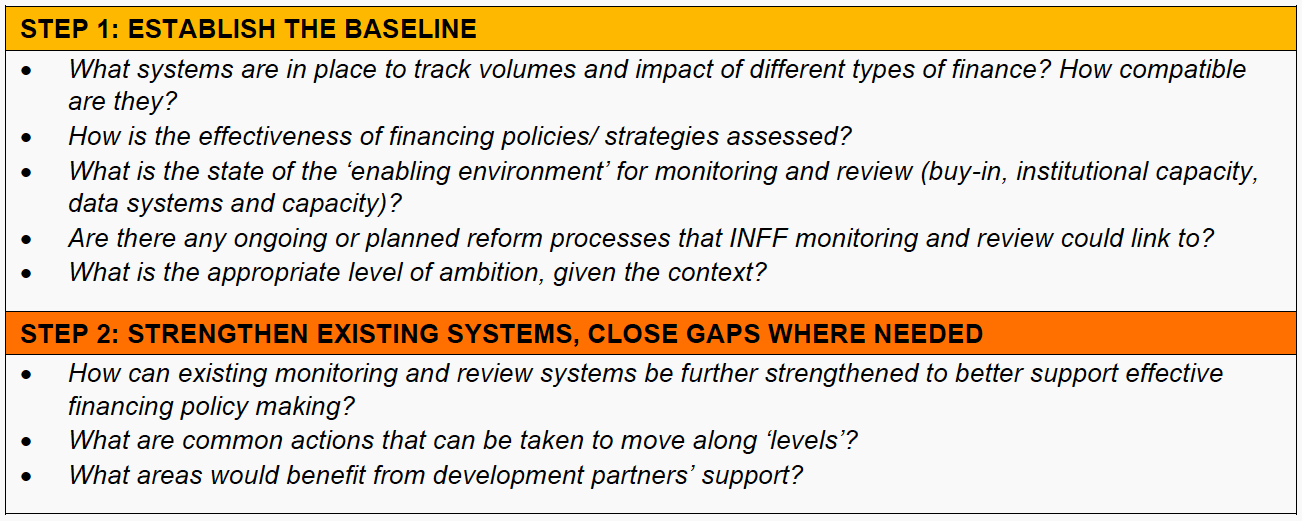
There is no one-size-fits all model to establish an effective monitoring and review system for INFFs. Different countries will start from different baselines and may have identified different priority areas as part of their financing strategies. Consequently, their focus and level of ambition with regard to INFF monitoring and review will also differ. Figure 6 sets out two common steps that may be used to guide efforts to establish and/or strengthen monitoring and review functions in all contexts. The first focuses on establishing the baseline, looking across existing systems and the ‘enabling environment’ for monitoring and review (including underpinning elements, such as level of buy-in, roles and responsibilities, and relevant data systems and capacity). An illustration of basic, intermediate, advanced levels of integrated monitoring and review is presented to guide countries in establishing their level of ambition with regard to strengthening existing systems in the context of their INFF. The second step lays out possible actions to do so, drawing on good practice in the field complemented by country examples, and focusing on: i) institutionalizing INFF monitoring and review, and forging alliances among stakeholders; ii) enhancing integration of existing systems and developing pilots to fill gaps; iii) linking to ongoing or planned data/ statistical reform processes and making use of needs-based IT solutions; iv) leveraging insight and lessons learned from peers and regional/global knowledge-sharing platforms.
Рисунок 2. Пошаговое руководство
В таблицах 2–4 (посвященных обязательствам и лидерству, доступу к знаниям и мнениям, а также координации) представлен ряд вопросов для самооценки FN 5, относящихся к функциям управления, обсуждаемым в разделе 3. Они также содержат наглядные примеры из практики разных стран. Эти вопросы и примеры помогут определить существующие механизмы управления, в которые можно интегрировать INFF, а также выявить пробелы, требующие устранения. В приложении I вопросы для самооценки сведены в контрольный список.
Анализ существующих институциональных механизмов, органов и процессов, связанных с финансированием, возможно, уже проводился в рамках этапа запуска INFF вместе с подробным картированием институтов и заинтересованных сторон. Если это так, полученные результаты можно использовать на данном этапе.
What systems are in place to monitor and review execution of the government budget, including the extent to which spending allocations are in line with identified sustainable development objectives?
What systems are in place to monitor and review government revenue, including the extent to which it is aligned with sustainable development objectives (e.g., progressivity of taxes)?
How is the sustainability of public borrowing monitored?
What systems are in place to monitor and review allocation and impact of public investment? Are findings from such systems considered alongside those related to government spending?
What systems are in place to monitor allocation, use, and impact of international development cooperation, including from public development banks? Are these separate or integrated into other monitoring and review processes related to government finance?
What systems are in place to monitor volumes, allocation, and impact of private investment in the country? Are there different systems for domestic and foreign investment (including from MDBs)?
Are there reporting requirements for companies and other financial institutions active in the country? If so, do these include requirements to report data on contributions to sustainable development outcomes? Are these mandatory or voluntary? If mandatory reporting requirements are not in place, are there established voluntary norms?
What systems are in place to monitor volumes and allocation of non-profit/ philanthropic finance in the country? Are there different requirements for domestic and foreign foundations? Is data and information from these systems considered alongside data related to other sources of finance (public and private)?
What systems are in place to monitor risks to the country’s capacity to finance sustainable development? Which types of risks are monitored (e.g., economic/ non-economic risks)?
How often is data collected through the above-mentioned systems? How is it used by government to inform policy making? How is it published for wider accessibility?
How often are existing monitoring and review systems related to different types of finance reviewed to ensure their continued relevance?
How compatible are they (e.g., do they rely on common definitions of key terms and/or on comparable data sources)?
How is the implementation of specific financing policies (e.g., medium-term revenue strategies/ debt management strategies/ public investment strategies/ development cooperation strategies/ investment promotion policies/ financial inclusion strategies/ etc.) monitored? How regularly are they reviewed? How are the findings from such reviews used?
Сильный политический мандат высокого уровня задает общее направление и видение, которые позволят: закрепить усилия по повышению согласованности действий; обеспечить наличие необходимых ресурсов (финансовых, временных, кадровых); а также послужить сигналом о готовности к объединению и вовлечению всех заинтересованных сторон.
Однако одного политического лидерства недостаточно. Комплексные национальные механизмы финансирования (INFF) требуют долгосрочных действий, выходящих за рамки политических циклов. Реформы в сфере финансирования, скорее всего, будут поэтапными и не произойдут в одночасье. Для дополнения политической воли и сопровождения всего процесса INFF — от разработки до реализации — необходим технический опыт, в том числе для обоснования и формирования возможных политических решений и выбора стратегий. Технические эксперты в ключевых государственных ведомствах и профильных институтах (таких как национальные статистические службы, налоговые органы, высшие органы финансового контроля) играют решающую роль в поддержании динамики INFF и связанных с ними реформ, а также в подготовке почвы для постепенного прогресса.
Комитет или орган по надзору за INFF, дополненный технической рабочей группой или секретариатом (которые могут быть интегрированы в существующие структуры, отвечающие за процессы, связанные с INFF, например, в органы национального планирования или реформирования системы управления государственными финансами), способны воплотить политическую волю и техническое руководство в практические результаты.
Who are the champions behind the INFF in the country? Do they have the required authority and political clout to drive efforts to strengthen monitoring and review systems and capacities across all relevant ministries/ stakeholders? FN 6
Is there broad-based buy-in for INFF monitoring and review, including a common understanding of the rationale behind it and its potential value?
Is there buy-in from development partners to support INFF monitoring and review, including through capacity building, where needed?
Roles and responsibilities:
What are the roles and responsibilities in relation to monitoring and review of financing issues in government, and among non-state actors? What is the role of Parliament and of the Supreme Audit Institution?
Who in the country produces data (both at the national and sub-national levels)? E.g., central ministries, line ministries, specialized units, provincial ministries, local government, NGOs, development partners, etc.
Who uses data? E.g., for budget preparation, resource allocation, programme policymaking, legislation and accountability to parliament, planning, fiscal management, evaluation and oversight.
Data systems and available capacity:
What is the quality of data produced and used in the country? Are needs-based IT processes in place to facilitate collection and processing of required data? (See Box 6).
What are the skills of civil servants in the national government in programme management, data analysis, budget management, performance auditing? Are these functions adequately resourced (including financially)?
Are any statistical/ data reform processes ongoing or planned (e.g., development of a national statistics development strategy, or related efforts in specific sectors or financing policy areas)?
Is there any technical assistance, capacity building, or training in monitoring and review underway or that was recently done? Who provided this support?
Are there any institutes, research centres, private organisations, or universities in the country that have capacity to provide technical assistance and training in monitoring and review to civil servants and other relevant stakeholders?
Data quality reviews (DQR) can be used to perform an independent review of the quality of the data that is available to inform INFF monitoring and review. Specific objectives of DQRs typically include: a) verifying baseline and historical data for key indicators based on information available from different sources; b) recommending changes to indicators, data collection mechanisms and protocols as necessary; c) identifying data sources that have been used and confirm their accuracy on the ground and/or between data sources or reports; d) suggesting appropriate method of data collection and sources of data, where new data may be required; e) identifying capacity needs for data collection and making recommendations on the most appropriate monitoring and review institutional mechanisms and technical tools as well as training needs for major stakeholders. Typically, a DQR can include an assessment of identified indicators, and an assessment of data used to calculate such indicators (e.g., validity, reliability, timeliness, precision, integrity). It may also include a more general assessment of existing monitoring and review systems, e.g., structure, functions and capacities, including for data collection, processing, analysis, reporting and use.
Source: Martin, F. P. and A-M. Fernandez (2021). Background Orientation Paper prepared for FSDO/UNDESA on INFF building block 3: Monitoring and Review (M&R) Analytical Framework and Country Case Studies, IDEA, Canada.
Рисунок 3. Уровни приверженности и лидерства: стилизованные примеры
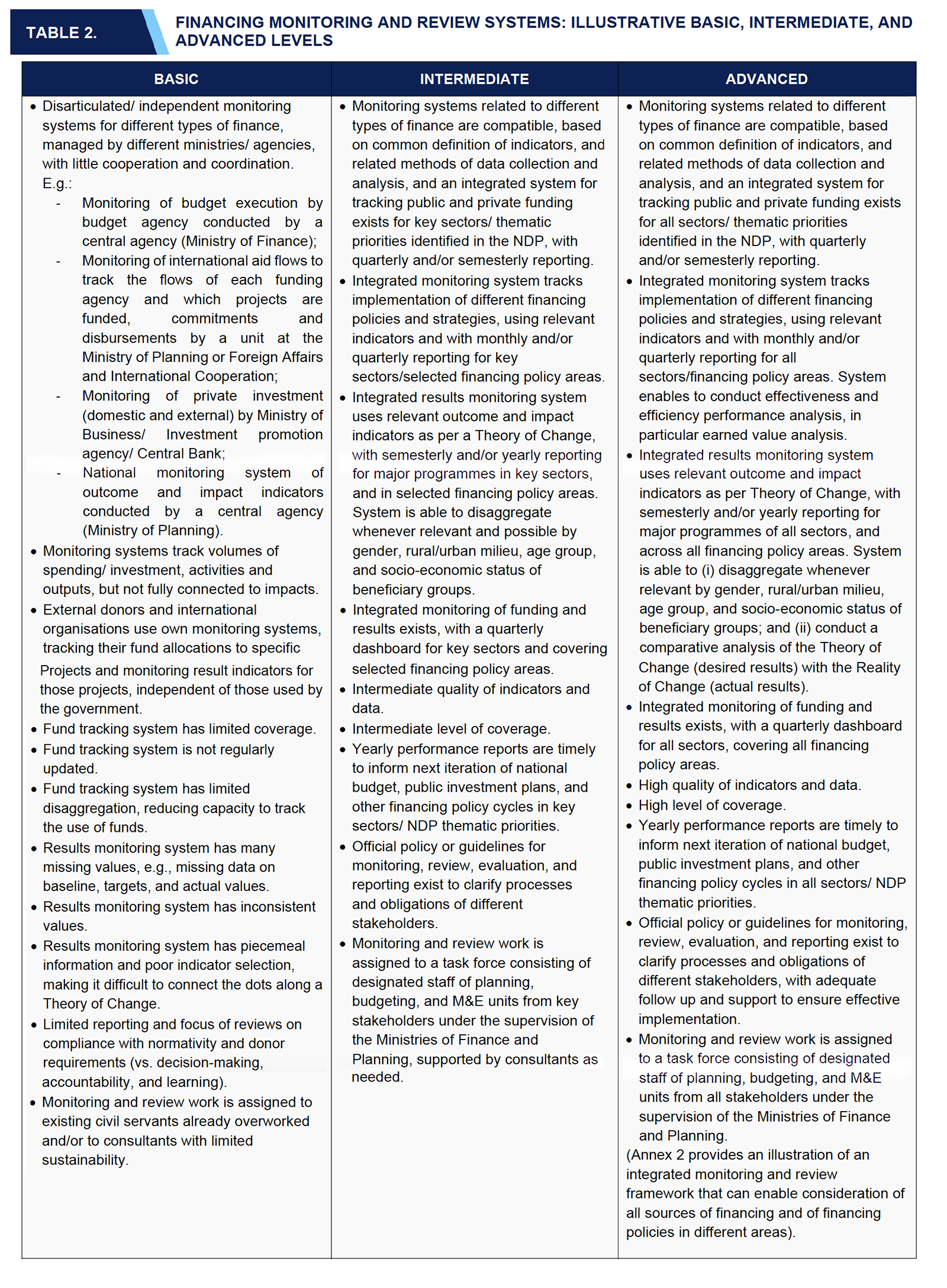
Building on the established baseline and targeted level of ambition, the second step is about taking action to strengthen existing systems, and to close any gaps, thus supporting the move along the ‘levels’ depicted in Table 2. Depending on the country baseline, capacity and needs, such action may be taken in one or more of the following areas:
Action area 1: Institutionalise INFF monitoring and review by progressively raising the level of ambition, putting in place or reinforcing the right incentives, establishing an effective monitoring and review function within government, and ensuring participatory approaches to shift the culture around monitoring and review from seeing it as a compliance exercise to focusing on accountability and learning;
Action area 2: Enhance integration of existing systems by ensuring they are compatible and able to feed the necessary information into key INFF indicators of performance, reviewing data and information currently being collected, and implementing pilots where changes or new systems may be required;
Action area 3: Link to ongoing or planned data/ statistical reform processes and make use of needs-based IT solutions by reviewing ongoing statistical capacity development efforts, articulating a data development plan (if needed), and considering the potential role of business intelligence software to facilitate collection, processing, use and storage of data in ways that can serve country needs;
Action area 4: Leverage insight and lessons learned from peers and regional/ global knowledge-sharing platforms by making use of existing knowledge on what may or may not work, with a focus on INFF-specific initiatives and platforms.
Overall, these actions involve strengthening both institutional arrangements and technical systems, which can help countries overcome common challenges in establishing effective monitoring and review systems (see Box 7). While every country is different, a pragmatic approach, taking advantage of monitoring and review ‘champions’ where they exist and of existing knowledge and current practices as a starting point, can help ensure sustainable improvements over time. Success factors in implementing these actions will depend on the specific country context, including institutional and cultural specificities; however, the following have been proven to be applicable in most situations:
A common understanding of the purpose and value of INFF monitoring and review. Monitoring and review requires additional time and efforts from government officials and professionals who may be already overwhelmed by current tasks. Unless everyone involved can clearly see the value of INFF monitoring and review, success and sustainability of the exercise will be at risk.
Buy-in from key stakeholders. Buy-in at both the political level and at senior technical levels within government can ensure that adequate resources (financial, time, human) are dedicated to monitoring and review activities from the inception and on an ongoing basis thereafter to support effective implementation and positive policy feedback loops. In addition, buy-in from non-state actors, including the private sector, is needed to ensure effective collaboration and sharing of relevant data and information.
Realism on what constitutes ‘good enough’ data. It is easy to be discouraged by the inadequate coverage and reliability of available data. However, once the idea that data quality is a relative concept is understood and internalised, a more realistic approach of trying to obtain ‘good enough’ data can be taken, which can form the basis for additional, gradual improvements over time, while at the same time providing the evidence needed to begin adequate monitoring and review.
Dissemination of intermediate results. Producing and sharing presentations, videos, infographics, and other similar materials that showcase results related to different aspects of the INFF can help demonstrate its value added and broaden buy-in. For example, disseminating success stories on what improvements in data and monitoring systems helped accomplish can help expand monitoring and review efforts beyond pilots where champions already exist.
Процесс разработки INFF в Тиморе-Лешти (который продолжается) начался с оценки финансирования развития (DFA).FN 9 Оценка DFA была инициирована министром финансов в 2017 году для анализа текущих и будущих тенденций финансирования в условиях значительного, но ограниченного богатства природных ресурсов, а также для разработки рекомендаций по созданию более комплексного подхода к финансированию устойчивого развития.
С самого начала процесс DFA направлялся правительственной группой по надзору, которая объединила ключевых политиков из разных ведомств (включая тех, кто отвечает за реализацию и мониторинг Стратегического плана развития и за ключевые области политики государственного и частного финансирования) и основных внешних партнеров. В нее вошли Отдел планирования, мониторинга и оценки Аппарата премьер-министра (который возглавлял процесс), Министерство финансов, Министерство планирования и стратегических инвестиций, Министерство торговли, промышленности и окружающей среды, а также Торгово-промышленная палата, ПРООН и ЕС. Группа по надзору была новым органом, созданным специально для процесса DFA. Через министра финансов она отчитывалась перед Советом министров — высшим межведомственным органом страны. ПРООН и ЕС также организовали неформальные встречи между присутствующими в стране партнерами по развитию для обеспечения координации действий международного сообщества в ответ на выводы и рекомендации DFA.
Интеграция процесса DFA в работу группы по надзору под руководством национальных органов помогла обеспечить соответствие полученных аналитических данных и рекомендаций местному контексту, а также их «присвоение» соответствующими национальными институтами. Активное участие представителей правительства на уровне старших должностных лиц также помогло сохранить динамику процесса в условиях меняющейся политической ситуации вокруг парламентских выборов 2017 и 2018 годов. Особое внимание было уделено наращиванию потенциала институтов, участвующих в техническом процессе, в отношении функций INFF, что способствовало дальнейшему внедрению концепций INFF и обеспечению потенциала для их продвижения внутри национальных институтов.
После завершения DFA было достигнуто предварительное соглашение о передаче надзора за INFF Межминистерскому совету. Этот совет, возглавляемый премьер-министром, был создан в 2019 году для контроля и продвижения программы управления государственными финансами и других реформ государственного управления. Межминистерский совет будет осуществлять надзор, координацию и согласование подхода правительства к финансированию по широкому спектру областей политики государственного и частного финансирования, объединяя эти повестки дня. Он будет руководить процессом операционализации INFF, направляя реализацию Дорожной карты INFF и других инициатив по реформированию INFF, включая создание комплексной стратегии финансирования.
Weak political will and institutional capacity, including for example, frequent staff turnover and different ministries/ agencies being at different stages in terms of capacity;
Resistance to enhancing transparency and accountability;
Difficulties in inter-ministerial cooperation and coordination, compounding issues related to being able to monitor and review cross-sectoral impacts;
Fragmentation of monitoring and review due to lack of coherent policy framework and supporting systems, and proliferation of indicators and reporting requirements;
Limited respect for principles of harmonization and use of national systems by donors;
Limited data availability and access, and limited resources to effectively use existing data;
Poor statistical systems and capacity;
Risk of over reliance on digital (often remote) data collection tools, which can lead to over-collection of data with little capacity for analysis, and the loss of contextual understanding obtained from physical visits and face-to-face interviews;
Excessive focus on accountability and control and too little on learning;
Lack of follow up on findings from reviews and evaluations, reducing usefulness of the exercises.
Source: Martin, F. P. and A-M. Fernandez (2021). Background Orientation Paper prepared for FSDO/UNDESA on INFF building block 3: Monitoring and Review (M&R) Analytical Framework and Country Case Studies, IDEA, Canada; CEPA strategy guidance note on Monitoring and evaluation systems, February 2021; World Bank (2004) A Handbook for Development Practitioners: Ten Steps to a Results-Based Monitoring and Evaluation System
Ограниченность потенциала и ресурсов
Международное сообщество может помочь в решении проблем, связанных с ограниченностью потенциала и ресурсов. Во Вставке 1 изложены текущие усилия по предоставлению технической помощи и наращиванию потенциала в области INFF. Для определения дополнительных потребностей в поддержке могут быть полезны оценки готовности ключевых институтов. Например, инструментарий для самооценки парламентов, разработанный Межпарламентским союзом и ПРООН в 2016 году, содержит уроки о том, как парламенты могут подготовиться к реализации ЦУР, что также может быть полезно в контексте INFF. Обмен опытом между высшими органами аудита (ВОА) также может быть использован для наращивания потенциала в конкретных областях, имеющих отношение к INFF; например, Национальное аудиторское управление Малави и Шведское национальное аудиторское управление реализовали долгосрочную программу институционального сотрудничества для обмена знаниями и опытом в области продвижения механизмов прозрачности и участия.
Пробелы в потенциале и ресурсах будут особенно актуальны для стран, находящихся в особых ситуациях, таких как НРС, МСГМ и государства, затронутые конфликтами, где правительствам, возможно, приходится иметь дело с конкурирующими требованиями к ресурсам (например, решение текущих кризисов и укрепление систем для достижения долгосрочных результатов). Во Вставке 3 освещены некоторые общие уроки, которые помогут партнерам по развитию в оказании поддержки странам, находящимся в нестабильной ситуации.
Центр государственного управления (ЦГУ), такой как Аппарат президента, Аппарат кабинета министров или аналогичные структуры, может играть важную роль в обеспечении руководства для успешной разработки и текущего управления INFF. Он обладает полномочиями по созыву и властью влиять на политику и распределение ресурсов различных министерств и ведомств, а также опытом координации для продвижения сквозных приоритетов. Согласно Принципам эффективного управления для устойчивого развития ООН, координация со стороны ЦГУ является широко используемой стратегией для содействия сотрудничеству между институтами на всех уровнях власти и во всех секторах, включая взаимодействие с негосударственными субъектами.
Однако не во всех странах ЦГУ функционируют эффективно; страны, находящиеся в нестабильной ситуации, по своей природе часто имеют неэффективные ЦГУ. Хотя их конкретные функции и формы могут варьироваться в зависимости от страны, в литературе выделяются некоторые общие уроки для поддержки со стороны доноров в этой области:
Сосредоточьтесь на поддержке улучшений в политическом руководстве в первую очередь (например, физическая инфраструктура офисов ЦГУ и первоначальные системы поддержки, а также обучение руководителей и наращивание потенциала в соответствии с приоритетами лидеров), прежде чем переходить к содействию в укреплении функций стратегических коммуникаций, мониторинга и координации политики;
Стремитесь к постепенным изменениям, которые могут учитывать политические интересы и приоритеты, например, сначала укрепляя основной институт, лежащий в основе ЦГУ, или фокусируясь на тех, которые связаны с приоритетными областями финансирования или секторами, определенными правительством;
Используйте открывающиеся возможности, например, при формировании нового правительства;
Уделяйте пристальное внимание контексту, а также политическим и историческим процессам, в рамках которых могли развиваться центры государственного управления (ЦГУ), избегая импортированных моделей и поддерживая решения, разработанные на местном уровне. (Информационная панель INFF содержит сведения о различных механизмах, которые страны в разных ситуациях использовали для обеспечения руководства, необходимого для успешной реализации INFF).
Project, programme, or policy culture: compliments and encouragement for those who ask questions and innovate, giving relatively high status to monitoring and review among staff
Performance appraisal processes: equal focus on staff capacity to learn and innovate, rather than just on reaching quantitative targets
Showing the use of monitoring and review data: making the data explicit and interesting by displaying them
Feedback: telling data collectors, information providers, and others involved in the process how these data were used (analysed), and what it contributed toward.
Disincentives that can hinder quality monitoring and review:
Using the monitoring and review unit as the place to park demoted or unqualified staff
Not making clear how data will be or were used
Chastising those who innovate within the project boundaries or those who make mistakes
Focusing performance appraisals only on activities undertaken (outputs)
Frequent rotation of staff to different posts
Staff feeling isolated or helpless in terms of their contribution being recognised toward achieving identified objectives (‘line of sight’ issue)
Unconstructive attitudes toward what constitutes participation or toward primary stakeholder groups.
Source: Boxes 10.3 and 10.4 in World Bank (2004) A Handbook for Development Practitioners: Ten Steps to a Results-Based Monitoring and Evaluation System
По мере того как страны стремятся совершенствовать институты и процессы для расширения доступа к знаниям и точкам зрения (Рисунок 4), возникают следующие общие проблемы:
Рассогласованность приоритетов, отсутствие интереса или возможностей для участия в комплексных подходах (что приводит к усилению ведомственной разобщенности между участниками/секторами);
Превращение многосторонних форумов в лоббистские площадки, что создает риск коррупции и захвата власти элитами или корпорациями, если некоторые участники способны оказывать непропорционально большое влияние;
The elaboration of working-level monitoring and review guidelines (e.g., Monitoring for Results Handbook by the Department of Budget and Management of the Philippines);
Недоверие к правительству;
Forging alliances at all levels of government (e.g., between the Ministries of Finance and/or Planning, and line ministries, as well as between central and subnational governments) and with, and among, non-state actors, can be a powerful way of creating the necessary buy-in to institutionalise monitoring and review and enhance related processes and practices.
In many contexts, monitoring and review is seen as a compliance exercise, without sufficient focus on accountability and learning. Ensuring participatory, inclusive approaches to budgeting and broader financing policy making can help shift the culture and attitude. Guidance on Building Block 4 Governance and Coordination (Section 5.2) lays out ways in which participation of all relevant stakeholders can be enhanced to strengthen accountability of public and private finance providers in the country (such as through dedicated agencies or units that ensure systematic dialogue between stakeholders, consultative committees or fora, networks, open government initiatives and citizen budgets). Country experiences with such participatory approaches highlight the importance of: i) significant technical skills and overall capacity of intermediary civic groups who analyse, track and evaluate different stages of the budget process (or other financing policy areas being considered); ii) a conducive political environment in the form of free and able media, information disclosure laws, and political will to make government systems more open; iii) institutionalized processes for participation at all stages of the policy cycle, and for disclosure of key data and information by all relevant stakeholders (including private finance providers).
В Армении организации гражданского общества вовлечены в бюджетный процесс с общей целью укрепления связи между бюджетными предложениями министерств и реальными потребностями на местах. Организации гражданского общества участвовали в слушаниях по бюджету совместно с государственными министерствами в течение ряда лет. Этот процесс был формализован для среднесрочной программы расходов на 2020–2022 годы. Премьер-министр поручил всем государственным министерствам проводить общественные обсуждения своих бюджетных предложений и смет расходов с участием соответствующих организаций гражданского общества. Государственные органы обязаны отчитываться о результатах обсуждений с организациями гражданского общества, включая обоснования, учитывающие мнения и рекомендации этих организаций. Доступно государственное финансирование для организации общественных слушаний, которые должны быть проведены до того, как государственные министерства представят свои бюджетные запросы в Министерство финансов.
Action Area 2: Enhance integration of existing systems
Специализированные агентства или постоянные структуры также могут создаваться для содействия постоянному и активному участию заинтересованных сторон. Например, в Чили есть специализированное агентство для обеспечения систематического государственно-частного диалога по приоритетам в области изменения климата (см. Таблицу 3 и подробнее во Вставке 5), а в Министерстве финансов Сьерра-Леоне действует постоянный офис для содействия участию гражданского общества в ежегодном бюджетном процессе (подробнее во Вставке 6). Такие институциональные механизмы также могут способствовать повышению доверия к правительству.
Чилийское Агентство по устойчивому развитию и изменению климата — это государственно-частный орган, отвечающий за продвижение экологически чистого производства в стране. Оно работает с 1997 года, используя систематический государственно-частный диалог для формирования четкого общего стратегического видения чистого производства. Этот диалог помог укрепить доверие и преодолеть первоначальный скептицизм со стороны многих компаний, опасавшихся роста издержек в своих производственных процессах.
Орган находится в ведении Министерства экономики, но имеет структуру управления, охватывающую как государственных, так и частных субъектов. Совет директоров возглавляет министр экономики, в него входят пять представителей правительства, а также пять представителей корпоративного сектора, профсоюзов и сектора малого и среднего бизнеса. В работе участвуют исполнительный директор и региональные секретариаты по всем географическим регионам.
Платформа диалога сосредоточена на достижении консенсуса и разработке инноваций, поддерживающих чистое производство в стране таким образом, чтобы это приносило пользу частным компаниям и способствовало достижению национальных целей Чили в области устойчивого развития. Первые дискуссии на платформе были посвящены согласованию ключевых концепций и определений. С тех пор она эволюционировала, став площадкой для обмена знаниями о наилучших доступных методах и поддержки разработки инструментов и подходов, способствующих чистому производству. Наиболее примечательно, что платформа диалога легла в основу разработки соглашений о чистом производстве (CPA) в стране. CPA — это формальные добровольные соглашения между целым сектором бизнеса, отдельными компаниями и правительством. Они применяют методы чистого производства посредством конкретных целей и действий, которые должны быть предприняты в рамках сектора и компании (или группы компаний) в течение определенного периода времени. Фирмы, участвующие в CPA, имеют доступ к ряду видов финансовой поддержки со стороны государства для таких услуг, как отраслевая диагностика, специализированная техническая помощь, а также распространение передового опыта и технологий. По завершении CPA и после проведения итогового аудита компании могут получить сертификат соответствия или знак CPA.
CPA стали широко используемым инструментом, внесшим важный вклад в достижение целей Чили в области устойчивого развития. Было подписано 153 соглашения CPA в 37 секторах и подсекторах, охватывающих более 8 000 частных компаний и более 13 000 производственных объектов. 70% из них приходятся на сельскохозяйственный сектор, за которым следуют обрабатывающая промышленность и гостиничный бизнес. Большинство CPA (72%) заключено с микро- и малыми предприятиями. По оценкам, завершенные CPA позволили сократить выбросы CO2 на более 0,5 млн тонн CO₂, сноска 11 что является важным вкладом в сокращение общих национальных выбросов, которые оцениваются в 86 млн тонн CO₂ за 2018 год. Компании также получили финансовую выгоду, например, за счет экономии потребления энергии и воды, при этом экономическая выгода оценивается в более 280 млн долларов США. Компании также отмечают, что CPA способствовали улучшению отношений с местными сообществами, в которых они работают.
Where there are gaps in existing systems and/or additional systems need to be established, government officials could start with pilots in sectors and/or financing policy areas where champions can be identified (and interest in testing exists), as a way of learning what may work and what may not, and of demonstrating the feasibility of enhanced systems FN 9.Box 11 illustrates the case of Guyana, where efforts to enhance monitoring and review of government finance started from specific ministries before being rolled out across central government.
Following a demand-led approach is important to ensure sustainability and a higher likelihood of success and learning. Progressive expansion of scope and depth can then be more easily pursued as successes from pilots are demonstrated and buy-in is broadened as a result. A balance between perfection, practicality and sustainability should always be pursued, when selecting pilots and when expanding efforts beyond them. For example, relying on consultants to conduct pilots and set up systems for data collection and analysis may yield to results that cannot be extended or adopted in other sectors/ areas, given common issues related to data availability and human resource capacities in the public sector. Relying on available human resources and data systems, investing in capacity building, and adopting a stepwise and pragmatic perspective, though longer-term, can ensure more sustainable improvements and expansions in monitoring and review practices.
Совместный консультативный комитет государственного и частного секторов (JPPSCC) был создан в 1981 году в качестве центральной платформы для государственно-частного диалога. Он объединяет ключевые министерства с рядом ассоциаций частного сектора, представляющих различные отрасли: банковское дело, туризм, рынки капитала, торговлю, промышленность и судоходство. Опираясь на национальную структуру, было создано несколько региональных JPPSCC для объединения местных администраций и бизнеса.
Также существуют комитеты для вовлечения представителей частного сектора в процесс принятия решений по конкретным вопросам. Например, в сфере государственных закупок под эгидой Национального совета по реформам был создан многосторонний комитет после проведения оценки коррупционных рисков. Комитету было поручено разработать Закон о государственных закупках и управлении поставками 2017 года. В состав комитета вошли государственные лица, ответственные за разработку политики, а также представители ассоциаций частного сектора, организаций гражданского общества и научных кругов. Примечательно, что это также привело к внедрению пактов о добросовестности, призванных повысить стандарты в крупных инфраструктурных проектах, снизить уровень коррупции и способствовать более честной конкуренции.
Action Area 3: Link to ongoing or planned data/ statistical reform processes and make use of needs-based IT solutions
Консультативные комитеты или форумы — это еще один, менее формальный способ обеспечения постоянного диалога и участия различных заинтересованных сторон как внутри правительства, так и за его пределами. Например, в Финляндии министерские политические форумы регулярно собирают министров для совместного рассмотрения конкретных направлений политики. В Таиланде государственно-частные консультативные комитеты используются для поощрения участия частного сектора в политических процессах как на центральном, так и на местном уровне, включая привлечение таких органов, как бизнес-форумы, советы или торгово-промышленные палаты (см. Вставку 7). Национальные форумы по сотрудничеству в целях развития являются распространенным способом объединения партнеров по развитию и государственных структур для обмена знаниями, повышения согласованности сотрудничества с национальной политикой и продвижения переговоров. Согласно обзору Форума по сотрудничеству в целях развития (DCF) за 2020 год, в 2019/2020 годах национальные форумы по сотрудничеству в целях развития действовали в 37 странах. В некоторых случаях дискуссии по вопросам сотрудничества в целях развития включаются в отраслевые рабочие группы или другие форумы, например, форумы частного сектора. Регулярные общественные слушания, дискуссии и встречи также могут рассматриваться как площадки для взаимодействия с гражданским обществом.
В 2018 году высший орган финансового контроля Филиппин, Комиссия по аудиту, провела аудит готовности к реализации ЦУР. В ходе него было изучено, как правительство адаптировало Повестку дня на период до 2030 года к национальному контексту, какие средства реализации ЦУР были выбраны, а также механизмы мониторинга, последующей деятельности, обзора и отчетности о прогрессе в достижении ЦУР.
Аудит оценил подход правительства к финансированию ЦУР и существующие механизмы реализации Филиппинского плана развития (PDP). Было установлено, что существуют различные финансовые политики для выявления и обеспечения ресурсов для реализации PDP и ЦУР, однако общая стратегия финансирования еще не была разработана. Было отмечено, что это препятствует усилиям правительства по эффективной и согласованной мобилизации государственных и частных ресурсов.
По итогам аудита было рекомендовано разработать такую стратегию финансирования, а также внести изменения в институциональные структуры, например, создать подкомитет по ЦУР в составе Комитета по координации бюджетного развития правительства и внедрить маркировку бюджетных программ, способствующих достижению ЦУР. В то время как процесс разработки ИНФФ продолжается, другие рекомендации, такие как создание подкомитета по ЦУР, уже были выполнены.
Ряд процессов и инструментов, таких как экспертные обзоры и инициативы «Открытое правительство», бюджеты для граждан, коды ЦУР в бюджете и системы оценки результатов сотрудничества в целях развития, могут помочь повысить прозрачность и подотчетность в интересах согласованности политики финансирования. Глобальные принципы высокого уровня могут служить ориентиром для таких усилий (см. вставку 9).
Глобальная инициатива по фискальной прозрачности опубликовала список десяти принципов высокого уровня в области фискальной прозрачности:
Action Area 4: Leverage insight and lessons learned from peers and regional/ global knowledge-sharing platforms
To support actions related to all the above-mentioned areas and facilitate the shift toward more effective and efficient INFF monitoring and review, governments should leverage insight and knowledge from others who have already gone through the process. While each country situation will be different, implementation experiences from peers can provide valuable lessons on what may or may not work, and on how to best overcome specific challenges.
Since 2019, when the first pioneer countries begun their INFF journeys, INFFs are now being considered and implemented in over 70 countries worldwide. The INFF Knowledge Platform provides a digital space where country experiences and lessons from early implementers can be shared and accessed, and represents the basis of a growing community of practice. The INFF Dashboard tracks operationalization of INFFs at the national, regional and global levels. It contains data and information related to the ways in which different countries across the globe have started to design and implement various elements of INFFs, ranging from the inception phase to each of the four INFF building blocks. With specific reference to the monitoring and review building block, it provides the status of the monitoring system for the country’s financing strategy, its key elements (such as public financial management information systems and private sector monitoring initiatives), and information on any planned or ongoing capacity building support for monitoring and review. The UN system is also working to foster regional and global exchanges, ensuring peer learning at the regional level and facilitating knowledge transfer at the global level.
Приложение: Контрольный список для самооценки управления
Приверженность и лидерство
Доступ к знаниям и мнениям
Buy-in
Roles and responsibilities
Координация







.png)