1. 概述
政策制定者在为可持续发展融资时面临诸多障碍和挑战。融资需求、环境和风险评估确定了融资政策的挑战、机遇和风险。它们指出了潜在的市场、政策或能力约束可能阻碍有效动员和使用资金的领域。约束条件诊断通过借鉴当地机构和参与者的经验与知识以及相关工具,深化了对障碍及其根本原因的分析,从而有助于明确融资战略的重点,特别是优先排序的方向。
其目的是回答以下问题:
哪些经济、政策、体制和能力方面的约束在消除后会对国家可持续发展优先事项的融资产生最大影响(即“约束性”瓶颈)?
有哪些工具可用于识别这些约束?
政策制定者应优先解决哪些约束,例如在融资战略的背景下?
解决或消除已识别的约束在多大程度上可行(且可取)?
约束条件可能涉及经济或市场因素、政策或监管缺口,或体制与能力限制。通常,各国面临着多种此类约束。同时解决所有问题既不可能也不切实际,必须设定优先事项。虽然这种优先排序最终是一个政治过程,但约束条件分析可以帮助支持更明智的决策。
下文概述的约束条件分析方法建议与当地专家和从业者进行结构化对话,并使用相关的分析工具。它指导识别那些对当地环境和前提条件敏感、考虑了权衡取舍和潜在问题驱动因素,并能对可持续发展融资能力产生最大影响的融资政策优先事项。因此,它有助于在《亚的斯亚贝巴行动议程》的各个行动领域内,更高效、更有效地对政策行动和改革进行优先排序和顺序安排。
2. 约束条件诊断的价值
约束条件诊断可以帮助政策制定者:
识别当前阻碍国家有效为可持续发展提供资金的关键瓶颈;
权衡已识别瓶颈的相对重要性,并考虑解决或消除这些瓶颈的可行性,包括在涉及重要权衡取舍时的考量;
建立系统且透明的方法,为融资政策行动和改革的优先排序和顺序安排提供依据。
约束条件诊断并不要求对现有环境的所有细节有完全的了解。关键在于识别出在特定国家背景下影响巨大的扭曲因素。虽然政策制定者在日常工作中会尝试识别和解决约束,但更系统、更有针对性的方法可以挖掘出那些原本可能被忽视的约束。这也使得本质上必然涉及政治考量的优先排序过程,能够建立在更扎实的分析基础之上,并更加透明。专栏 1 强调了此类渐进式改革方法的关键特征,包括工作的迭代性质,以及依靠当地实践知识来为高度情境化的分析提供信息的重要性。
关于解决结构性约束和实施改革的正确方法,从业者和学者之间一直存在争论。近年来,舆论强烈倾向于基于具体国情、以问题为导向的实验和迭代方法(例如问题驱动的迭代适应(PDIA)方法),但这并非一贯如此。下表总结了“隐喻之争”,即全面“大推进”方法与本模块所提倡的渐进式方法之间的对比。
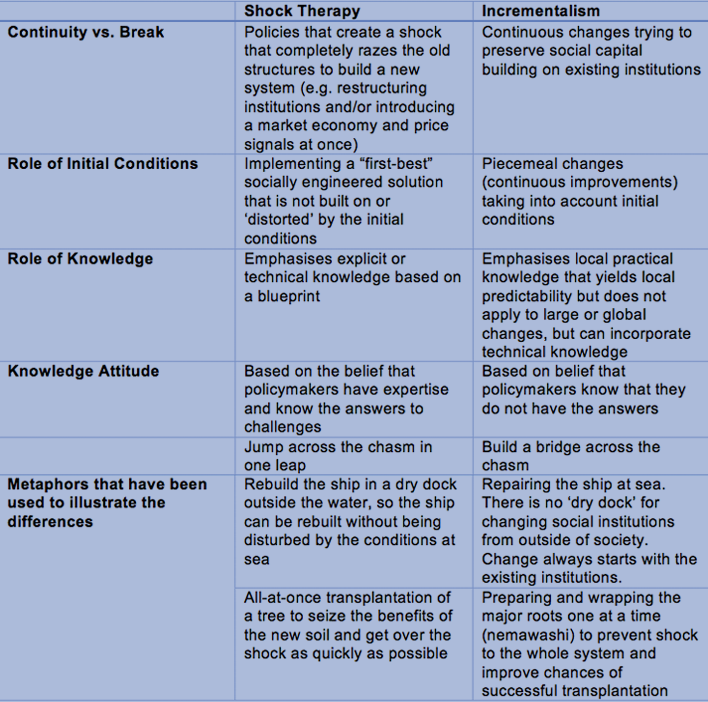
来源:Stiglitz J. 1999. Whither reform? Ten years of the transition. Pleskovic, B; Stiglitz J. Annual World Bank Conference on Development Economics 27 56 Washington, DC World Bank.
3. 范围与局限性
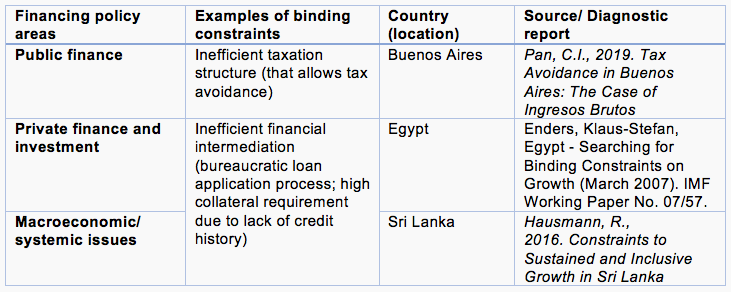
各国在为可持续发展提供资金时,往往面临多重瓶颈。这些瓶颈既涉及动员充足资金(公共和私人资金)的能力,也涉及确保融资流向与既定可持续发展优先事项有效对接的能力。在国家综合融资框架(INFF)的背景下,重点在于政府可以通过制定和实施融资战略及相关政策改革(见模块 2)直接或间接影响的障碍。相关瓶颈可能与经济或市场、政策、或体制与能力有关。表 1 基于各国层面的分析,涵盖了不同的融资政策领域。
表 1. 约束条件示例
冲击和风险的性质决定了谁最适合应对这些问题,以及可能采取的政策应对措施。通常,这里的重点是公共政策制定者,因为他们承担着为可持续发展提供融资的主要责任,并负责为包括私营部门在内的其他参与者创造有利环境。
对于某些被视为“风险系统”内内生性的冲击(例如与宏观经济政策选择、政治不稳定或制度薄弱相关的冲击),国家政策制定者可以降低(甚至消除)其发生的可能性,并减轻其负面后果(例如通过改善国内投资者的有利环境或加强宏观经济政策和监管)。
许多风险驱动因素和冲击,无论其起源是经济还是非经济的,都超出了国内参与者的控制范围,或者属于外生性(例如全球风险厌恶情绪上升、大宗商品价格突然变化、气候变化),在发展中国家尤其如此。在这些情况下,国家政府仍然可以投资于风险降低和防范(例如投资于韧性基础设施)并管理剩余风险。另一方面,降低外生性冲击的可能性通常需要全球协调一致的行动。当冲击是特质性的,或者彼此不相关时,国家政府或许能够分担剩余风险(例如在市场深度足够时通过保险和对冲);某些风险(如货币风险)从全球角度来看可能是特质性的,因此适合由多边参与者(如区域性或多边开发银行)进行分散化处理。
在一个日益互联互通的世界和复杂的全球风险格局中,许多风险是系统性的,其特征是跨领域的传染和扩散过程,导致单一事件可能引发系统崩溃。与特质性风险不同,系统性风险是无法分散的。此外,还可能存在高度的不确定性。减轻系统性风险或应对不确定性的选择更为有限,这要求对系统的整体韧性进行投资,并增强其应对不同冲击和压力的能力(例如通过加强社会保障体系,详见专栏 4)。
在国家综合融资框架(INFF)背景下进行的风险评估会考虑并评估所有这些可能的冲击(见表 1)。因此,它们为应对风险的国内政策提供了依据。它们还可以为发展伙伴和全球政策进程提供参考,旨在加强发展合作,并为可持续发展融资创造一个更具支持性的国际环境。
Limited mechanical application: the flexibility of the approach, which builds on different assessment tools, could pose a challenge to implementation. The approach requires capacity to use and combine tools, as blind standardization could lead the assessment astray.
Data availability: some binding constraints are difficult to empirically estimate. Shadow prices – monetary values assigned to unknowable costs in the absence of a functioning market - constitute the perfect example of such a shortcoming. Lack of data and lack of capacity could impede quantitative assessments of binding constraints.
Long-term identification: The binding constraint approach is most applicable for existing obstacles. It is difficult to confidently identify what constraints will become binding in the long term.
Where data, capacity or resource constraints prohibit a more structured diagnostic, a more ad hoc use of guiding questions and tools presented below can still provide valuable insights and help bring more analytical rigor to the inherently political process of financing policy prioritization and strategy development.
4. “操作指南”——实践中的风险评估
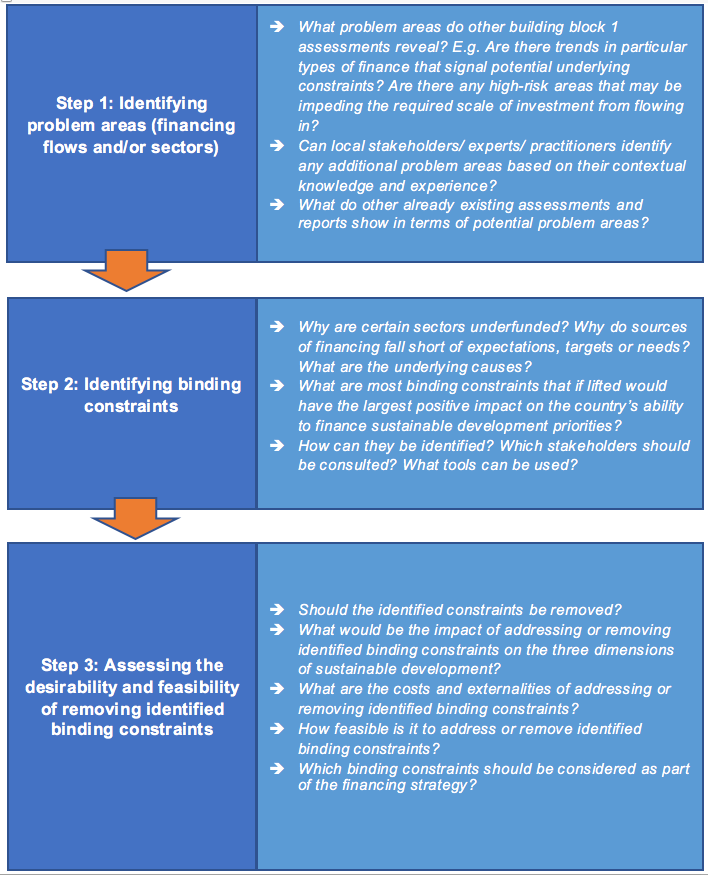
The overall aim of the binding constraints diagnostic is to identify those critical impediments that if removed would have the largest impact on the country’s ability to effectively mobilise and align the scale and types of finance required to meet its sustainable development objectives. Figure 1 summarises the suggested approach.
It starts with the identification of financing areas/ flows or sectors where potential binding constraints could exist, drawing on insight from previous building block 1 assessments (financing needs, landscape and risk assessments); the scoping and mapping of existing policies and institutions undertaken in the inception phase; FN 1 and primary sources of information including local experts and practitioners. This is followed by an analysis to identify those constraints that are most binding in each identified problem area, making use of a range of available tools and methodologies as well as in-depth dialogue with relevant experts and stakeholders. Third, the costs of removing identified constraints are assessed – not all constraints can be removed or addressed at the same time, and unintended consequences of removing identified constraints (particularly on sustainable development outcomes) must be understood. This third step involves assessing resources, time and political will required, and relevant externalities and the potential risks to sustainable development outcomes of removing identified constraints.
Figure 1. Step-by-step guidance
所建议的方法反映了在减少灾害风险、韧性以及经济/金融风险领域所形成的原则和方法。图 2 展示了各国在进行风险评估以指导 INFF 设计和实施时可以采取的步骤。这些步骤承认,不同的决策者和专家可能了解与其国家及特定政策领域相关的各类风险。因此,首先,INFF 风险评估有助于汇集这些知识 FN 4。随后,它支持决策者识别那些与其国家融资系统运作最相关的风险,并确定作为前瞻性、具备风险意识的融资战略的一部分可以采取的政策解决方案(参见构建模块 2 指南)。
专栏 1 概述了源自《仙台减少灾害风险框架》的原则,以及它们如何指导在 INFF 中有效考量风险。
What are thematic areas/ sectors in which the country has significantly underinvested relative to need, domestic targets and expectations by stakeholders, and/or peers?
In which areas of financing is there the greatest need to alter current trends, or greatest opportunity to mobilise new resources and/or sustainable development impact? Are there particular financing flows that perform poorly compared to the country’s own aspirations or peers (both in relation to volumes being mobilised and in terms of alignment with national development priorities)?
Does the country face major risks that may be hindering access to and availability of required financing? Are there gaps in its capacity to manage (or where possible reduce) them?
Once problem areas have been identified, the second step is to ask a series of why questions (e.g. why is government spending in the education sector below needs? Why are tax revenue levels low compared to set targets? Why is foreign investment poorly aligned with national sustainable development priorities? Why do women-owned MSMEs have lower-than-average access to finance?) and determine the major underlying causes, or in other words, the most binding constraints.
A structured series of dialogues and inquiry, following steps a) through e) laid out below, assesses each of the problem areas identified in Step 1 by asking questions, and gathering relevant evidence and perspectives from stakeholders to facilitate the identification of related binding constraints (Sections 4.2.1 and 4.2.2 provide examples of its application in both public and private finance problem areas). The problem areas identified in Step 1 will determine the experts and practitioners that should be consulted, as well as the most suitable tools and sources of data and evidence. For example, if problem areas are identified in particular sectors (e.g. health/ education/ agriculture/ housing/ etc.), relevant sector-specific expertise and knowledge will have to be sought. Section 4.4 lists tools and assessments available from the international community that countries can draw upon to complement local knowledge and expertise; they range from public financial management and investment assessment tools to private sector diagnostics, productive capacity and financial sector assessments.
a) Turn the problem area into a ‘why’ question to guide the exercise. For example, why is tax revenue below target levels? Why is domestic private investment lower than in peer economies? The set of plausible answers become the branches of a ‘decision-tree’ to further explore.
b) Explore and map possible answers to the ‘why’ question. By drawing on local knowledge and evidence from existing assessments (such as those listed in Section 4.4), possible reasons that may explain the problem area can be mapped, all the way down to the fundamental underlying causes, or in other words, the possible binding constraints. All possible types of binding constraints should be considered, including market-related, institutional, policy and/or capacity-related constraints. It is critical at this stage to involve the right stakeholders (relevant government and non-state actors who can provide concrete insight from the implementation level) so that no potential binding constraint is left out of the short-list, including ones that may be particularly relevant to specific segments of the population. FN4
c) Formulate a binding constraint hypothesis. One of the short-listed binding constraints is posited as a primary underlying cause of the problem.
d) Test the hypothesis. The identification of binding constraints is often a matter of judgement and not precise science, and thus relies on insights from local experts and specialists. Nonetheless, constraints that are truly binding should exhibit certain properties FN5 that can guide hypothesis testing. Quantitative analysis, where appropriate, and consultations with practitioners and institutional stakeholders can shed light on whether certain constraints are indeed binding in the specific national context:
i. Would increased supply of a constrained input have a large impact on the ‘objective function’, e.g. the price or cost of the objective? The constraint has a high price/ “shadow price”. FN 6 While “shadow prices” are not always observable, they can be signalled by market prices. For example, high real interest rates can signal that access to finance is scarce and potentially a binding constraint.
ii. Would removal of the constraint provoke a major positive impact in the problem area? Changes in the constraint would produce shifts in costs, incentives and behaviour. For example, service delivery providers in the public sector (e.g. in health or education) may be able to pinpoint those aspects of public financial management that most adversely affect them. If access to finance is the most binding constraint to domestic private investment, increased availability of credit would significantly increase investment.
iii. Do agents affected by the problem attempt to bypass or overcome the constraint? There is inefficient or costly economic behaviour in the problem areas. Agents often find alternatives to circumvent constraints, such as barter during hyperinflation or borrowing at high interest rates in the informal sector due to banks’ high collateral requirements.
iv. Do individuals, firms and institutions less reliant on the constraint perform better than others? Those not as impacted by the constraint are more likely to survive and thrive, and vice-versa. For example, in the case of access to finance being posited as a binding constraint to domestic private investment, firms in sectors that are more likely to be able to self-finance investments will be performing better than those that depend on debt and external financing.
e) Repeat c) and d) until the right binding constraint is identified. If the binding constraint posited in step c) is found not to meet properties listed in step d), an alternative hypothesis is formulated and tested until the right binding constraint related to the specific problem area is identified.
The approach is inspired by the ‘growth diagnostic’ methodology, which at its core seeks to identify a small set of key obstacles to economic growth relevant to the specific national context (instead of following international ‘best practice’ or ‘cookie-cutter’ approaches), and to strategically focus efforts and limited capacities and resources (or ‘political capital’) for policy change and reform. INFFs are broader in ambition. All dimensions of sustainable development come into play, and constraints beyond those that may be unearthed using a growth diagnostic are also relevant (e.g. public financial management and state capacity issues). As such, the approach outlined here borrows the problem-driven, decision-tree method of growth diagnostics but applies it to the broader objective of INFFs. FN7
4.2.1. Applying the approach to public finance
An illustration of how the approach may be applied to a public finance related problem area is provided in Figure 2. In 2016, the government of Costa Rica, with technical support from the UN Economic Commission for Latin America and the Caribbean (ECLAC), assessed the structural economic, social and institutional gaps of Costa Rica. The report drew attention to institutional and capacity gaps in the tax system that explained its ‘fiscal gap’, or, in other words, the structural challenges in its fiscal system to manage resource mobilization and public spending to support sustainable and inclusive development. A decision tree was developed to assess binding constraints, mapping three potential drivers of the fiscal gap: low fiscal revenue, inadequate expenditure for social and economic development, and a regressive fiscal system. The analysis concluded that low tax revenue was the main reason behind Costa Rica’s fiscal gap, and that the most binding constraint underlying such low levels of tax revenue were low income and sales tax revenues, as a result in part of high levels of tax avoidance and evasion (see Figure 2).
Figure 2. Decision tree for fiscal gap analysis of Costa Rica
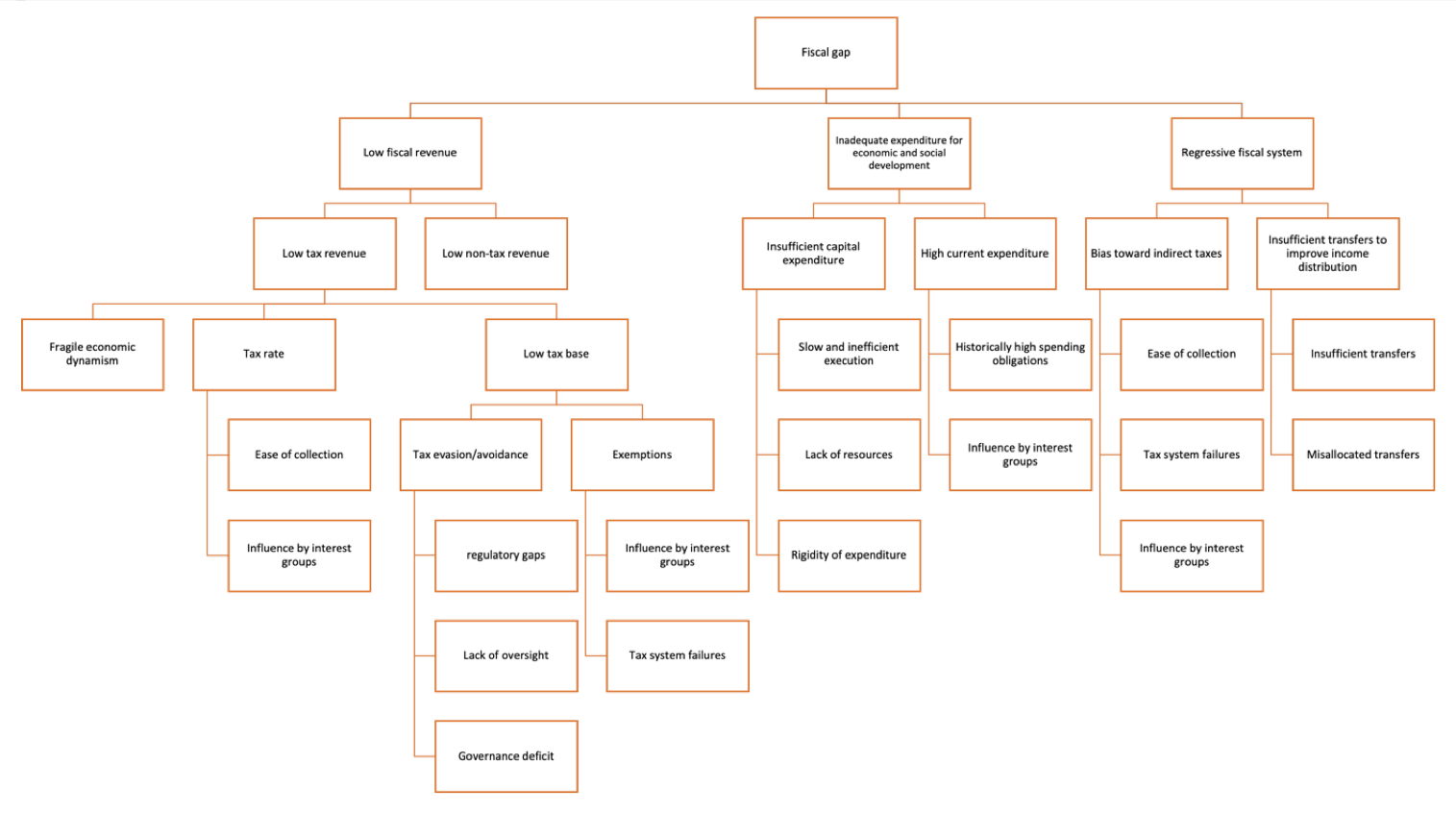
Source: UN ECLAC (2016) El enfoque de brechas estructurales: análisis del caso de Costa Rica
Any diagnosis of binding constraints in public finance can draw on (i) insight and expertise from practitioners and institutional stakeholders, and (ii) tools listed in Tables 2 and 3 as public finance or cross-cutting tools, to both develop relevant decision trees and identify the most binding constraints.
Practitioners and stakeholders. Both providers and users of public financial services may have important insights and information. For example, with regard to domestic public resources and public financial management, this would include not just budget officials in the Finance Ministry and key line ministries, but also those involved in public service delivery, who may better understand key service delivery problems impeding achievement of sustainable development priorities, and underlying bottlenecks in public financial management that cause them.
Tools and analysis by the international community. International organizations carry out targeted analysis and assessments that can inform analysis. For example, IMF Fiscal Affairs Department Technical Assistance reports provide evidence on key impediments of fiscal policy and processes at the country level. Reports on public sector balance sheets, medium-term budget frameworks and fiscal risk management can shed light on important institutional gaps that may in turn inform more detailed and in-depth analysis of potential binding constraints. Fiscal transparency diagnostics (see Fiscal Transparency Evaluations in Table 3) can be used to pinpoint key weaknesses in relation to fiscal reporting, forecasting and budgeting, risk analysis and management, and resource revenue management, which in turn can flag possible related institutional or capacity binding constraints. Public Expenditure Tracking Surveys (PETS) can inform sector-specific assessments of how public resources flow through different levels of administration and to identify specific challenges such as leakages or issues related to the deployment of human resources at the service provision level.
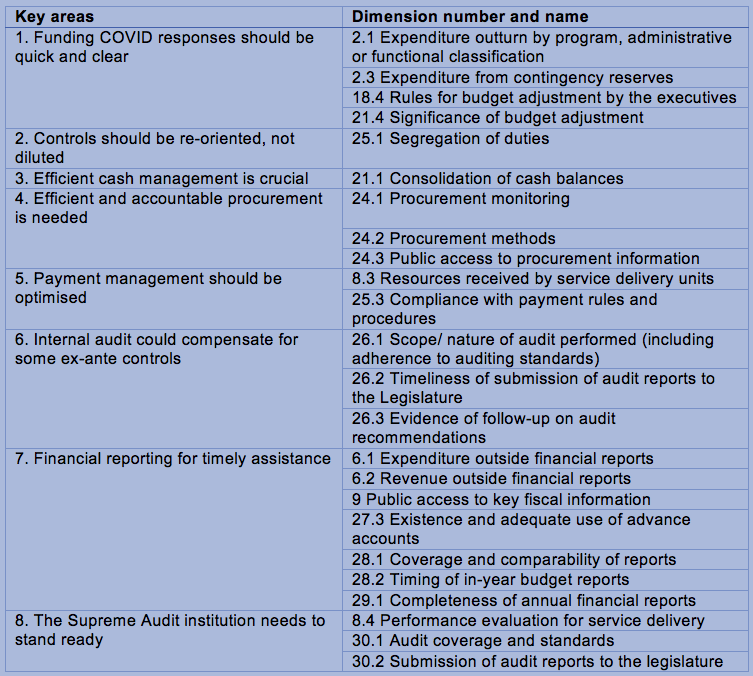
Scores from Public Expenditure and Financial Accountability (PEFA) assessments can inform the identification of both specific problem areas and underlying binding constraints in three key aspects of public financial management (PFM): aggregate fiscal discipline; strategic allocation of resources; and efficient service delivery. They are based on 31 performance indicators further disaggregated into 94 ‘dimensions’, which span 7 broad areas (or ‘pillars’) – namely: i) budget reliability; ii) transparency of public finances; iii) management of assets and liabilities; iv) policy based fiscal strategy and budgeting; v) predictability and control in budget execution; vi) accounting and reporting; and vii) external scrutiny and audit. The construction of the PEFA scoring mechanism offers multiple levels of disaggregation which can help narrow down the identification of PFM capacity binding constraints. Low-scoring pillars could be further scrutinized to identify issues at the indicator or dimension levels which could constitute binding constraints. The PEFA tool can also be used to assess governments’ capacity, and related underlying constraints, to responding to crises, such as the COVID-19 pandemic (as illustrated in Box 2).
灾害对男性和女性的影响不同。研究表明,死于自然灾害的女性多于男性,这主要是由于女性不平等的社会经济地位所致——这意味着灾害可能会加剧现有的性别不平等。在特定部门(如农业)中,男性和女性的典型角色和职责也会影响他们各自的应对能力和复原力水平。探索这种脆弱性的差异对于全面了解一个国家的风险和脆弱性状况至关重要,并将带来更有效和更具成本效益的政策行动。
在缅甸,在性别响应流程的指导下,对气旋“科门”(Cyclone Komen)对农业和农村生计的影响进行了评估。通过探索农业中的性别方面——如角色、工资、获得信贷和培训的机会、土地所有权等方面的差异,评估能够识别并解释气旋对男性和女性影响的差异。通过这样做,它支持了更有效的应对和恢复干预措施,以及能够增强男性和女性应对未来灾害能力的长期复原力措施。
来源:联合国国际减灾战略署(UNISDR)、联合国开发计划署(UNDP)和世界自然保护联盟(IUCN)(2009)《使减灾具有性别敏感性——政策和实践指南》;缅甸农业与灌溉部、畜牧、渔业与农村发展部、联合国粮农组织(FAO)和世界粮食计划署(WFP)(2015),《缅甸农业与生计洪水影响评估》
了解风险的潜在驱动因素
特定于国家的潜在风险驱动因素可以深入了解风险暴露和脆弱性的根源。识别这些因素有助于查明可能增加多种风险暴露度和脆弱性的因素。
风险驱动因素包括:
The Tax Administration Diagnostic Assessment Tool (TADAT) is a tool designed to provide an objective assessment of the strengths and weaknesses of key components of a country's tax administration with reference to nine performance outcome areas (POAs). These include: integrity of the registered taxpayer base; effective risk management; supporting voluntary compliance; timely filling of tax declarations; timely payment of taxes; accurate reporting in declarations; effective tax dispute resolution; efficient revenue management; and accountability and transparency. The assessment of the results can inform the identification of potential capacity binding constraints related to government finances, the extent of reform required, and the relative priorities for attention. It has 32 high-level indicators and 55 measured and scored dimensions. While the scoring methodology is based on PEFA, the TADAT is narrower than the PEFA and focuses solely on taxation.
The Debt Management Performance Assessment (DeMPA) highlights the strengths and weaknesses in government debt management practices. The DeMPA is also modelled after the PEFA indicators. However, it is a more detailed and comprehensive assessment of government debt management capacity than the PEFA. Each performance indicator (listed in the table below) has several dimensions, which can be used to inform steps b) and c) of the binding constraints identification approach outlined in Section 4.2 above.
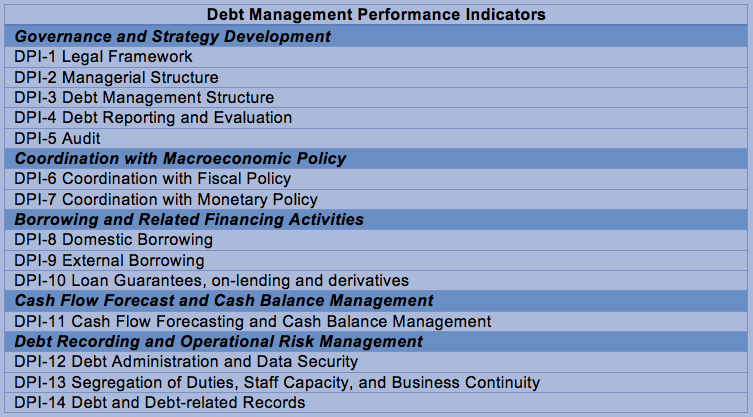
The scoring methodology assesses each dimension and assigns a score from A to D. Score C indicates that a minimum requirement for that dimension has been met. Score D means that the minimum requirement has not been achieved - requiring priority action. Score A reflects sound practice. B is between minimum requirement and sound practice.
第 4.2 节中列出的一些工具包含了关于如何识别这些潜在因素的指南。例如,信用评级机构报告通常会考虑影响主权信用度的结构性特征,如治理和政治能力以及 GDP 水平,并展示外部投资者如何看待一个国家的风险。政府间气候变化专门委员会(IPCC)发布了与可能增加各国对气候变化危害的暴露度和脆弱性的因素相关的指南。联合国国家共同分析(CCA)指南中包含的步骤可用于识别可能影响对广泛风险暴露程度的经济、环境和制度因素。
4.2.1. Applying the approach to public finance
The growth diagnostic methodology develops a decision tree to identify potential binding constraints to private investment and financing (see Figure 3). Growth diagnostics have been carried out in various countries and are used by some donors (e.g. USAID and the Millennium Challenge Corporation) in their strategic planning. Building on a simple growth modelFN8 ,the diagnostics introduce institutional and economic factors that can affect private investment in two broad categories: those stemming from the real sector (left hand side of the decision tree), and those originating from the financial sector and access to finance (right hand side of the decision tree). The methodology ‘translates’ this simple model into a ‘diagnostic decision tree’ to help policymakers isolate, define and identify specific binding constraints in their economies (be they market-related; institutional; policy-related; or related to productive capabilities). The exercise consists of moving down the decision tree following the approach and steps (a – e) outlined above. Specifically, growth diagnostics involve quantitative empirical analysis or statistical inference to test binding constraints hypotheses and identify the most binding constraint.
Figure 3. Growth diagnostic decision tree
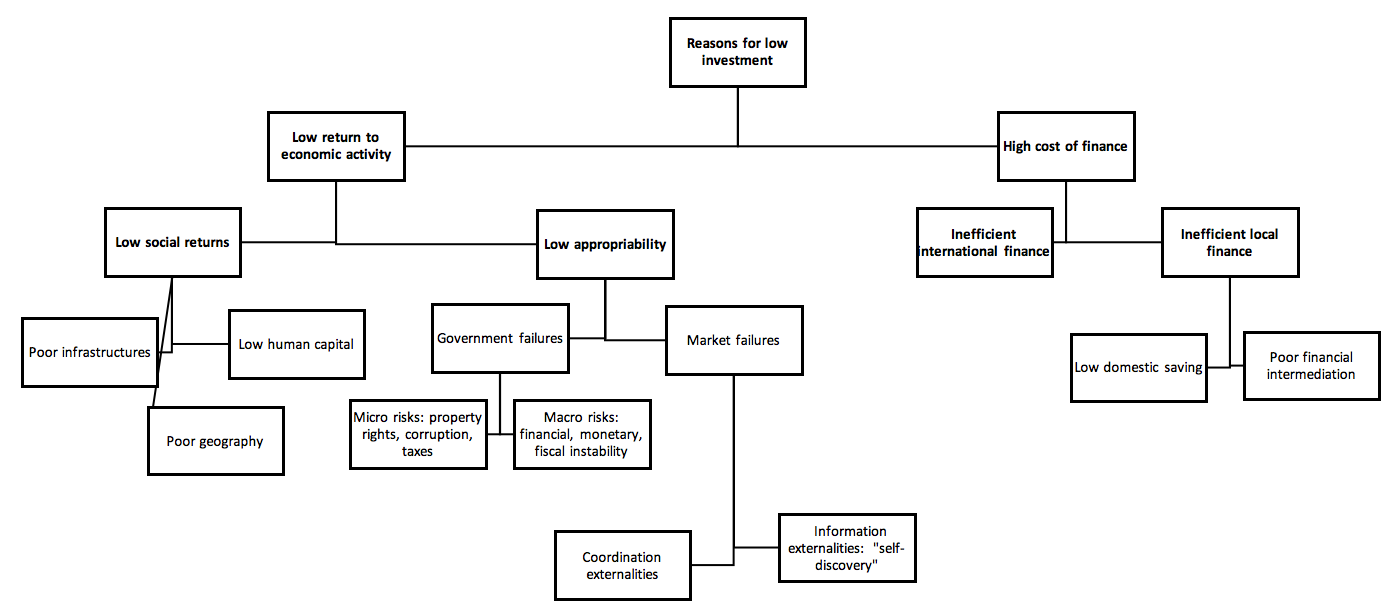
Source: Hausmann, R., Rodrik, D. & Velasco, A., 2005.
More recently, growth diagnostic decision trees have been adapted to better reflect inclusion dynamics. Figure 4 illustrates an expansion with a focus on gender. It recognises that constraints are not neutral both in relation to who is bound by them and who is able to reap the benefits when they are lifted, and thus incorporates additional gender-specific considerations at various levels. For example, in Sub-Saharan Africa, women make up over half of all entrepreneurs, yet the rate at which they borrow from formal institutions is lower compared to men; gender-specific barriers to accessing finance could thus represent potential binding constraints to private investment - such as requirements for male co-signers on female accounts, or women being asked to pay higher interest rates and being offered smaller loan sizes compared to men.
Figure 4. ‘Engendered’ growth diagnostics decision tree
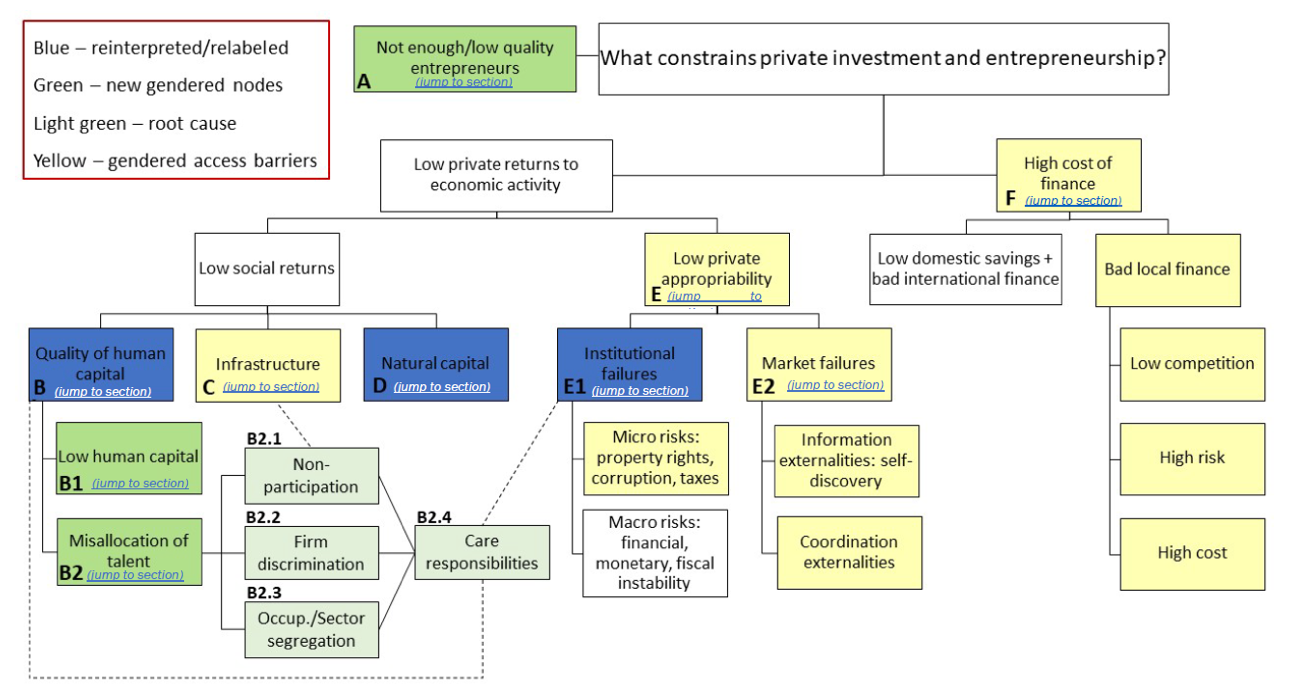
Source: Brookings (2020), The constraints that bind (or don’t) Integrating gender into economic constraints analyses, Global Economy and Development Working Paper 137
Other tools such as those listed in Section 4.4 under private finance or cross-cutting tools may be used to work down the branches of a growth diagnostic decision-tree and to formulate binding constraints hypotheses. Where a full growth diagnostic is not feasible or desirable, or when the problem area in Step 1 is different from ‘low levels of private investment’ (which is the starting point for growth diagnostics), these tools can still inform a decision tree exercise. Data and evidence from their application at the country level can complement local knowledge and expertise from relevant stakeholders. They include policy makers, ‘suppliers of finance’ or representatives of the financial system, and ‘demanders’ of finance such as representatives of firms and sector experts.
For example, IFC’s Country Private Sector Diagnostics involve analysing possible constraints to the mobilisation of both domestic and external private investment, based on a wide range of indicators (including both macroeconomic and survey data) and with the view of supporting inclusive, diversified and sustainable growth. They can help assess the state of the private sector and identify near-term opportunities for private sector engagement as well as recommendations for policy actions and reforms to mobilise private investment, taking into account spill-overs and linkages across sectors. FN9 UNCTAD’s Investment Policy Reviews identify regulatory, institutional and capacity obstacles that may be binding to foreign direct investment. UNCTAD’s Productive Capacities Index can be a useful source of data and evidence on potential issues related to private sector development, spanning across 3 main areas (productive resources, entrepreneurial capacities, and production linkages/ networks) and 8 categories (human capital; ICT; structural change; transport infrastructure; energy; natural capital; institutions; and private sector development). World Bank Enterprise Survey data can provide relevant evidence on specific constraints that firms may be facing in the country, including in relation to the business enabling environment or access to finance. The IMF’s Financial Development Index can be used in the context of growth diagnostics to pinpoint issues related to financial sector development (see Box 4). In all cases, and as further detailed in Step 3 below, identified constraints for private sector actors may of course represent important safeguards for public policy objectives, in which case they are not binding from a sustainable development perspective.
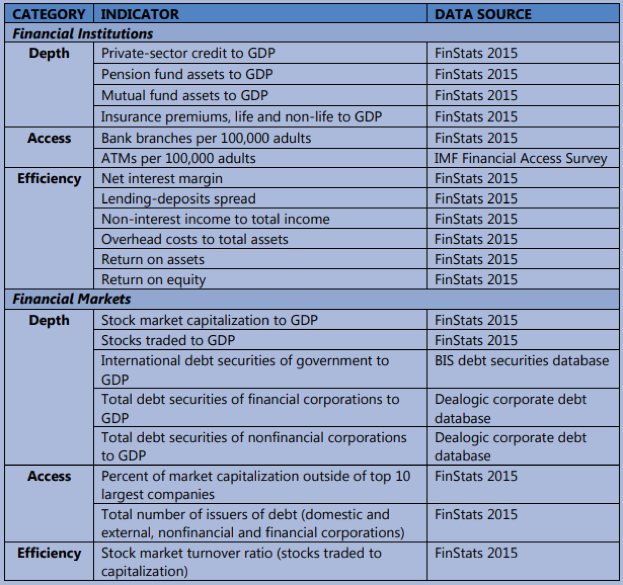
The IMF introduced the financial development index to assess countries’ financial development – an area where existing indicators do not always capture the multidimensional aspect of financial development and maturity. The IMF defines financial development as the combination of depth (size and liquidity of markets), access (ability of individuals and companies to access financial services), and efficiency (ability of institutions to provide). This index can be used to identify potential binding constraints in the financial sector when applying a growth diagnostic, and is composed of 20 indicators, as shown in the table below:
决策树(见图6示例)可以指导识别现有应对风险能力的差距,并确定政策选项和支持需求。应优先考虑风险预防和减缓措施,特别是那些针对国家特定风险驱动因素的措施(符合专栏1中的原则)。在评估系统当前的韧性时,应同时考虑制度能力差距和政策差距。
No government will be able to address all the constraints identified in Step 2. Governments will not necessarily find it desirable to remove all identified constraints either. In some cases, constraints would be not only costly to remove, but removing them might also have unintended consequences on sustainable development outcomes.
To facilitate prioritisation and sequencing of interventions, costs and externalities have to be considered. These include: the impact which removing a constraint would have on all dimensions of sustainability; the resources (time, financial, expertise and capacity) required; and the political will required to implement possible solutions. A number of considerations will come into play:
Impact on sustainable development outcomes. Lifting identified binding constraints should always result in better alignment between financing and sustainable development outcomes. It should not risk jeopardizing the achievement of such outcomes, including through the creation or reinforcement of inequalities (such as gender or income). It should also avoid other unintended consequences – e.g. rapid expansions in access to finance that may threaten macroeconomic or financial sector stability. This requires an understanding of the rationale for existing constraints, and of the potential trade-offs of removing them. For example, environmental or labour market regulations may constrain investment to a degree but are key to ensure and mainstream environmental and social standards.
Cross-area or cross-sector effects. Policy makers may decide to prioritize binding constraints that if lifted would have a positive effect across multiple financing areas or sectors. For example, addressing misalignments between government and donor systems for financial management would be beneficial across sectors of intervention and improve coordination between domestic and external sources of public finance.
Immediate impact and political momentum. Some constraints may take longer to fix than others; policy makers may choose to prioritize ‘quick-fixes’ that have large visible impacts first, and build on such successes to address longer-term issues.
Ease of remediation. This refers to identifying those constraints which can be addressed more easily without the need for complex coordination across sectors and/or stakeholders, and without the need for new or additional institutional arrangements. For example, untimely fund releases by the Ministry of Finance would be easier to address than human capital or capacity gaps across the public sector. Policy makers may also identify which binding constraints are less costly to remove, both in terms of resources and political will, as well as those that require international support or action to fix.
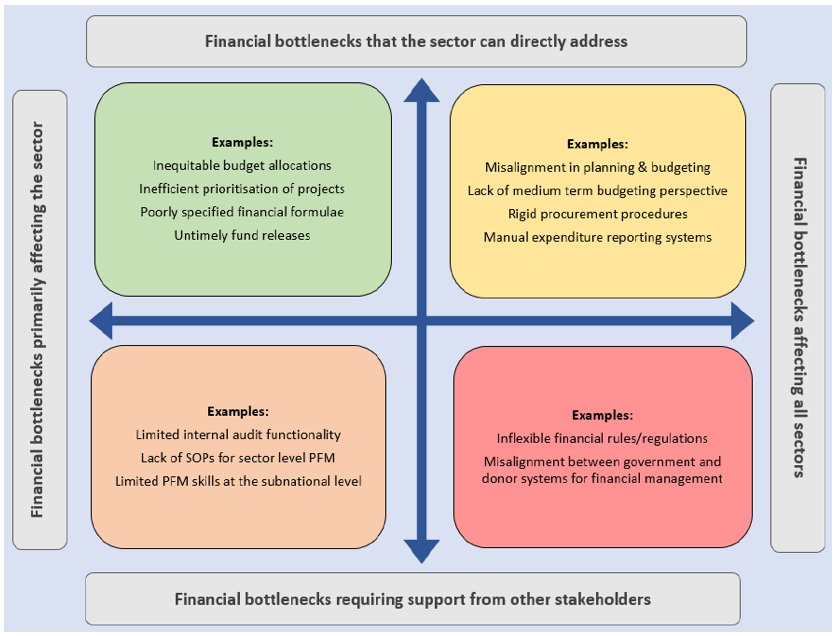
A matrix such as the one illustrated in Figure 5 can help to bring together these last two criteria. Constraints that require addressing would be organized in four quadrants: according to whether they are relevant to one or multiple sectors/ financing areas, and according to whether they can be fixed within one sector/ institution or require intervention from multiple entities.
图6. 指导识别潜在政策解决方案的决策树
Source: Oxford Policy Management (2020), Problem-driven diagnostics: the case for financial bottleneck analysis
本节概述了国际社会现有的风险评估工具和方法。为方便查阅,这些工具按其涵盖的风险领域(经济风险、非经济风险及跨领域风险)进行了分类。
现有经济风险评估工具示例
国际货币基金组织(IMF)的国家风险评估方法被用于新兴市场(EM)和低收入国家(LIC)的风险评估。这些方法基于通用的信号提取机制,通过为关键指标设定阈值并汇总超出阈值的指标,来评估国家面临的危机脆弱性。根据国家具体情况,会采用不同的模型。例如,针对新兴市场,使用“突然停止”模型,该模型根据资本流动定义危机,并强调外部指标;针对部分低收入国家,则使用“粮食减产脆弱性指数”,该指数考察自然灾害与粮食减产、粮食依赖度及治理指标之间的关联。
The World Bank Systematic Country Diagnostic is used to identify key challenges/ constraints and opportunities for accelerating progress toward development objectives that are consistent with the World Bank’s twin goals of ending absolute poverty and boosting shared prosperity, and to inform priorities for World Bank country engagement.
The UNDP Development Finance Assessment (DFA) provides data and analysis relevant to all INFF building blocks. With specific reference to binding constraints analysis, DFA findings can be used to inform the identification of problem areas and underlying constraints, especially in relation to institutional and capacity related issues.
Public finance tools
IMF Fiscal Affairs Department technical assistance reports
IMF Fiscal Affairs Department technical assistance reports are tailored and targeted reports that carefully assess impediments in diverse and institutionally complex areas, such as public sector balance sheets, medium-term budget frameworks and fiscal risk management. Can provide context-specific evidence for the identification of institutional gaps and weaknesses related to public finance problem areas.
The IMF Fiscal Transparency Evaluations (FTEs) tool identifies gaps in fiscal management and accountability, specifically in the areas of fiscal reporting, forecasting and budgeting, fiscal risk management, and resource revenue management.
The IMF Tax Administration Diagnostic Assessment Tool (TADAT) assesses strengths and weaknesses of key components of a country’s tax administration with reference to nine performance outcome areas. More detail in Box 3.
This online modular tool is designed to serve as a guide for systematic and comprehensive tax policy assessments. It covers all major taxes and can help inform tax policy reforms.
The IMF Expenditure Assessment Tool assesses government spending efficiency by benchmarking spending levels and composition against comparator countries. It may be used to inform the identification of problem areas (in Step 1 of the suggested approach set out above).
Initiated in 2001 by seven international development partners, including the EU, IMF, WB and four bilateral governments, this tool provides a standard methodology for PFM diagnostic assessments. More detail in Section 4.2.1.
A wide range of tools covering broad PFM diagnostics, diagnostics focusing on individual PFM elements, and tools related to fiduciary risk and/or the use of country systems.
This tool analyses the allocation of public resources and assesses the efficiency and effectiveness of public spending (both recurrent and capital), including by looking at the level and composition of public expenditures, and the structures of governance and functioning of public institutions. Has been applied at the sector level in many developing countries.
The World Bank Public Expenditure Tracking Survey (PETS) is used to track the flow of public resources from the highest levels of government to frontline service providers. It can support better understanding of funding flows in specific sectors and the identification of leakages and challenges related to resource deployment all the way to the service delivery level.
This comprehensive framework tool is used to assess infrastructure governance. It evaluates the procedures, tools, decision-making and monitoring processes used by governments to provide infrastructure assets and services to the public; and helps identify reform priorities and practical steps for their implementation.
The World Bank Debt Management Performance Assessment (DeMPA) assesses strengths and weaknesses in government’s debt management practices in the country. More detail in Box 3.
This tool assesses the sustainability of public and external debt (of market-access countries and low-income countries) and supports the identification of vulnerabilities in the debt structure or policy framework.
The UN Development Cooperation Forum (DCF) Surveys is used to monitor progress in mutual accountability and transparency of development cooperation. Can help to identify gaps or weaknesses in effectiveness of development cooperation in responding countries, especially around five key enablers.
Led by developing countries, this tool focuses on progress in implementing effective development cooperation at the country, regional and global levels, and provides evidence on both achievements and gaps in the implementation of relevant commitments by development partners.
现有非经济风险评估工具示例
This decision tree methodology supports the determination of binding constraints to economic growth and private investment through a differential diagnosis of observed symptoms or signals.
This tool assesses opportunities for and constraints to private sector led growth. Each diagnostic includes an assessment of the state of the private sector, identification of near-term opportunities for private sector engagement and recommendations of policy actions and reforms to mobilise private investment.
The UNCTAD Productive Capacities Index (PCI) collects country-level data on productive resources, entrepreneurial capabilities and production linkages, with the view of assessing the capacity of countries to produce goods and services that can contribute to growth and development. It can be used to explore problem areas and binding constraints related to private investment and private sector development.
The IMF Financial Development Index assesses countries’ financial sector development looking at indicators of depth, access, and efficiency. More detail in Box 4.
The IMF Financial Sector Assessment Programme (FSAP) assesses the stability and soundness of the financial sector and its potential contribution to growth and development. It does this by examining several aspects of the financial sector which could inform the nature and location of potential binding constraints (e.g. obstacles to competitiveness and efficiency; financial inclusion issues; central banks’ capacity; issues around the deepening of domestic capital markets; quality of bank and non-bank supervision and financial market oversight).
The UNCTAD Investment Policy Reviews tool provides an objective evaluation of a country’s legal, regulatory, and institutional framework for FDI, in order to attract increased volumes and to maximise benefits from it.
A repository of country diagnostics undertaken by ADB, AfDB, DFID, EBRD, EIB, IFC, MCC, OECD, Sida, UNDP and WB. These include systematic country diagnostics and private sector diagnostics (mentioned above); MCC constraints analysis; and others.
现有跨领域风险评估工具示例
This tool expands the growth diagnostic approach to better reflect inclusion dynamics, particularly gender, by highlighting areas where a gendered lens may yield different results in assessing constraints to economic growth and private investment.
The PEFA Supplementary Framework for Assessing Gender Responsive Public Financial Management is modified to assess strengths and weaknesses of PFM systems in responding to differentiated needs of men and women, as well as sub-groups within these categories. Based on nine indicators distributed across the budget cycle and can be applied both at the national and sub-national level.
The PEFA for health tool assess strengths and weaknesses of PFM systems in the health sector specifically. (See Table 3 for general PEFA tool).
This tool is typically used by World Bank country teams to identify key challenges and opportunities regarding PFM arrangements in country health systems; can provide information on specific bottlenecks.
The WHO PFM and health financing process guide provides a framework to assess budgeting practices and financial rules in health financing compared to international best practice; and guides policy makers in diagnosing misalignments and obstacles in achieving financing objectives in the sector with a view of supporting the formulation of reform plans.
This tool collects information on key institutional characteristics of national health budgeting procedures for comparative purposes. It can inform the identification of related problem areas in Step 1 of the binding constraints approach.
6. 经验教训
实施全面国家风险评估的关键经验教训强调了以下需求:
获得高层政治支持和政府领导,以确保评估工作具有足够的范围(包括时间跨度和需考虑的不同情景范围),拥有充足的资源(例如通过对专业知识、人员和时间的保障性承诺),并确保评估结果能够转化为实际行动(克服短期主义相关的问题);
在流程初期就与国家相关部门进行协调与接触,以增强各方认同并确保对后续政策行动的支持;
与发展伙伴协调,避免各自为政的评估;
稳健的规划阶段,包括回顾以往风险评估的经验教训,以确保吸取过去成功与失败的经验,避免重蹈覆辙。







.png)