1. 简要概述
The overarching goal of integrated national financing frameworks (INFFs) is to help countries raise resources for their national sustainable development objectives by increasing the coherence of financing policies – both across sectors and financing policy areas (horizontal synergies) and between financing and sustainable development priorities (vertical synergies). Enhancing this coherence depends on effective ‘INFF governance’, i.e. the institutions and processes responsible for the formulation and implementation of financing policies.
What are the drivers of coherence? Three lessons consistently emerge from experiences in countries that have been developing INFFs, including the INFF ‘pioneer’ countries FN 1, and from similar processes.
First, is the need for strong political commitment, complemented by leadership at senior technical levels. This will ensure ownership, broad-based buy-in and participation, adequate resourcing of INFF-related efforts, and help sustain momentum around the INFF across political cycles.
Second, access to knowledge and incorporating the perspectives of relevant stakeholders increases coherence and enables policy makers to incorporate the broad set of needs, priorities and interests necessary for an integrated approach to financing. This helps to ensure that policy makers have the data and information they need to make decisions, and that finance providers – both public and private – can be held to account.
Third, coordination among different stakeholders, both within government and between state and non-state actors, maximises synergies in the design and implementation of financing policies in different areas and at different levels, minimises risk, avoids the creation of new risk, and effectively addresses trade-offs or contradictions in policy mixes.
The institutions and processes that will facilitate the fulfilment of these functions will differ across countries, as governance arrangements tend to be deeply embedded in the history, traditions and politics of a society. In addition, coherence is a moving target, meaning that the appropriate level of ambition may change over time, and will differ depending on country contexts and what may (or may not) be already in place (see Section 5).
This guidance aims to support national stakeholders to better determine which institutions and processes can best enhance coherence and support successful implementation of INFFs, including how existing institutions can be strengthened, and where new structures may be needed (i.e., where there may be gaps), mindful of country contexts and capacities.
2. The value of governance and coordination
The institutional arrangements that support operationalization and management of an INFF are key drivers of its overall effectiveness. They determine the ability of an INFF to deliver a coherent, well-prioritised approach to financing national sustainable development that promotes inclusivity, sustainability, and resilience.
More specifically, robust governance and coordination can help countries:
Establish and maintain the political backing and leadership required for the successful implementation of INFFs;
Ensure country ownership and allow national governments to remain firmly in the driver seat of developing and implementing their financing strategies;
Strengthen intra-governmental collaboration in the formulation and implementation of financing policies across different areas (e.g., public finance, private finance and investment, macroeconomic issues), both within central government and between central and local governments;
Facilitate participation of, and generate buy-in from, all relevant state and non-state stakeholders, by ensuring that they are involved in all stages of the policymaking and implementation process;
Strengthen coordination with development partners around nationally identified financing priorities or issues;
Enhance integration and coherence across different financing policy areas (including development cooperation and private finance and investment), with a view to ensure that: consequences of financing policies outside the specific policy area, particularly for sustainable development outcomes, are considered; the creation of new risk is avoided; synergies are taken into account; trade-offs are managed; and duplication of effort is avoided;
Overcome silos in existing approaches to estimating financing needs, identifying financing opportunities and challenges, and in designing and implementing financing policies in different areas.
3. Scope
The specific form of governance arrangements – i.e., relevant institutions FN 2 and processes FN 3 – will vary across contexts. However, their functions will be common, in line with the fundamental purpose of INFFs – i.e., raising resources by increasing the coherence of financing policies.
The idea of coherent policymaking is not new: it has been addressed in public administration for decades, mostly under the concept of ‘coordination’, and in connection to development cooperation, as 'policy coherence for sustainable development'. Broadly, it can be defined as policymaking that systematically considers the pursuit of multiple policy goals in a coordinated way, minimising trade-offs and contradictions, and maximising synergies. In the context of INFFs, coherent policymaking means considering policy goals across different financing policy areas (such as public finance, including development cooperation, private finance and investment, and macro-fiscal issues) and coherent financing of different sectoral priorities, addressing potential trade-offs and exploiting opportunities for win-wins.
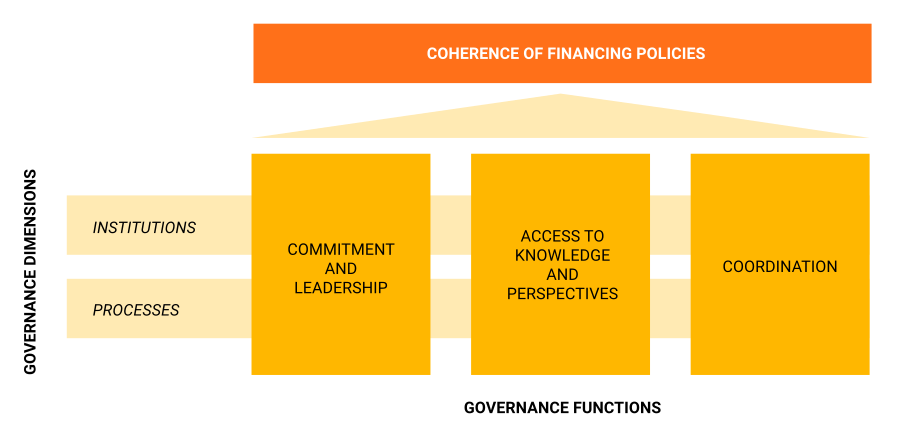
As illustrated in Figure 1, three key functions will enable coherence:
Commitment and leadership from the top (both at the political and technical level) provides the overall vision and direction around which increased coherence can be pursued, and ensures ownership, broad-based buy-in and participation, sustained momentum over time (including across political cycles), and adequate resourcing of INFF-related efforts and activities.
Access to knowledge and perspectives ensures that policy makers have the information they need to make decisions on the suitability of different financing policy options and their impact on sustainable development; that finance providers (public, private, national, international) can be held to account; and that the broad set of needs, priorities and interests that affect the success of INFFs are recognised and addressed.
Coordination among different stakeholders (both within and beyond government) maximises synergies, reduces duplication, enables the management of trade-offs, and minimises contradictions or inconsistencies in the formulation and implementation of financing policies in different areas. Coordination among stakeholders is also critical to facilitate a coherent approach to financing that reduces risk across economic, social, and environmental systems and ensures that financing priorities and policies in one area do not create risk in another.
Figure 1. Dimensions and functions of INFF governance
The appropriate level of ambition will depend on a country’s circumstances, resources and capacities. Efforts should build on existing institutions and processes:
INFFs are about financing sustainable development priorities; related governance arrangements should build on what is already in place to guide and support SDG implementation, e.g., institutions and processes linked to national strategies and plans, and those used to undertake Voluntary National Reviews (VNR) for SDG implementation or to develop Nationally Determined Contributions (NDCs) to the UNFCCC;
INFFs consider all sources of finance; related governance arrangements should build on and bring together the institutions and processes that govern the national budget and broader public financial management (such as budget preparation, procurement, and public investment), the alignment of private finance and investment (e.g. public-private dialogue platforms), development cooperation (e.g. development partners coordination forums), and broader economic governance arrangements (see Section 4 for more comprehensive overview of relevant institutions and processes);
INFFs are about financing at the country level; related governance arrangements are primarily about national institutions and processes that can guide and support financing policy making and implementation (see Section 4). However, it is important to contextualise them within regional and global processes. Policy decisions or positions taken by countries in international negotiations should not undermine national efforts; similarly, domestic financing policy decisions should reflect international agreements. INFFs should thus draw on and include institutions and actors that lead such engagements FN 4.
4. 相关利益相关方与流程
No single institution can develop and sustain an INFF on its own, nor can a successful INFF rely on a single process to be implemented and managed over time. Integrated financing of national priorities requires bringing together a variety of stakeholders (both from within and outside government) and needs to be supported by a variety of processes (to guide policy formulation and implementation across different areas and facilitate information sharing and coordination among different stakeholders).
与所有 INFF 组件一样,政府在监测和审查方面发挥着核心作用。来自政治和高级技术层面的领导对于确保监测和审查工作的可持续性和有效性至关重要(见第 5.2 节列出的成功因素)。通常,这种领导力来自财政部和/或规划部,或总统或总理办公室。根据 INFF 的重点,它也可能存在于专门机构或主管部门内。
如果设有 INFF 监督委员会,它很可能是负责监督适当监测和审查系统设计与实施的机构,并负责在内部(如向政府高级领导层)和公开(如在年度预算声明前后)报告 INFF 融资战略的实施进展。
政府内外的各种利益相关方将参与不同层面和不同部门的融资工作监测。在考虑 INFF 监测和审查系统时,应寻求他们的经验和专业知识。
图 5 展示了典型的数据生产者和使用者。根据 INFF 的范围,监测和审查的角色可能会有所不同。例如,如果一个国家的 INFF 侧重于特定部门或特定融资政策领域,专门机构的作用可能会变得更加核心。如果 INFF 侧重于地方层面(如加纳),那么地方机构的作用将更加突出。
图 5. INFF 监测和审查中的典型角色与职责
在 INFF 监测和审查方面,各国无需从零开始。现有的监测系统、流程和框架应作为起点。这些系统可以根据需要进行加强或扩展,并在 INFF 内实现更好的协调与一致。与关于治理与协调的构建模块 4 类似,总体目标应是精简工作,而不是取代或重复现有系统,除非存在需要填补的空白。
表 1 展示了 INFF 监测和审查的潜在切入点,以及通常参与建立和维护适当系统的相关利益相关方。它还包含了指向有用资源和工具的链接,这些资源和工具可以阐明现有的系统和流程。(构建模块 1.2 融资格局评估中的表 2 提供了数据来源概述,可为跟踪融资规模提供参考)。
总体而言,如果已建立完善的国家发展计划实施监测系统,它可以作为 INFF 监测和审查的起点。同样,如果存在围绕国家自愿审查(VNR)的既定流程,也应予以考虑(见专栏 4)。数据和统计战略及改革进程可能构成另一个切入点(详见第 5.2 节,行动领域 3)。针对不同类型融资的现有监测系统(如国家预算跟踪系统和审查流程,或私营部门融资报告倡议)可以作为构建更全面系统的切入点。正如第 5 节进一步阐述的那样,此类系统的全面性将根据国家背景而有所不同,这反映了 INFF 作为指导融资政策改革更好规划和实施的长期、渐进式方法的本质。
关于公共财政,监测系统涉及政府财政(收入、支出和投资)以及发展合作。公共财政管理信息系统(PFMIS)是政府视角的典型起点。越来越多的国家已经建立了性别、气候或可持续发展目标预算标记或编码系统,或者正在将其作为 INFF 的一部分进行开发。政府财政监测系统通常围绕年度预算流程开发,并报告与各预算机构内项目预期在年度或多年基础上实现的目标相关的规模和绩效指标数据。在预算规划和编制阶段,作为提交给财政部材料的一部分,预算机构可能需要阐述其将如何为既定的国家优先事项或可持续发展目标做出贡献,和/或将其项目与具体目标挂钩。政府收入数据可以以不同程度的细分进行收集,并可能就累进性或不平等问题进行审查。在税收支出监测方面也存在不同的做法,用于揭示通过税收优惠放弃的收入。针对重大投资项目(例如,由参与重大基础设施项目的部委和其他实体阐述)和国有企业,也可能存在具体的监测框架,这些企业可能有专门的系统来跟踪其投资和对国家发展的贡献。
发展合作和融资的监测系统基于国家援助信息系统和国家成果框架。根据2018 年全球发展有效性伙伴关系(GPEDC)监测数据,96% 的发展中国家拥有一个或多个用于收集发展合作信息的信息管理系统。虽然此类信息的质量各不相同,但通常包括关于财务承诺、计划和实际拨付的数据,在某些情况下还包括关于预期和已实现成果的数据。然而,来自2020 年发展合作论坛(DCF)调查的数据显示,不到一半的发展合作信息系统跟踪成果、预算外资金流、资金缺口和附加条件。只有略多于一半的受访国家(56%)建立了用于审查国际发展合作绩效和成果的成果框架。至关重要的是,在 INFF 背景下,只有 36% 的案例中,国家和发展伙伴使用相同或大部分重叠的成果框架,这意味着存在多个并行系统。此外,根据 GPEDC 数据,只有一半来自发展伙伴项目的成果指标是使用国家统计和监测系统进行监测的。
关于私营部门融资,监测和报告格局更加分散。在融资流向规模方面,国民账户和相关的中央银行报告是常见的系统。此外,相关主管部门(如商业部或地方发展部)可能拥有收集和报告国内投资数据的系统,包括与地方层面中小企业作用相关的数据。除了规模之外,决策者还需要关于私营企业和投资对经济、环境和社会问题影响的数据和信息,以评估私营部门对可持续发展目标的贡献。尽管许多倡议和创新正在进行中,但关于此方面的有意义的数据和信息仍然匮乏,而 INFF 为在国家层面增强这些日益丰富的信息的连贯性并将其纳入融资决策过程提供了一个平台。
例如,一些国家(如菲律宾和哥伦比亚)存在由私营部门或政府主导的系统,用于整合企业对可持续发展优先事项贡献的数据,并且越来越多的公司(主要是大型上市公司)发布可持续发展报告。然而,发布的信息往往在公司之间或时间跨度上不可比,且倾向于关注定性指标而非定量数据。由于可持续发展报告在很大程度上仍然是自愿的,公司会选择他们想要传达的问题。此外,与可持续发展相关的信息通常处于付费墙之后,不属于公共领域;决策者可以通过建立企业可持续发展数据的开放存储库来改变这一点,从而提高透明度。公司也需要调整其内部系统,以跟踪和报告环境和社会问题的数据。对于资源有限的小型公司来说,这可能尤其具有挑战性。尽管如此,自愿性可持续发展报告可以作为一个起点。政府可以通过就用于企业披露的统一指标和衡量标准达成一致(包括在全球层面)来提高其相关性。处于不同发展背景的国家(如欧盟、中国、墨西哥、南非、蒙古、孟加拉国)已经制定或正在制定分类法,这些分类法可以加强对私营企业和融资规模及影响的报告。2021 年成立的二十国集团(G20)可持续金融工作组(SFWG)也致力于改善企业可持续发展披露,并促进各国在可持续分类法方面的方法的兼容性和一致性。INFF 流程有助于将这些国家和国际努力与公共财政分类系统联系起来考虑。
National and sectoral planning, including with regard to COVID-19 response and recovery;
Medium-term planning, including the development and implementation of medium-term revenue and expenditure strategies;
The annual government budget;
Fiscal decentralisation, public financial management (PMF) reforms and other financing-related reforms;
Designing or approving major public investment projects, such as infrastructure;
Designing or amending development cooperation policies or strategies;
Designing or amending private sector development strategies and investment promotion strategies.
国家自愿审查(VNR)是对国家和/或地方层面可持续发展目标实施进展的定期审查。它们为各国政府提供了反思国家优先事项与可持续发展目标一致性的机会,并据此确定目标和指标的优先顺序。其目的是促进经验分享,包括成功因素、挑战和经验教训,以加强相关政策和机构,并增强多方利益相关方的支持与伙伴关系。在 INFF 与可持续发展目标行动计划和战略挂钩的国家,VNR 流程与 INFF 监测和审查尤为相关。
一方面,如第 4.2 节所述,在 VNR 准备和交付过程中可能已有的流程和治理安排,将为 INFF 监测和审查提供切入点(例如,不同利益相关方共享信息的参与式论坛、数据收集系统等)。另一方面,通过 INFF 监测和审查收集的数据和信息可以帮助各国在 VNR 中报告实施手段。例如,关于不同类型融资规模和分配的数据可以揭示融资缺口阻碍进展的领域;关于 INFF 实施中哪些有效、哪些无效的信息,有助于突出具体的治理挑战和能力限制。(更新后的 VNR 指南详细阐述了 INFF 的其他方面(如融资战略)如何用于为可持续发展目标实施手段的报告提供信息)。
5. “操作指南”——监测与审查实践
关于治理与协调的构建模块 4 概述了支撑透明度和问责制的机构与流程,这些机构与流程能够支持政府内外利益相关方充分获取相关知识和信息。本节重点关注此类机构和流程为提供必要数据和信息并实现其应用所需的系统。
图 6. 分步指南
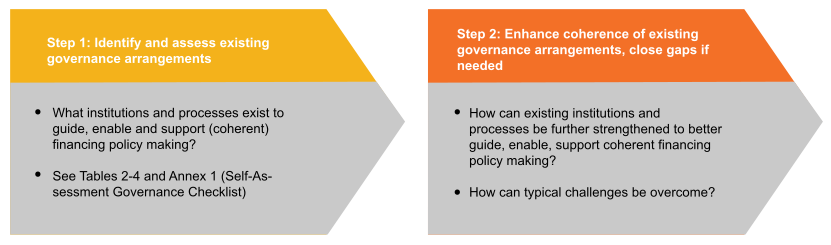
第一步是识别所有相关系统,即国内政府和非政府利益相关方用于监测和审查融资流向及其影响、融资政策与战略实施情况,以及第 3.2 节所列关键要素纳入程度的系统。第 4.2 节概述了各国可能已建立的相关系统和流程。以下问题(也以清单形式包含在附录 1 中)有助于进一步指导识别工作:
Commitment and leadership
为了便于说明,表 2 FN 4 展示了与上述领域相关的监测与审查系统发展的三个典型阶段:基础级、中级和高级。各国在系统不同要素上的发展阶段可能各不相同;本图示旨在帮助各国在INFF背景下,确定提升系统水平的适当目标。现有的 法律、政治和组织因素 将决定进展的“有利环境”及其可持续性。在建立基准时,应将这些因素纳入评估范围。以下问题可为这项工作提供指导: FN 5
共识:
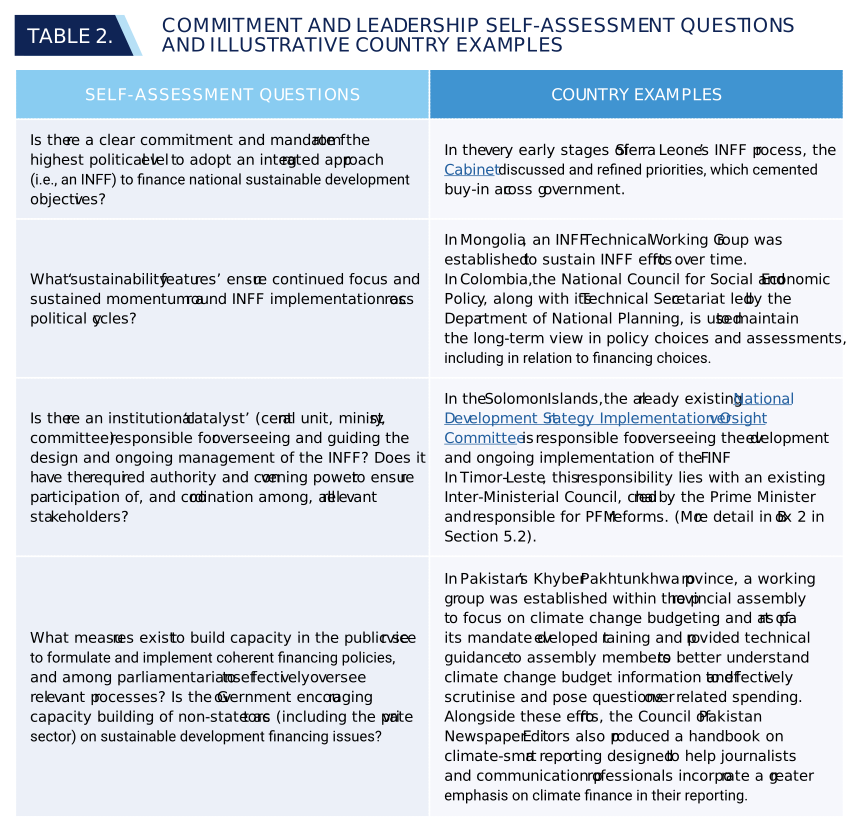
Table 2. Commitment and leadership self-assessment questions and illustrative country examples
Access to knowledge and perspectives
Sharing of information and participatory approaches are fundamental to facilitate engagement and coherent action by different stakeholders (both within and outside government). In the first instance, the commitment to develop and implement an INFF and its added value need to be clearly articulated to all relevant stakeholders – from different parts of government, parliaments and other public entities, to development partners, private business and investors, and civil society at the local, national and international level. Second, a broad set of needs, interests and perspectives has to be taken into account – underlining the importance of dialogue as part of the INFF process.
Existing dialogue platforms and engagement mechanisms often do not focus on financing issues; embarking on an INFF represents an opportunity to widen the scope of such arrangements. It is also an opportunity to identify, assess and streamline existing governance arrangements related to transparency and accountability, so that they can support generation of, and facilitate access to, relevant data and information; and hold all finance providers (public, private, national, international) to account with regard to their commitments and alignment with national sustainable development priorities.
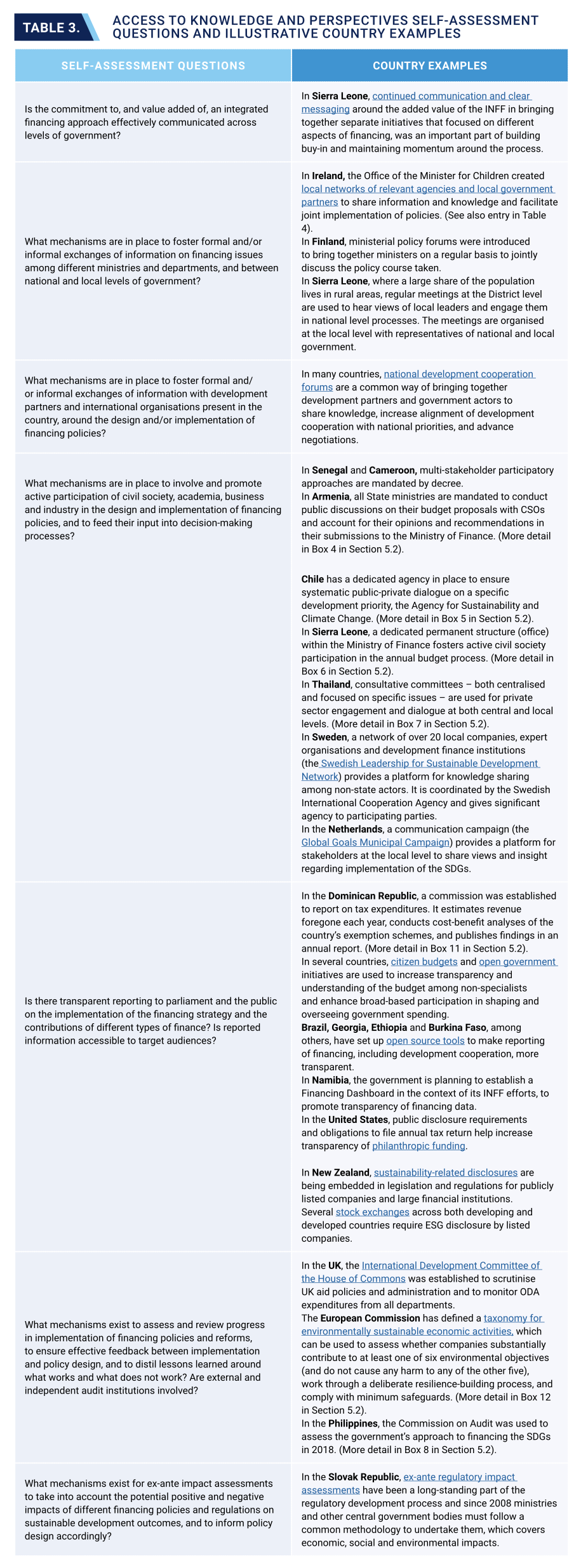
Table 3. Access to knowledge and perspectives self-assessment questions and illustrative country examples
Coordination
Enhancing coherence of financing policies rests on the ability of different stakeholders to work together. In many contexts, policy areas are treated as distinct, with trade-offs left unaddressed and synergies unexploited. Different finance providers (public, private, national, international) are often not aligned in their allocation and investment decision-making.
INFFs aim to enhance coherence and integration in the resourcing of national sustainable development objectives and thus require intra-governmental coordination as well as collaboration and alignment with, and among, non-state actors, especially development partners and the private sector. Better coordination can overcome policy silos, enhance joint planning, reduce duplication of efforts, increase efficiencies, lead to better management of risks, trade-offs and inconsistencies in the formulation and implementation of financing policies.
INFFs represent an opportunity for governments to identify, assess and streamline existing coordination structures and mechanisms, with the view of minimising their proliferation and maximising their efficiency and effectiveness. The ultimate aim is to facilitate a holistic approach to financing policy formulation and implementation, coordinating all relevant processes (see list in Section 4.2).
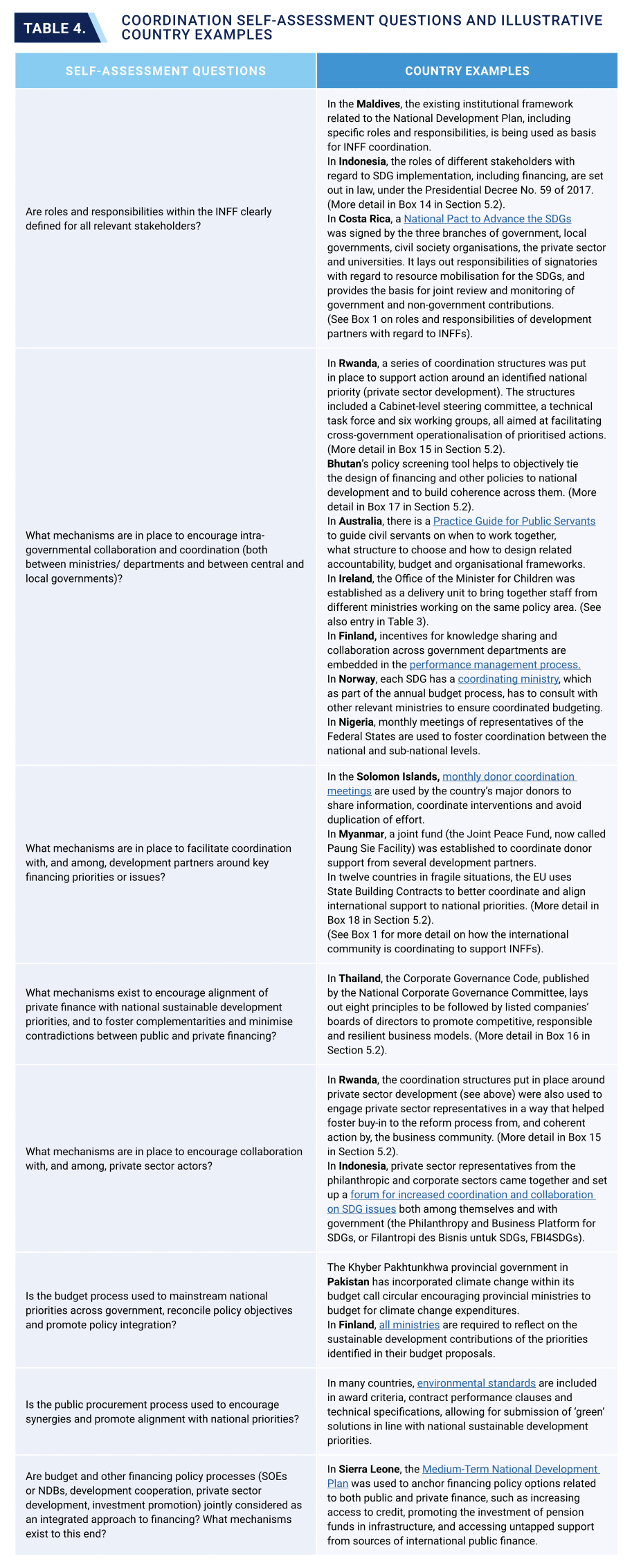
Table 4. Coordination self-assessment questions and illustrative country examples
Enhancing coherence is a moving target. FN 6 The appropriate level of ambition will depend on country circumstances, on available technical capacity and resources, and on the specific objectives identified in the country’s financing strategy (see Building Block 2 Financing Strategy). Formulation and implementation of the national budget and broader public financial management (PFM) will often be the starting point. In many countries, separate governance arrangements will also be in place for financing policies, such as development cooperation or investment promotion strategies. Depending on this baseline (established in Step 1), priority may be given to strengthening the institutions and processes related to domestic public finance first, and on better linking these to existing aid coordination and investment efforts, or to the financing of particular thematic priorities or sectors, with the view of encouraging a more comprehensive approach over time. FN 7
The sections below provide an overview of the typical challenges to enhancing coherence, in relation to (i) commitment and leadership, (ii) access to knowledge and perspectives, and (iii) coordination, and guidance on how to overcome them, based on good practices and lessons from country experiences.
Commitment and leadership
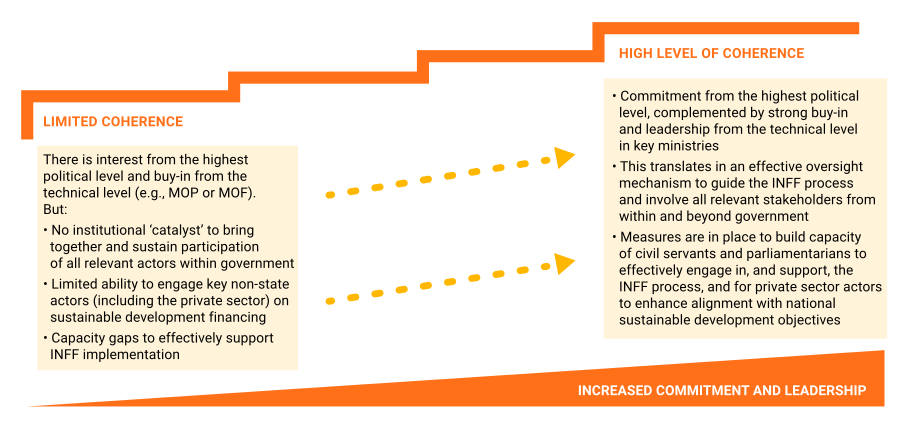
Figure 3 provides a stylized example of different levels of commitment and leadership. Typical challenges to ensuring commitment and leadership to support high levels of coherence include:
Reluctance from the political level to engage and/or difficulty to sustain commitment over time;
Lack of buy-in from key ministries/ departments and potential rivalry between finance and planning ministries/ departments;
Weak centres of government (especially in contexts of political instability, conflict or other protracted crises) as well as broader capacity gaps and resource limitations.
Below lays out steps to address them, and relevant country examples, focusing on:
Sustaining interest and buy-in (e.g., identifying right level of engagement, finding an institutional home); and
Addressing capacity gaps (role of development partners).
表2. 融资监测和审查系统:基础、中级和高级水平示意
Sustained interest and buy-in
To sustain interest and buy-in, countries have taken different approaches FN 8. In Sierra Leone, for example, initial interest in the INFF concept came from the Ministry of Planning and Economic Development, which, with close involvement of the Ministry of Finance and other key ministries, used a Development Finance Assessment (DFA) to build comprehensive analysis and facilitate inclusive dialogue about financing priorities for the implementation of the Medium-Term National Development Plan. This process also served to articulate the potential value of an INFF. Findings and recommendations were taken to Cabinet, thus elevating previously technical discussions to the political level, and rooting the INFF process at the most senior level of government.
Country experiences also show the importance of finding an institutional home for the INFF. In some cases, as in the Solomon Islands, INFF leadership and oversight may be embedded within the committee or body responsible for delivering the national development plan. In others, existing inter-ministerial bodies responsible for financing issues may be chosen to oversee and guide the INFF process (see Box 2 on Timor-Leste). When existing structures are not appropriate, a dedicated INFF oversight committee may be established, as was the case in the Maldives. These do not have to be permanent structures; instead, they may be set up in the early stages to provide a platform for dialogue on appropriate governance arrangements.
建立和维护监测与评估体系所面临的常见挑战涵盖了政治和技术两个层面。与 INFF 监测与评估最相关的挑战包括:
行动领域 1:将 INFF 监测与评估制度化
在国家综合融资框架(INFF)背景下建立并维持一套监测与评估体系绝非易事。从实际出发,此类体系的目标和范围必须切合实际,并综合考虑多种因素,例如:官僚流程的滞后性;利用激励机制克服既得利益和变革阻力的重要性;理解监测与评估在法律、政治、制度和文化层面的必要性;以及构建成功伙伴关系的复杂性。INFF 监测与评估体系应作为一项中期流程进行设计和管理,并随着范围的逐步扩大,从现有的监测平台及相关改革进程(正在进行或计划中)起步。
这涉及依托现有的制度机制(参见治理与协调模块指南中的示例),并就公共和私人融资相关数据的生产、收集、分析、报告和使用,明确界定互补的角色与职责。这还涉及建立或强化适当的激励机制(参见专栏 8),例如提供更好的机会来协调和整合现有系统,并减少(或至少不增加)行政负担。此外,还需要让政策制定者和高级技术官员认识到建立完善的 INFF 监测与评估体系的必要性和价值,从而获得并维持他们的支持(例如,参考下文行动 2 中讨论的试点经验)。此外,将 INFF 监测与评估制度化可能需要开展能力建设活动(参见专栏 9)。
激励措施,可促进质量监测与评估:
明确的角色与职责
财务及其他奖励:合理的薪酬及其他奖励措施
活动支持:为开展项目、计划或政策活动提供财务及其他资源支持
人事与合作伙伴战略:聘用对学习持开放态度的员工,并签约愿意尝试更具参与性的监测与评估形式的合作伙伴。
Access to knowledge and perspectives
需要在将监测与评估作为“每个人的工作”(将其整合到所有规划和实施流程中)与设立一个拥有必要权力、能力和独立性以履行其职责并汇总各方信息的专门监测与评估部门之间取得平衡。这种平衡将取决于国家背景、雄心水平以及与国家 INFF 相关的重点和需求。
可以为相关决策提供参考的良好实践示例包括:
由最高行政和立法部门制定并正式采纳有关监测与评估的政策或法律(例如,乌干达总理办公室制定并经议会正式审查的评估政策,以及菲律宾预算与管理部与国家经济发展署制定的相关政策);
在行政部门最高层设立监测与评估部门以进行协调。该部门可与国家综合融资框架(INFF)监督委员会(如已设立)挂钩或由其设立,并与各职能部门/机构现有的监测与评估单位保持联络(例如,南非总统府规划、监测与评估部,加拿大联邦政府国库委员会秘书处 2001 年至 2016 年设立的评估卓越中心,以及哥伦比亚的总统管理与执行顾问办公室FN 7 );
采取制度能力建设方法(例如,支持尼日尔“国家行政学院”开发和改进其基于结果的管理培训课程),而不是个人能力建设方法(例如,培训数千名公共投资管理领域的公务员,但他们随后可能因行政变动而被解职)。
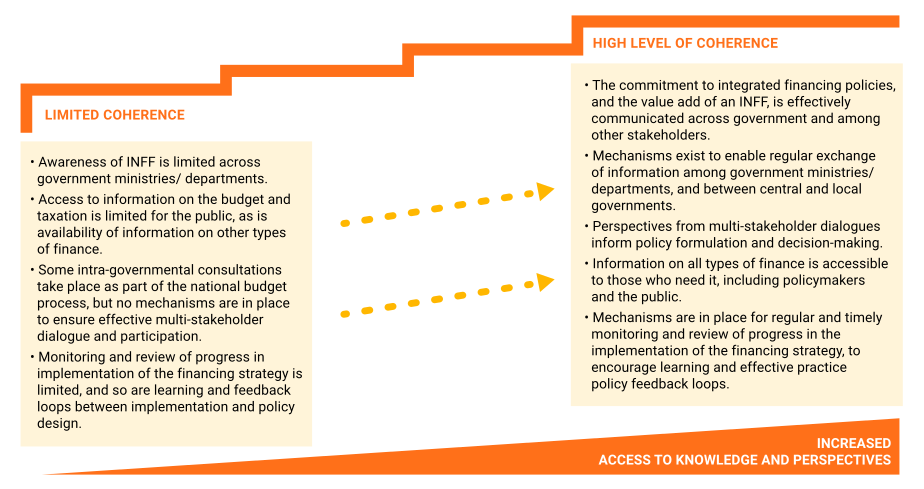
Lack of reporting and/or monitoring and review mechanisms, especially with regard to private and international financing;
Reluctance of development partners to share information, especially forward-looking expenditure plans;
Weaknesses in data and audit systems, especially timeliness and lack of capacity, internal resources and leadership from the Executive.
Figure 4. Levels of access to knowledge and perspectives: stylized examples
A combination of top-down institutional structures and other complementary mechanisms can be considered to address the challenges listed above. These are discussed under two main categories:
Dialogue and participation, covering issues of intra-governmental and multi-stakeholder engagement and exchange of information (e.g., through mandated dialogues, dedicated entities, consultative fora or networks); and
Transparency and accountability, covering issues related to availability and access to the data and information required to make effective financing policy decisions (e.g., through formal institutions, peer reviews, open government initiatives, and tools including citizen budgets, results frameworks, laws, regulations and standards).
Dialogue and participation
Dialogue among different government ministries/ departments and between state and non-state actors is important across all INFF building blocks:
In the assessment and diagnostics phase, perspectives from all relevant stakeholders should inform the identification of financing needs, opportunities and binding constraints.
When developing the financing strategy, expertise and knowledge from different stakeholders is needed to inform the choice of financing policy options, including to ensure that trade-offs between different areas and/or sectors can be adequately considered, and where possible, addressed.
When monitoring and reviewing progress, input from a variety of stakeholders can help ensure that: all finance providers are held to account; adjustments to ineffective policies are triggered in a timely manner; and any misconduct regarding implementation of activities within the scope of INFFs can be reported and addressed. Input from different stakeholders is also key to ensure adequate impact assessments, both ex-ante in the policy identification phase,FN 10 and ex-post in the monitoring and review phase.
Overall, increased dialogue and participation around sustainable development financing can lead to better governance of both financing policies and broader economic reforms and national development planning.
Some countries have mandated inclusive approaches in financing policy-making processes (e.g., Senegal and Cameroon as highlighted in Table 3 above and Armenia as detailed in Box 4). Such mandates may be warranted when stakeholders lack interest to participate. To address power dynamics and imbalances, criteria could be identified to ensure the mix of participants meets certain standards of expertise and representation.
哥伦比亚在设计和实施面向绩效管理制度框架方面取得了重大进展。其经验凸显了适当的能力建设对于成功制度化这一过程的重要性。
自 20 世纪 90 年代初以来,宪法赋予国家规划当局设计和组织公共政策和项目评估系统的责任。SINERGIA(国家管理与结果评估系统)是为响应这一授权而建立的,作为监测国家发展计划(NDP)中确定的目标的系统,包括评估相关政策、公共投资项目和其他支出计划。SINERGIA 由国家规划部(DNP)和总统府管理,职能部门和财政部(MOF)参与其中。
国家规划部与财政部和职能部门协调,负责编制国家发展计划,并将预算资本支出分配给已确定的投资项目(预算资源只能分配给国家发展计划中列出的投资项目)。财政部负责编制中期支出框架,其中包括国家层面的经常性支出和资本支出。国家规划部在预算编制过程中发挥顾问作用,重点是提供在资源分配中需要考虑的绩效信息。结果导向型项目目前已占总预算的 30%,2022 年的目标是通过结果导向型项目分配 50% 的预算。
通过几届政府的迭代,哥伦比亚成功地从供给和需求的角度建立了关键角色的平衡,重点在于提高数据质量、建立信息分析能力,以及建立利用此类数据和信息进行决策的机制。虽然在国家层面做出了巨大努力,但在地方层面建立此类机制并使其运作仍然是一个挑战。权力下放进程正在进行中,关键部门承担着提供卫生和教育服务的责任。然而,中小型地方政府没有人力和财力能力像国家层面那样严格。为应对这一挑战而采取的策略是设计绩效说明,在国家和地方政府之间建立共同的发展目标和投资努力,并商定绩效指标和目标,并在 SINERGIA REGIONAL 网站上报告实际值。这是一个有用的制度机制,尽管其结果在很大程度上取决于地方层面的能力建设。
来源:Martin, F. P. 和 A-M. Fernandez (2021)。为 FSDO/UNDESA 编写的关于 INFF 支柱 3:监测与评估 (M&R) 分析框架和国家案例研究的背景指导文件,IDEA,加拿大。
沿着表 2 所示的水平移动并不意味着取代现有的监测与评估系统。相反,它是关于增强它们之间的兼容性,以确保它们与总体 INFF 监测与评估框架(见附录 2)保持一致,并能为其提供信息。从这个意义上讲,正如第 2 节中的图 1 所示,INFF 监测与评估是一个整合系统,它从与不同类型融资和政策相关的各种现有系统中获取数据和信息,并将其汇集为关键绩效指标。
并非通过专门监测系统(例如,关于政府预算、发展合作或国内私人投资)和通过不同融资政策审查收集的所有信息都会反映在总体 INFF 监测框架中。同样,通过现有系统目前收集的数据和信息可能存在差距,而这些数据和信息是总体 INFF 监测与评估所必需的。INFF 进程是一个审查通过现有系统收集的数据和信息是否相关、充分且正在被使用的机会,并据此调整相关指标和数据源。在 INFF 监测与评估方面,总体指导原则应该是选择尽可能少量的指标,这些指标结合起来,能够提供关于国家融资战略实施进展以及支撑治理结构和机制运作的足够全面的图景。
公共财政在为可持续发展提供资金方面发挥着基础性作用,在许多国家,它将是起点。各国通常拥有比私人融资更发达的监测国内公共财政(政府支出和投资)和发展合作的系统。政府官员可以考虑增强公共财政相关系统的兼容性和整合性,并在着手为其他类型的融资(如私人融资)创建额外系统之前,从这一练习中学习。根据全球商定的原则,发展伙伴应确保优先使用国家流程来监测援助资源的分配和影响,FN 8 以避免阻碍这种整合(例如,见关于卫生部门融资的专栏 10)。
国家和捐助者监测系统的更好整合可以在一系列领域中优先考虑,包括资本投资项目。这些项目在实现国家发展优先事项方面发挥着关键作用,并经常获得在该国活跃的捐助者的大力支持。许多国家的经验表明了结构化和分步方法的重要性。经验教训包括需要一个灵活的投资监测系统,能够适应各种项目复杂性和规模、部门特殊性、数据可用性以及职能部门内的项目分析能力,同时在投资项目排序中明确考虑政治优先事项(而不是强加一个纸面上看起来不错但不切实际的紧身衣)。该系统应易于定制,以反映不同的情况和国家业务流程。(关于治理与协调的支柱 4 提供了关于如何促进获取各种利益相关者(政府、发展伙伴和相关私营部门)的观点和投入的方法的见解,以确保产生的系统能够满足所有相关利益相关者的需求)。
由于卫生部门涵盖的公共和私人来源范围广泛,以及服务和项目种类繁多,跟踪与卫生相关的资金具有挑战性。在国家层面,国家卫生核算工作并未总是发挥其全部潜力,部分原因是难以获得关于所有相关资金来源(包括私人融资和发展合作)的及时且一致的数据。
2004 年,全球发展中心召集了全球卫生资源跟踪工作组,对来自公共和私人来源的捐助者和国家层面的融资流进行了审查。结果,工作组能够概述协调一致的方法如何随着时间的推移产生一个跟踪全球卫生领域重要资金流的连贯系统,这需要新的资源和政治承诺。
在全球层面,卫生资源跟踪侧重于跟踪有多少与卫生相关的援助从各种捐助者流向低收入和中等收入国家(LMICs),并分析其构成。一个主要来源是经合组织发展援助委员会(DAC)管理的经合组织债权人报告系统(CRS)数据库,该数据库跟踪成员国、几个多边机构和一些大型私人基金会向发展中国家提供的双边和多边援助及其他资源流,涵盖总量和项目层面。另一个来源是各国使用国际标准化卫生核算体系报告的卫生支出数据,其中包括国内支出。
目前在比较 CRS 跟踪的捐助者援助数据与国家系统跟踪的捐助者援助信息方面所做的工作很少。如果 CRS 能够为各国开展卫生核算所需的捐助者资金流的一致信息提供基础,那么就可以避免额外的数据采集工作,从而使卫生核算工作成本更低,并减轻所有卫生部门利益相关者的报告负担。
全球卫生资源跟踪工作组建议承诺捐助者越来越多地依赖国家公共财政管理(PFM)系统来监测和报告其援助资金流(根据《援助有效性巴黎宣言》),并促进国家决策者对这些估算的支持。捐助者必须“抵制”重复建立系统的诱惑,而应在现有系统的基础上进行建设,并使各国政府能够通过国家流程管理援助。正如 INFF 方法所呈现的那样,其本质是支持提高各国政府制定健全融资政策和预算,并报告其执行情况的能力。
来源:Martin, F. P. 和 A-M. Fernandez (2021)。为 FSDO/UNDESA 编写的关于 INFF 支柱 3:监测与评估 (M&R) 分析框架和国家案例研究的背景指导文件,IDEA,加拿大。
The Sierra Leone Association of Non-Governmental Organisations (SLANGO) has a dedicated non-state actors office within the Ministry of Finance. This allows them to actively participate in the annual budget cycle. The non-state actors group has a formal role in reviewing budget proposals once they are submitted by ministries and participates in hearings to examine these proposals. Their recommendations carry considerable weight and concerns in areas such as project and procurement costs or details about how projects will be effectively implemented, have led to significant revisions in budgetary proposals.
SLANGO’s participation is not only limited to the design and process of approving budgets; they often undertake project verification missions. These ensure that projects listed in the budget are carried out to cost in the relevant communities before the subsequent budget review hearing, with any discrepancies communicated to the government.
This formal role for CSOs in the budget process, from preparation and sign off to review, has significantly increased transparency and accountability over ministries, departments and agencies in carrying out their functions and has encouraged efficiency savings and consistency in pricing across government actors.
数据系统和能力是有效监测与评估的基石。INFF 监测与评估应考虑政府为改善不同领域现有数据和统计能力所做的所有持续努力。通常,统计能力建设工作往往是孤立进行的,以响应特定的捐助者利益和要求,而不一定与总体国家发展优先事项挂钩。INFF 进程,特别是监测与评估支柱,提供了一个审查所有正在进行的倡议的机会,并确定是否已经存在可以将 INFF 监测与评估纳入其中的流程。如有必要,可以制定一个以国家确定的需求和优先事项为核心的总体数据发展计划。INFF 监督委员会(如有)应领导这一进程并审查该计划,以确保采取系统性方法。作为第 1 步(见专栏 6)评估数据系统质量的结果,可用于为该计划提供信息。专栏 12 展示了尼日尔的经验。
数据发展计划可以通过参与式方法确定关键的数据改进需求,然后制定分步工作计划,以改善与信息流相关的业务流程并解决关键的方法论问题。它不仅应关注数据的生产和采集,还应关注数据的使用。作为计划的一部分,应考虑加强相关数据的报告,以促进目标用户的使用和获取。
圭亚那目前被列为中高收入经济体,并于 2019 年成为最新的石油生产国之一,这改变了其发展前景。在基尼系数为 0.451 的背景下,这对公共部门扩大公共服务既是机遇也是挑战,以确保新的财政空间能够惠及全体民众,包括最贫困和最脆弱的群体。在过去五年中,财政部(MoF)开始进行更基于证据的预算分析,考虑替代性的预算结果情景,并从年度预算转向中期视野,以更好地考虑战略优先事项。
财政部为实现结果导向型管理改革进程选择的切入点是加强中央政府的战略规划以及监测与评估(M&E)能力。在过去十年中,财政部组织并资助了针对所有职能部门工作人员的重复培训。它还支持多个部门起草其绩效衡量框架(指标和目标),并就改进现有结果矩阵进行临床会议。培训和直接支持最初在两个部门(卫生部和教育部)进行了试点,随后推广到所有职能部门。
此后,预算编制手册中引入了结果导向预算的概念,要求职能部门在预算申请中包含项目绩效说明,并将其纳入每年公开的预算估算卷中。
然而,将预算分配与产出目标联系起来仍然是一个挑战。财政部继续致力于产出单位成本核算和预算情景的制定,并在卫生部(MoH)进行了试点项目。这得到了用于结果导向预算的商业智能软件的定制和参数化的支持。产出单位成本核算面临的最大挑战是该行业缺乏用于提供医疗服务的分析性会计数据。这意味着在试点实施的第一年,有时不得不使用医疗服务包的总额。在实施的第二年和第三年,试点项目能够通过多种方法(包括过去平均成本、规范成本或作业成本法)迭代和细化成本数据。创新的核心是根据会计科目的预算行确定关键行动、活动、子项目和项目的成本。
除了产出单位成本核算外,财政部还结合了两种预算编制方法来确定预算情景:一方面,它使用自下而上的方法,要求职能部门(本例中为卫生部)根据结果目标和产出单位成本估算预算需求;另一方面,它使用自上而下的方法,根据财政框架和过去的预算分配对预算额度进行“先验”估算。然后,这两种方法进行协调,以制定替代性的预算结果情景,并在预算谈判期间与职能部门进行讨论。最理想的预算结果情景随后提交给政府最高当局进行最终仲裁。
该试点代表了该国的第一个里程碑,并强调了采取分步和务实方法的重要性,即从领导者有兴趣担任变革和创新倡导者的项目开始,在数据和能力质量足够好的情况下,然后逐步扩大系统的范围和深度。
来源:Martin, F. P. 和 A-M. Fernandez (2021)。为 FSDO/UNDESA 编写的关于 INFF 支柱 3:监测与评估 (M&R) 分析框架和国家案例研究的背景指导文件,IDEA,加拿大。
Networks, such as the Swedish Leadership for Sustainable Development Network, highlighted in Table 3, can provide the basis for more organised access to the government for non-state actors, especially in the absence of more structured mechanisms such as those discussed above. Similarly, online consultations and communication campaigns, such as the Global Goals Municipal Campaign in the Netherlands highlighted in Table 3, can provide a platform for stakeholders to share views and initiate partnerships across specific thematic areas or objectives.
Transparency and accountability
Building Block 3 on Monitoring and Review considers existing systems to track and assess the impact of different types of finance, and how these may be better aligned. The focus in this section is on the institutions and processes that underpin transparency and accountability and that support the availability and access to relevant knowledge and information.
Formal institutions include public technical institutions such as National Statistical Offices and Revenue Authorities, Parliaments, and Supreme Audit Institutions. National Statistical Offices and Revenue Authorities collect and analyse data on various aspects of public finance, economic and investment indicators, and sustainable development outcomes.
Parliaments already provide oversight of the budget process, typically through committees and sub-committees. Beyond the budget, such committees can assess whether broader financing policies are aligned with national priorities and the SDGs. For example, the International Development Committee in the UK scrutinises UK development cooperation policies and administration and monitors ODA expenditures. In Kenya, a less formal structure, the Parliamentary Caucus on Poverty and MDGs, was set up as a watchdog related to the government’s approach to MDG policies, implementation and budget allocations. It does not have standing committee status, but rather it is an informal group approved by all parties and by the leadership of the house.
Oversight by Supreme Audit Institutions typically focuses on public finance, but can also support scrutiny of wider financing policy areas. Such oversight can strengthen transparency and accountability of revenue mobilization and public spending and investment, and contribute toward strengthening the approach and systems used by the government to mobilise and align all types of finance to key national priorities. Box 8 illustrates how audits can be applied to SDG financing, including to identify gaps or inconsistencies in existing financing policies and institutional set-ups and recommendations for remedial action.
由千年挑战公司(MCC)资助,尼日尔千年挑战账户(MCA-Niger)是一项旨在 2018-2023 年期间促进尼日尔四个农村地区粮食安全和气候韧性的援助计划。作为该计划的一部分,委托开展了一项数据质量审查(DQR),旨在评估现有数据系统的质量,包括用于为已确定的绩效指标提供信息的数据。
审查得出的结论是,有必要认识到改善信息的收益与成本之间的权衡,这凸显了确定信息用户所需的信息完整性、精确性和及时性水平的重要性。高质量的信息是有代价的。在需求侧,重要的是根据信息主要用户在决策、问责和学习方面的优先需求,确定每个关键绩效指标可接受的覆盖范围、准确性和频率。在供给侧,至关重要的是确定数据采集和分析系统在人力、物力和财力资源方面的必要能力,以提供预期的质量水平,并检查它们是否与当前能力相匹配;如果不匹配,则需修订预期的质量水平。
审查结果制定了一项数据质量改进计划,作为中期的分步能力建设过程。其中包括以下建议:修订数据质量存在问题的指标的数据采集和分析方法;通过指标选择和数据质量培训开展数据采集和分析能力建设活动;提高利益相关者对数据质量对其自身绩效重要性的认识;以及开展问题解决评估。该计划还强调了文档记录和逐步开发知识管理系统的重要性。
来源:Martin, F. P. 和 A-M. Fernandez (2021)。为 FSDO/UNDESA 编写的关于 INFF 支柱 3:监测与评估 (M&R) 分析框架和国家案例研究的背景指导文件,IDEA,加拿大。
信息技术(IT),特别是商业智能软件的使用,有助于解决和实施数据发展计划中确定的改进措施,并支持加强与 INFF 监测和评估相关的流程(例如,见专栏 13)。在可行的情况下,为了提高效率,此类软件应:i) 根据具体的国家业务流程进行构建或定制;ii) 包含与现有相关信息系统的接口;iii) 通过响应用户需求的仪表板和报告功能支持数据分析。通常需要的不是理论上完美但与现有数据限制、人员能力和技术能力(例如,包括对可靠宽带互联网的访问)不兼容的复杂且昂贵的解决方案。相反,它应该使用提取、转换、加载(ETL)方法,能够从不同平台上的各种数据库(例如,与不同类型的融资相关)中提取相关数据,并以安全的方式进行转换和存储。IT 解决方案的附加值将取决于其在项目架构、数据分类、报告仪表板、预警系统和报告生成方面可定制的程度。例如,报告的自动化和系统化可以在预算编制的关键时刻节省时间。然而,采用 IT 解决方案时应始终注意其可能带来的缺陷,例如可能丢失数据结果背后的背景信息,而这些信息在没有面对面数据采集和验证方法的情况下往往难以获取。
自 2008 年以来,多米尼加共和国政府一直在加强其公共管理,重点关注绩效和问责制管理。作为这些努力的一部分,政府决定转向项目预算编制。经济、规划和发展部设计并实施了一个信息系统,用于采集公共产出信息并将其纳入预算;同时将国家发展战略和公共部门多年期计划的类别与预算的项目类别挂钩。
2019 年,由预算办公室(DIGEPRES)在欧盟、联合国开发计划署和世界银行等发展伙伴的支持下编制的“新多米尼加预算系统”(NSPD),代表了为编制多年期预算迈出的又一关键步骤。新系统引入了:i) 编制中期财政框架;ii) 多年期预算政策;iii) 各公共实体产出的成本估算;iv) 部长理事会关于引入结果导向型预算的承诺;以及 v) 一个通过清晰的变革理论构建,旨在促进实物和财务规划的信息系统。
随着该进程的开始,预算机构需要遵循新标准,但估算产出单位成本以及建立产出与更高层次结果之间的联系仍然具有挑战性。2020 年,DIGEPRES 开始试点使用软件来指导这一过程,并利用商业智能工具。目前,两个试点机构已根据项目预算视角及其相关的成本核算要素重新组织了其规划架构。他们正在测试两个新的软件模块(结果导向预算 (B4R ®) 和结果导向监测 (M4R ®)),作为与现有综合财务管理系统(Sistema Integrado de Gestión Financiera)对接的插件。
来源:Martin, F. P. 和 A-M. Fernandez (2021)。为 FSDO/UNDESA 编写的关于 INFF 支柱 3:监测与评估 (M&R) 分析框架和国家案例研究的背景指导文件,IDEA,加拿大。
Everyone has the right to seek, receive and impart, information on fiscal policies. To help guarantee this right, national legal systems should establish a clear presumption in favor of the public availability of fiscal information without discrimination. Exceptions should be limited in nature, clearly set out in the legal framework, and subject to challenge through low-cost, independent and timely review mechanisms.
Governments should publish clear and measurable objectives for aggregate fiscal policy, regularly report progress against them, and explain deviations from the plan.
The public should be presented with high quality financial and non-financial information on past, present, and forecast fiscal activities, performance, fiscal risks, and public assets and liabilities. The presentation of fiscal information in budgets, fiscal reports, financial statements, and National Accounts should be an obligation of government, meet internationally-recognized standards, and should be consistent across the different types of reports or include an explanation and reconciliation of differences. Assurances are required of the integrity of fiscal data and information.
Governments should communicate the objectives they are pursuing and the outputs they are producing with the resources entrusted to them, and endeavour to assess and disclose the anticipated and actual social, economic and environmental outcomes.
All financial transactions of the public sector should have their basis in law. Laws, regulations and administrative procedures regulating public financial management should be available to the public, and their implementation should be subject to independent review.
The Government sector should be clearly defined and identified for the purposes of reporting, transparency, and accountability, and government financial relationships with the private sector should be disclosed, conducted in an open manner, and follow clear rules and procedures.
Roles and responsibilities for raising revenues, incurring liabilities, consuming resources, investing, and managing public resources should be clearly assigned in legislation between the three branches of governments (the legislature, the executive and the judiciary), between national and each sub-national level of government, between the government sector and the rest of the public sector, and within the government sector itself.
The authority to raise taxes and incur expenditure on behalf of the public should be vested in the legislature. No government revenue should be raised or expenditure incurred or committed without the approval of the legislature through the budget or other legislation. The legislature should be provided with the authority, resources, and information required to effectively hold the executive to account for the use of public resources.
The Supreme Audit Institution should have statutory independence from the executive, and the mandate, access to information, and appropriate resources to audit and report publicly on the raising and commitment of public funds. It should operate in an independent, accountable, and transparent manner.
Citizens should have the right and they, and all non-state actors, should have effective opportunities to participate directly in public debate and discussion over the design and implementation of fiscal policies.
Peer reviews can be carried out within government, with different departments and agencies reviewing each others’ performance, or with external partners, through external peer reviews. For example, in 2018 the German Federal Government mandated a peer review of its Sustainable Development Strategy, soliciting feedback from a range of domestic and international stakeholders, and then used results to update the strategy and mainstream sustainability into all policymaking. The UN High Level Political Forum, and related Voluntary National Reviews, can also be considered a peer review process, focused on good practices in SDG implementation. External peer reviews can also be effective accountability mechanisms. Members of the Development Assistance Committee (DAC) are reviewed by two peer DAC members every five or six years. Through a combination of accountability and peer learning, DAC peer reviews seek to improve DAC member development co-operation policies, systems, financing and practices. They track progress against previous recommendations, and recommend actions to improve performance. As more countries adopt INFFs, peer reviews of integrated financing could be considered, e.g., at the regional level, to formalize sharing of experiences and learning of lessons.
Open government initiatives can help governments become more accountable and responsive to citizens. The Open Government Partnership was launched in 2011 at the UN General Assembly with eight founding governments. Today, it counts 78 member countries as well as a growing number of local governments and civil society organisations. Member governments work with civil society to co-create action plans with concrete commitments, which may be made across a range of policy areas, from gender to anti-corruption, health, extractive industries, and include specific measures such as the introduction of participatory budgeting or enhanced tax revenue reporting.FN 12
Citizen budgets make key budget information accessible to a general non-specialist audience; their aim is to empower citizens to better understand budget processes and exercise their right to influence the allocation and use of public finance. Citizen budgets can institutionalise a greater level of transparency by governments in relation to their policies, revenues and spending. The format of citizens budgets may vary, ranging from simple brochures to fiscal transparency portals with extensive information and open data and visualization tools. Citizen budgets typically contain information on the economic assumptions underlying the budget; sources of revenue; spending allocations; any significant policy reforms that may explain sizeable changes in revenue or spending levels; and contact information. They can also include information on how the budget is formulated and executed, and who is responsible at each stage.FN 13 In the context of INFFs, governments may consider including information on the contributions of different types of finance toward specific national development priorities, provided tracking systems exist (see more in Building Block 3 Monitoring and Review). Box 10 shows how a citizen budget developed by civil society was used in Cambodia to enhance transparency and accountability in relation to government spending on climate.
It is estimated that nearly 1 million households (from a total population of 16.5 million) have suffered from the effects of extreme weather since the year 2000 in Cambodia. In 2017, the Government undertook a climate public expenditure and institutional review (CPEIR) that analysed public expenditure on activities related to climate change across the government. Taking this data, and inspired by the experience with climate citizens budgets in Nepal, civil society has been at the forefront of driving greater accountability for public expenditure on climate.
In 2020, the NGO Forum on Cambodia developed a citizen climate budget. This presented an accessible analysis designed to inform the public about how public funds are being used to combat climate change. This citizen climate budget represented the first analysis of its kind, showing how government spending on climate change has grown, how it is disbursed and considering related issues, such as the higher vulnerability of women to the effects of climate change in the country.
Beyond domestic public finance, development cooperation results frameworks enhance transparency and accountability of donor resources. They bring a results focus to development cooperation and can reinforce alignment with national sustainable development priorities. Results frameworks that are developed in close consultation with development partners can enhance trust and encourage use by all actors, which in turn can reduce duplication of efforts and the existence of parallel systems. According to the 2020 DCF survey, country results frameworks that monitor and evaluable the contributions of development partners were in place in 56% of countries (compared to 72% when the previous survey was administered in 2018). Obstacles to operationalising them, lack of demand, limited resources for maintenance, and fragmentation of monitoring functions across different institutions and departments, are common challenges. In addition, as highlighted in data from the Third Monitoring Round of the Global Partnership for Effective Development Cooperation, specific targets are not always included. INFFs represent an opportunity to review these tools (where they exist), to better align them with results frameworks used in national budgeting, and to identify areas for support.
Laws and regulations can enhance transparency and accountability among both public and private finance providers. For example, in the Dominican Republic, the Public Sector Budget Law mandates the reporting and publishing of annual tax expenditure data (see Box 11). Governments can mandate private sector disclosures through laws and regulations. Disclosure requirements for companies typically focus on enhancing availability and access to financial information, although much scope remains to further enhance tax transparency, particularly to tackle cross-border tax evasion and avoidance. Financial, human resource and institutional constraints often stand in the way of developing countries benefiting from international exchange of information on tax. Increasingly, disclosure requirements cover a broader scope of issues, including a company’s social and environmental performance. Globally, some progress has been made toward harmonisation of sustainability reporting. INFFs represent an opportunity for governments to consider and set a minimum level of corporate disclosures both on financials and on sustainability issues and SDG-relevant risks, which can be adjusted for companies with smaller footprints. Governments can build on ongoing global efforts to develop their own corporate reporting requirements, with the view of establishing a package of regulations or policies that can improve availability and access to necessary information on volumes, allocations and impact of all types of finance.
Disclosure requirements differ substantially between private companies and private not-for-profit entities, such as foundations. Not-for-profit private entities such as foundations often have limited obligations, though, in some countries, such as the United States, foundations have to meet public disclosure requirements and are obliged to file annual tax returns.
Tax expenditures in the Dominican Republic are among the highest in Latin America. In 2008, the Dominican Republic introduced tax expenditure reporting under the Public Sector Budget Law. It required that estimates of the revenue foregone through all tax incentives be published within the annual budget. The Interinstitutional Tax Expenditure Commission was setup within the Ministry of Finance’s Audit and Evaluation Unit. The Commission has a mandate to both estimate the revenue foregone each year and to conduct cost-benefit analyses on the country’s exemption schemes. It publishes the annual report Gastos Tributarios en República Dominicana, which provides a breakdown of estimated tax expenditure under each tax exemption scheme as well as the sectors and industries, and domestic and foreign actors, that are thought to have benefited.
This system has allowed the government of the Dominican Republic to better understand the costs that its tax exemption programmes are incurring. It has also created a platform of transparency and information that allows for detailed understanding and analysis in this important area of public and private financing policy.
Governments can also strengthen corporate accountability by establishing common definitions and minimum standards. Corporate accountability should cover the wider impact that corporate behaviour has on sustainable development outcomes, beyond immediate financial impacts. This includes meeting tax obligations, relations with employees, suppliers, and the communities companies operate in, and other ESG considerations. A company is not only accountable to its shareholders, but to its employees, communities, and the public at large. A plethora of initiatives exists seeking to establish common standards across industries and sectors for sustainable investment. The Global Investors for Sustainable Development Alliance (GISD) Navigator provides an overview of existing principles, practice standards and tools applicable to investors, corporates, and finance institutions.FN 14 Among these are high-level principles, such as UNEP’s Principles for Responsible Banking and the Principles for Responsible Investment (PRI); methodologies used to cross-check company reporting with unreported information and verify the absence of inconsistencies with sustainable development objectives; and detailed taxonomies that can help define standard minimum criteria to be met in specific sectors or activities, such as the EU taxonomy for environmentally sustainable economic activities (see Box 12). Box 13 illustrates how green loans and green bonds taxonomies were used in China to enhance green financing and influence the wider lending behaviour and capitalisation of Chinese banks.
The European Commission put together a new classification scheme for sustainable economic activities which was adopted in June 2020 and came into force in July 2020. The taxonomy covers six priority areas: climate change mitigation; climate change adaptation; the sustainable use and protection of water and marine resources; the transition to a circular economy; pollution prevention and control; and the protection and restoration of biodiversity and ecosystems. It provides appropriate definitions to companies, investors and policymakers according to which economic activities can be considered environmentally sustainable, i.e. if they substantially contribute to at least one of these six environmental objectives, do not cause any significant harm to any of the other five environmental objectives, work through a deliberate resilience-building process, and comply with minimum safeguards as outlined in international guidelines on employment and/or businesses. The taxonomy sets out a list of technical screening criteria across a set of issues ranging from forestry to agriculture to manufacturing or construction and real estate-related activities.
In 2013, the China Banking and Insurance Regulatory Commission (CBIRC) introduced a green loan taxonomy. This identified twelve categories of green loans, including renewable energy, green transportation, green building and others. The regulator stipulated that major banks would have to report their green lending against this taxonomy within the CBIRC’s green credit statistics system.
The development of the green taxonomy and green credit statistics was an important milestone in the larger effort to expand green financing in China. It has brought greater transparency to activities within a key part of the national financial system, in which the banking sector is dominant. The regulations required that the 21 largest banks all publish information on the proportion of their loans that met the green criteria as well as the performance of their green and conventional loans. This has presented evidence that green credit may be significantly less risky than other lending; at the end of 2018, for example, just 0.42% of green loans were non-performing in comparison to 1.83% of all loans.
Following the introduction of the green loan taxonomy, China has introduced further taxonomies for green bonds (in 2015) as well as a range of other regulatory and incentive measures to promote expansion in green financing in line with national objectives. The proportion of green loans as a share of overall credit has risen from 8.8% in 2013 to 10.4% at the end of 2019. It is also impacting the wider lending behaviour and capitalisation of Chinese banks, with many increasingly integrating green criteria into their lending decisions and credit risk analyses.
Coordination
Common challenges to improve coordination include:
Entrenched ministerial/ departmental as well as sectoral silos, and conflicting interests and mandates (e.g. between conservation and infrastructure development agencies);
Unwillingness to collaborate and reluctance to change due to differences in organisational cultures, potential loss of control, influence or autonomy;
Lack of harmonisation between central and local governments systems (e.g. use of different budget codes);
Administrative burdens, time-consuming processes and blurred lines of accountability caused by a proliferation of coordination structures;
Non-participation of key development partners;
Difficulty of measuring impact and effectiveness (see also Figure 5).
Figure 5. Levels of coordination: stylized examples
To overcome these challenges, the following measures can be considered:
Setting out clear roles and responsibilities (e.g., institutional frameworks, laws and regulations);
Encouraging effective collaboration among stakeholders (e.g., through steering committees, working groups, regular coordination meetings and fora, delivery units, and tools such as practice guides, codes of conduct, and performance management systems);
Incentivizing alignment of all types of finance with national priorities (e.g., through policy screening tools, the annual budget process, public procurement processes, specific financing instruments and strategies or policies).
Clear roles and responsibilities
Existing institutional frameworks for management of a national development plan or strategy provide a starting point for assigning responsibilities and coordinating INFF-related efforts. They need not be considered separately but can rather be incorporated in existing institutional structures. This will not only support stronger links between financing and planning, but also help avoid excessive proliferation and duplication of these structures. For example, in the Maldives, a comprehensive institutional framework for the management of the Strategic Action Plan (SAP) defines lead implementing and coordination agencies, as well as Working Groups for in-depth policy reviews. It also includes NGO and academic networks to provide quality assurance and monitoring by non-state actors.
In some cases, statutory measures, including laws and regulations, may be needed to overcome entrenched siloes, and to clearly define roles, responsibilities and lines of accountability. In Indonesia, a presidential decree identifies and lays out the roles and responsibilities of different stakeholder groups with regard to SDG implementation and financing (see Box 14). These could provide the basis for further articulation of INFF-specific expectations.
In Indonesia, Presidential Decree (No. 59 of 2017) provides the legal basis for the participation of all actors in SDG implementation and financing. The decree identifies four ‘participatory platforms’: government and parliament; civil society organisations and media; philanthropy and business; and academics and experts. Each platform has representatives in the Implementation Team and Working Groups of the SDGs National Coordination Team, which is led by the President. The figure below illustrates the roles assigned to each ‘platform’, which include financing ones such as budget allocation (assigned to government) and resource mobilisation (assigned to philanthropy and business).

Effective collaboration
Coordination mechanisms to implement national development plans and strategies, if in place, should be the starting point for fostering coordination of relevant actors within an INFF as well. They may need to include additional stakeholders critical for financing-specific issues (see Table 1).
Coordination mechanisms that focus on specific sectors/ thematic areas or financing policy areas could provide an alternative starting point. These may include steering committees and working groups organised around identified national priorities (e.g., see Box 15), regular donor coordination meetings and/or fora set up by non-state actors to enhance coordination among themselves and with government (see examples from the Solomon Islands and Indonesia respectively in Table 5). INFFs represent an opportunity to further strengthen and coordinate, and in some cases consolidate these structures around a country’s financing strategy.
In contexts with strong Centres of Government, delivery units – small teams that report to the President or Prime Minister – may sustain momentum and enhance intra-governmental coordination in relation to specific priority areas. Under an INFF, delivery units could ensure financing priorities are effectively implemented, that they remain high on the agenda of relevant ministries/ departments, and that progress is monitored in an integrated manner. For example, Ireland established the Office of the Minister for Children (OMC) as a delivery unit to bring together staff from different ministries in the same building, while still receiving funding from, and reporting to, their parent ministries. This resulted in greater coherence in both policy development and service delivery, with no blurring of accountability lines and responsibilities. Similar structures could be envisaged in the context of an INFF.
Specific coordination mechanisms to ensure alignment between central and local governments should also be considered in financing policy areas that may be of particular reference to sub-national stakeholders (e.g., infrastructure financing). For example, in Nigeria, representatives of the Federal States meet on a monthly basis to foster coordination between the national and sub-national levels.
In 2008, the Rwanda Development Board (RDB) was established to oversee efforts to improve regulation and the wider business environment. Its creation involved the merger of eight institutions with responsibility across a wide range of areas, including investment promotion, support for SMEs, IT, and others.FN 15 With private sector-led development prioritized at the highest levels of government, a series of structures were put in place to coordinate efforts across relevant actors and make this priority a reality.
A Doing Business Steering Committee was created at the Cabinet level to coordinate reforms across different ministries. A technical task force comprising six working groups was created to report to the Steering Committee. These working groups focus on key areas of regulation – business entry, licensing reform, legislative changes, taxes and trade logistics, construction permits, and property registration. They include private sector representatives who can both share their experiences and opinions to help shape the design of new reforms and foster greater buy-in to the reform process from the business community.
A Doing Business Unit was also established to drive forward implementation of reforms. This unit links the working groups with the steering committee and identifies opportunities for reform that the task force can develop. It coordinates with development partners to promote targeted technical support and other efforts to improve the business environment and monitors the implementation of reforms, reporting to the steering committee.
These structures have enabled Rwanda to develop and implement a wide range of reforms, including the establishment of a one-stop centre for investors, streamlined and simplified processes for permits and property registration, reforms to customs including the implementation of risk-based inspections, and the provision of post-investment support through the Rwanda Development Board. The reforms have also contributed to a rapid rise in investment. The Rwanda Development Board registered close to US$2.5 billion in domestic and foreign investment in 2019, around six times the volume registered in 2010. These new investments are expected to create more than 35,000 jobs.
Practice guides, codes of conduct, and performance management incentives can complement such formal coordination structures:
Practice guides and codes of conduct can help overcome challenges related to blurred lines of accountability, the risk of blame shifting and difficulties in evaluation and either rewarding or sanctioning performance. As illustrated in Table 5 above, Australia’s Practice Guide for Public Servants provides an overview of when to work together, what structure to choose and how to design related accountability, budget and organisational frameworks. Codes of conduct or related legal documents can clearly define the dynamics of cross-sectoral and/or cross-departmental collaboration. Codes of conduct can also incentivise alignment of private sector actors with national priorities (see for example Box 16).
Performance management systems can be designed to incentivise cross-departmental or cross-agency collaboration. In Finland, senior officials are assessed based on their ability to share knowledge and create partnerships across institutions.
Promoting good corporate governance has been a policy priority for the Thai government since 2002, and related efforts saw the establishment of the National Corporate Governance Committee (NCGC). The NCGC has a mandate to establish policies and promote improvements in corporate governance with a particular focus on actors within the capital market. It is chaired by the Prime Minister and brings together representatives of key ministries and regulators, the central bank, stock exchange and a range of industry representatives, including among others the Thai Chamber of Commerce, the Thai Bankers’ Association, and the Thai Investors Association.
In 2017, the NCGC published the Corporate Governance Code for listed companies which built on earlier principles developed by the Stock Exchange of Thailand and those of the G20/ OECD. It articulates eight principles for boards of directors for the governance of the companies they lead and is designed to promote business models that are competitive, responsible, and resilient. This includes, for example, striving toward sustainability in corporate value creation and promoting sustainability reporting.
Alignment of all types of finance
A range of tools and processes can encourage alignment of financing with national priorities, including policy screening tools, the budget process, public procurement processes, specific financing instruments and policies.
Several countries have developed screening tools to assess whether policies, including financing policies, will contribute to set goals (see for example Bhutan’s policy screening tool in Box 17). The Risk-Sensitive Budget Review tool, which has recently been applied in 16 African countries, offers an example of an effective screening tool to improve understanding of public budgeting for disaster risk reduction as well as the need to refocus internal and external financial resources based on national multi-hazard risk profiles. While these tools may be labour-intensive to set up, they can strengthen coherence of policy reforms by ensuring that only policies with a positive (or neutral) impact on identified priorities are pursued. IATF guidance on INFF Building Block 2 Financing Strategy provides additional detail on various coherence, risk and sustainability checks that may be useful in designing screening tools for financing policies in particular.
Bhutan has a unique approach to national development in which the Gross National Happiness (GNH) Index provides the measure against which progress is monitored. Gross National Happiness is considered to have four pillars: equitable socio-economic development, protection of culture, preservation of the environment, and good governance. The Index builds on these, capturing nine domains, each with a variety of indicators and variables by which they are measured.
The GNH index is used as the basis for designing and formulating policies and the government has developed a screening tool designed to build coherence across its policies and programmes, ensuring that they are well integrated with the country’s national objectives across the GNH index. This has been in place since 2008.
When a new policy is developed, it is assessed against 22 variables that draw from the Gross National Happiness Index. The screening assesses the likely impacts of the policy against each of these variables on a four-point scale which looks at whether the policy will have a negative, uncertain, neutral, or positive effect. The likely effects of the new policy on each of the variables is quantified and added together to give a summary of the potential overall contribution of the policy toward gross national happiness.
To be implemented, new policies must achieve a positive score across the index overall. While the screening is not exclusive to financing policies alone, they are subject to it in the same way as other policies. The screening of government policies is led by the Gross National Happiness Commission, which works jointly with the responsible ministry to evaluate new policies. The Commission is chaired by the prime minister and brings together ministers and other actors from across government. Policies are often sent back to be adjusted or rejected outright. For example, a proposed mineral development policy was rejected on the grounds of being too polluting and unsustainable. Tourism in the country also follows a strict high-value, low-volume approach in line with GNH screening.
In this way, the government has established a unique, structured mechanism that helps to objectively tie the design of financing and other policies to national development and to build coherence across them.
The annual budget process can provide an effective entry point for greater coordination and coherence across government. It can facilitate mainstreaming of sustainable development priorities across ministries and agencies. For example, in Pakistan, the Khyber Pakhtunkhwa provincial government has incorporated climate change within its budget call circular encouraging provincial ministries to budget for climate change expenditures. In Finland, all ministries are required to reflect on the sustainable development contributions of the priorities identified in their budget proposals. The budget process can also incentivize greater coordination in the budget preparation stage; in Norway, for example, ministries in charge of specific SDGs have to consult with other ministries involved in the implementation of the goal when putting together their budgets. In Bangladesh, a predefined amount of resources is set aside for climate adaptation purposes; it can be accessed only by ministries that cooperate on the issue.
Public procurement processes are increasingly used to promote alignment with national priorities. For example, as noted in Table 5 above, environmental standards are included in award criteria, contract performance clauses and technical specifications, to encourage green solutions. Public-private partnerships, which are long-term contractual arrangements between a government entity and a private party, may also be used, where appropriate, to promote public-private collaboration on specific sustainable development priorities. However, these tend to entail greater development, bidding, and ongoing costs compared to traditional government procurement processes, and should therefore be considered carefully, depending on resource and capacity availability.
Specific financing instruments may be used to enhance alignment of development cooperation and private finance, and to strengthen coordination with, and among, non-state actors:
Joint or pooled funds can help better coordinate assistance and funding from multiple development partners. For example, as highlighted in Table 5, a joint fund was established in Myanmar to coordinate donor support from several development partners, including nine bilateral development partners and the EU.
Blended finance may be used to encourage alignment of private investments with nationally identified priorities in sectors where there is potential for financial returns but risk (perceived or actual) may be too high for purely commercial investments. (See guidance on Building Block 2 Financing Strategy for more detail on the preconditions and applicability of specific financing instruments, especially public-private ones, including the Addis Ababa principles for blended finance).
INFFs also provide an opportunity to engage key development partners, and improve coordination and coherence of different financing (see Building Block 2 Financing Strategy for more detail). Development cooperation strategies or policies, which could be an important element of an INFF, can set out roles and expectations of development partners. Box 18 illustrates how donor-initiated strategies may be used to enhance donor coordination in countries in fragile situations. Similarly, national private sector development strategies and investment policies can set out priority sectors/ areas and inform private investment decisions accordingly. The Kampala Principles on effective private sector engagement note that defining such strategies and policies should be inclusive and explicit about the role expected of the private sector in delivering national and sectoral development priorities, including how success will be measured.
The EU began using ‘State Building Contracts’ (SBCs) in early 2013 to better coordinate support to fragile and conflict-affected countries. The goal of the contracts is to resolve the tension between long- and short-term engagement by clearly tailoring cooperation to the objectives defined by receiving countries, increasing country ownership, and including provisions for more concrete risk monitoring. SBCs have been implemented in 12 countries and are in preparation in two more. They can contribute to domestic resource mobilization across a variety of sectors, including health, education and other social sectors, and support improvements in audit and control, justice, and security, among others.
The decision to initiate an SBC is based on five core considerations:
An assessment of the state of fragility in the given state to better understand the context and ensure that the SBC is designed accordingly;
A risk assessment that captures the overall political and security situation, the financial risks and the cost of inaction to inform the design of risk mitigation measures;
Linking the purpose of the SBC clearly with state-building objectives;
An understanding of how the potential partner government seeks to foster state-building, governance and the promotion of rights;
The ability to foster an internationally coordinated response by assessing the potential for wider international support for the provision of budget support, most notably from the World Bank and the IMF.
SBCs can formalize a legal basis for budget support operations in fragile and conflict-affected states. They clearly identify risks, can facilitate greater coherence, and can have a catalytic effect of raising additional resources. However, they also face some challenges, such as undefined exit strategies and next steps as well as potential capacity limitations at the country level, and they risk imposing requirements that may overload governments already stretched thin. Some key lessons learned from the country level that may help minimize such challenges include:
Ensuring that technical assistance is demand-driven;
Having clearly defined objectives and designing instruments that are aligned with them and tailored to the specific contexts;
Undertaking frequent risk assessments and adopting a broader definition of political risks, given the prevalence of volatility in post-conflict countries;
Ensuring that the right dialogue partners, who have sufficient political clout, are engaged in SBCs.
National financing strategies may be less government-driven or comprehensive in conflict-affected and fragile contexts. This may be due to weak institutional structures to support a whole-of-government approach, or insufficient trust in the government. Humanitarian actors are often involved in such settings. Related coordination structures (e.g., to support financing of specific outcomes related to the development-humanitarian-peace nexus, as laid out in Box 19) may be a starting point to further enhance coherence of financing through an INFF in such contexts.
In February 2019, the OECD Development Assistance Committee (DAC) adopted the Recommendation on the Humanitarian-Development-Peace Nexus. This offered impetus for strategic change in the way humanitarian, development and peace actors collaborate in fragile and conflict-affected contexts. The International Network on Conflict and Fragility (INCAF) is supporting implementation of the DAC recommendation globally and at the country level, which will involve financing strategies to target specific outcomes.FN 16
附录 1. 监测与评估核查清单
现有监测与评估系统:
现有体系的基础方面:
数据系统与现有能力
At the 2019 United Nations General Assembly a group of 16 countries indicated their interest and commitment to pioneer the INFF approach. These are referred to as INFF ‘pioneer’ countries and include: Bangladesh, Burkina Faso, Cabo Verde, Colombia, Cote d’Ivoire, Ghana, Indonesia, Kenya, Kyrgyzstan, Namibia, Nigeria, Rwanda, Senegal, Timor-Leste, Uganda, Vietnam. Since then, several more countries have picked up the concept and currently there are approximately 70 countries working on the design and operationalisation of INFFs in their respective country contexts.
Institutions refer to relevant organizations/ bodies as well as rules/ norms/ codes of conduct.
Processes are defined as the actions taken by actors and institutions to achieve objectives of governance, including their communication and coordination efforts and means to arbiter differences and come to agreements.
This is in line with the extension of the definition of ‘policy coherence for sustainable development’ (PCSD) by the OECD. See CEPA strategy guidance note on Promotion of coherent policymaking, February 2021.
Some of the questions proposed in Section 5.1 are based on the OECD PCSD institutional mechanisms checklist and ‘self-assessment’ questions for PCSD building blocks.
See CEPA strategy guidance note on Promotion of coherent policymaking (February 2021) for an overview of existing coherence scales.
Of the 62 joint programmes related to INFFs, which received funding from the Joint SDG Fund, over a fifth of them have articulated a focus on public finance and/or specific sectors and thematic priorities.
Data reported to the INFF Dashboard shows that countries are adopting a variety of different approaches to institutionalizing INFFs.
See Inception Phase guidance for more on the links between the DFA and INFF processes.
Guidance on Building Block 2 Financing Strategy lays out various ‘checks’ that policy makers may wish to consider when choosing financing policy solutions; these may be included in ex-ante impact assessment criteria. For an overview of regulatory impact assessments (RIAs) specifically, including what they are, how related challenges may be overcome, and methods of implementation, see CEPA strategy guidance note (2021).
These figures are estimates based on the 26% of CPAs that have been completed. The remaining CPAs are ongoing and estimates of their results are not available.
See for example, Nigeria’s Open Government Partnership Action Plan.
See for example, the Philippines 2020 Citizens Budget.
See also the OECD/UNDP Framework for SDG Aligned Finance, which includes illustrative examples of actions governments can take to improve alignment of finance in the areas of policies, standards and tools.
The eight agencies were the Rwanda Investment Promotion Agency, Tourism and Conservation, the Registrar General’s Office, the Privatization Unit, Human and Institutional Development, the Centre for Support to Small and Medium-Sized Enterprises (CAPMER), the IT Agency and the National Environment Management Authority.
More detail in forthcoming OECD guidance (Financing for Stability: Financing across the nexus) and Interim Progress Report on the DAC Recommendation on the Humanitarian-Development-Peace Nexus.







.png)